
Catalogue Search | MBRL


Are you sure you want to remove the book from the shelf?

{{itemTitle}}
192
result(s) for
"Dex, Shirley"
Sort by:

Gendered lives : gender inequalities in production and reproduction
This book examines how gender inequalities in contemporary societies are changing and how further changes towards greater gender equality might be achieved.
Book

Measuring work—life balance and its covariates
A research note describes a study that measured the work-life balance of British employees. Data were obtained from questionnaires completed by a total of 3,080 employees for five difference research studies. The work-life balance checklist instrument & the method used to determine correlates of work-life balance are detailed. Weekly hours of work were found to be a very important determinant of employees' work-life balance, along with gender, occupation, age, & caring responsibilities. Working more than 48 hours a week was shown to have the largest single effect on the advancement of work-life imbalances; caring responsibilities & being aged 36-45 both contributed to imbalances about half as much as working over 48 hours. Surprisingly, managers were not found to always have higher levels of work-life problems & private-sector employees did not have less work-life balance than public-sector employees. Suggestions are made for ways the government could improve the work-life balance, especially through a reduction of long weekly work hours. 4 Tables, 2 Figures, 1 Appendix, 18 References. J. Lindroth
Journal Article

THE EFFECTS OF PART-TIME WORK ON WOMEN'S OCCUPATIONAL MOBILITY IN BRITAIN: EVIDENCE FROM THE 1958 BIRTH COHORT STUDY
The effects of working part time on job downgrading and upgrading are examined over the life course of British women born in 1958. We use longitudinal data with complete work histories from a large-scale nationally representative cohort study. Occupations were ranked by their hourly average earnings. Analyses show a strong link between full-time/parttime transitions and downward and upward occupational mobility over the course of up to thirty years of employment. Probabilities of occupational mobility were affected by women's personal traits, occupational characteristics and demandside factors. Downward mobility on moving from full-time to part-time work was more likely for women at the top levels of the occupational hierarchy working in male-dominated or mixed occupations and less likely in higher occupations with more part-time jobs available.
Journal Article

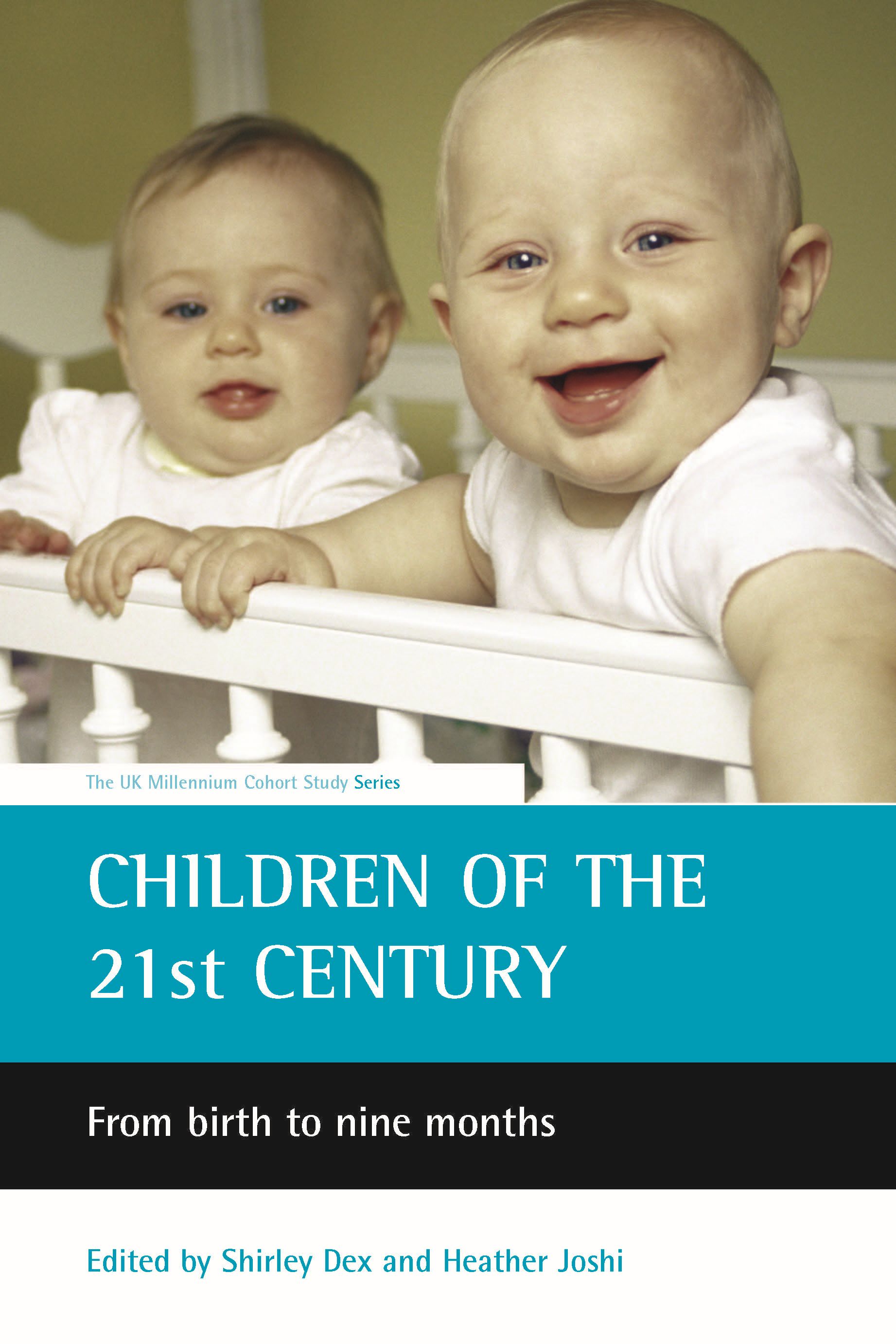
Children of the 21st century
This book documents the early lives of almost 19,000 children born in the UK at the start of the 21st century, and their families. It is the first time that analysis of data from the hugely important Millennium Cohort Study, a longitudinal study following the progress of the children and their families, has been drawn together in a single volume. The unrivalled data is examined here to address important policy and scientific issues. The book is also the first in a series of publications that will report on the children's lives at different stages of their development.
The fascinating range of findings presented here is strengthened by comparison with data on earlier generations. This has enabled the authors to assess the impact of a wide range of policies on the life courses of a new generation, including policies on child health, parenting, childcare and social exclusion.
Babies of the new millennium (title tbc) is the product of an exciting collaboration from experts across a wide range of health and social science fields. The result is a unique and authoritative analysis of family life and early childhood in the UK that cuts across old disciplinary boundaries. It is essential reading for academics, students and researchers in the health and social sciences. It will also be a useful resource for policy makers and practitioners who are interested in childhood, child development, child poverty, child health, childcare and family policy.
eBook

Careers and motherhood: policies for compatibility
This paper examines the economic issues relevant to policy debates that surround the increasing labour force participation of mothers. We review the main changes in women's labour market participation in Britain. The main source of increase in women's participation rates has come from mothers returning to work after childbirth after progressively shorter intervals. The major influences on this behaviour and the length of time spent out of work over the first childbirth and the associated empirical work are also reviewed. These changes have raised issues relevant to maternity and parental leave, childcare provision, employers' family-friendly working arrangements and children's welfare. The paper makes some recommendations about how to further gender equity in a form compatible with family life.
Journal Article

Bad start: is there a way up?
\"This article aims to examine gender and cohort differences in life-course occupational mobility in Britain and in particular the strength of the effects of career entry on subsequent upward or downward mobility. Does a 'bad start' in working life typically result in being trapped in the bottom tier of the occupational hierarchy or can it represent a stepping-stone towards more rewarding positions? Are there any gender differences in the effects of low entry occupations on subsequent careers? If so, are these differences stable or changing over time? Using large-scale data from the National Child Development Study and the British Cohort Study, we investigate individuals' occupational careers between the ages of 16 and 34 using an occupational scale based on the hourly average earnings of full-time workers. Although women's and men's career patterns in Britain have become more similar over time, women face the greatest and growing hindrance to career advancement from low level entry jobs. Entering at the bottom of the occupational hierarchy is more likely to represent a trap for women, while for men it is rather a stepping-stone to more favourable positions.\" Die Untersuchung enthält quantitative Daten. Forschungsmethode: empirisch-quantitativ; empirisch; Längsschnitt. Die Untersuchung bezieht sich auf den Zeitraum 1958 bis 2002. (author's abstract, IAB-Doku).
Journal Article


The conceptualisation and measurement of occupational hierarchies: a review, a proposal and some illustrative analyses
Occupational data are central to much research in the field of social stratification. Yet there is little consensus on how such data are most appropriately classified and scaled. We evaluate occupational scales currently in use on the basis of a fourfold typology. This cross-classifies scales, on the one hand, according to whether they are intended to be ‘synthetic’ or ‘analytic’ and, on the other, according to whether they are based on ‘subjective’ or ‘objective’ data. Focusing chiefly on issues of validity, we argue that scales of the analytic-objective type are those which, for most purposes, can be used to best advantage in stratification research. We illustrate our argument by applying scales of occupational earnings and occupational status in analyses of the worklife occupational mobility of men in Britain, using the data-set of the National Child Development Study.
Journal Article
Gender differences in occupational wage mobility in the 1958 cohort
This article examines the wage growth of British men and women between the ages of 33 and 42 who were employed full time at both of these ages using the 1958 National Child and Development Study. Wage growth is examined in the differences of the log of hourly wage rates reported at the 33 and 42 year old interviews of this cohort study. Men were found to have higher wage growth rewards than women when in higher occupations and be more likely than women to be in these higher wage growth occupations. Women's wages grew more slowly over the period than men's wages because they were located disproportionately in lower growth and feminized jobs. Domestic ties did not explain the differences in wage growth for this group, where the occupational penalties of gender widened.
Journal Article