
Catalogue Search | MBRL


Are you sure you want to remove the book from the shelf?

{{itemTitle}}
313
result(s) for
"Dick, Steven J"
Sort by:

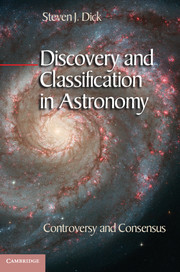
Discovery and Classification in Astronomy
Astronomical discovery involves more than detecting something previously unseen. The reclassification of Pluto as a dwarf planet in 2006, and the controversy it generated, shows that discovery is a complex and ongoing process – one comprising various stages of research, interpretation and understanding. Ranging from Galileo's observation of Jupiter's satellites, Saturn's rings and star clusters, to Herschel's nebulae and the modern discovery of quasars and pulsars, Steven J. Dick's comprehensive history identifies the concept of 'extended discovery' as the engine of progress in astronomy. The text traces more than 400 years of telescopic observation, exploring how the signal discoveries of new astronomical objects relate to and inform one another, and why controversies such as Pluto's reclassification are commonplace in the field. The volume is complete with a detailed classification system for known classes of astronomical objects, offering students, researchers and amateur observers a valuable reference and guide.
eBook


Cosmic evolution: the context for astrobiology and its cultural implications
Astrobiology must be seen in the context of cosmic evolution, the 13.7 billion-year master narrative of the universe. The idea of an evolving universe dates back only to the 19th century, and became a guiding principle for astronomical research only in the second half of the 20th century. The modern synthesis in evolutionary biology hastened the acceptance of the idea in its cosmic setting, as did the confirmation of the Big Bang theory for the origin of the universe. NASA programmes such as Origins incorporated it as a guiding principle. Cosmic evolution encompasses physical, biological and cultural evolution, and may result in a physical, biological or postbiological universe, each with its own implications for long-term human destiny, and each imbuing the meaning of life with different values. It has the status of an increasingly accepted worldview that is beginning to have a profound effect not only in science but also in religion and philosophy.
Journal Article
Cultural evolution, the postbiological universe and SETI
The Biological Universe (Dick 1996) analysed the history of the extraterrestrial life debate, documenting how scientists have assessed the chances of life beyond Earth during the 20th century. Here I propose another option – that we may in fact live in a postbiological universe, one that has evolved beyond flesh and blood intelligence to artificial intelligence that is a product of cultural rather than biological evolution. MacGowan & Ordway (1966), Davies (1995) and Shostak (1998), among others, have broached the subject, but the argument has not been given the attention it is due, nor has it been carried to its logical conclusion. This paper argues for the necessity of long-term thinking when contemplating the problem of intelligence in the universe. It provides arguments for a postbiological universe, based on the likely age and lifetimes of technological civilizations and the overriding importance of cultural evolution as an element of cosmic evolution. And it describes the general nature of a postbiological universe and its implications for the search for extraterrestrial intelligence.
Journal Article

Astronomy’s Three Kingdom System: A Comprehensive Classification System of Celestial Objects
Although classification has been an important aspect of astronomy since stellar spectroscopy in the late nineteenth century, to date no comprehensive classification system has existed for all classes of objects in the universe. Here we present such a system, and lay out its foundational definitions and principles. The system consists of the “Three Kingdoms” of planets, stars and galaxies, eighteen families, and eighty-two classes of objects. Gravitation is the defining organizing principle for the families and classes, and the physical nature of the objects is the defining characteristic of the classes. The system should prove useful for both scientific and pedagogical purposes.
Journal Article

Anthropology and the search for extraterrestrial intelligence: An historical view
Dick discusses the role that anthropology has historically played in the Search for Extraterrestrial Intelligence (SETI), and how the two intellectual cultures of natural scientists and social scientists made contact. He argues that these historical interactions bode well for beneficial mutual interactions between anthropology and SETI in the future.
Journal Article
