
Catalogue Search | MBRL


Are you sure you want to remove the book from the shelf?

{{itemTitle}}
86
result(s) for
"Dinter, Martin T"
Sort by:

Anatomizing Civil War : studies in Lucan's epic technique
\" Imperial Latin epic has seen a renaissance of scholarly interest. This book illuminates the work of the poet Lucan, a contemporary of the emperor Nero. This maverick but socially prominent poet, whom Nero commanded to commit suicide at the age of 26, left an epic poem on the civil war between Caesar and Pompey that epitomizes the exuberance and stylistic experimentation of Neronian culture. This study focuses on Lucan's epic technique and traces his influence through the Middle Ages and the Renaissance. Martin Dinter's newest volume engages with Lucan's use of body imagery, sententiae, Fama (rumor), and open-endedness throughout his civil war epic. Although Lucan's Bellum Civile is frequently decried as a fragmented as well as fragmentary epic, this study demonstrates how Lucan uses devices other than teleology and cohesive narrative structure to bind together the many parts of his epic body. Anatomizing Civil War places at center stage characteristics of Lucan's work that have so far been interpreted as excessive, or as symptoms of an overly rhetorical culture indicating a lack of substance. By demonstrating that they all contribute to Lucan's poetic technique, Martin Dinter shows how they play a fundamental role in shaping and connecting the many episodes of the Bellum Civile that constitute Lucan's epic body. This important volume will be of interest to students of classics and comparative literature as well as literary scholars. All Greek and Latin passages have been translated\"-- Provided by publisher.
BOOK
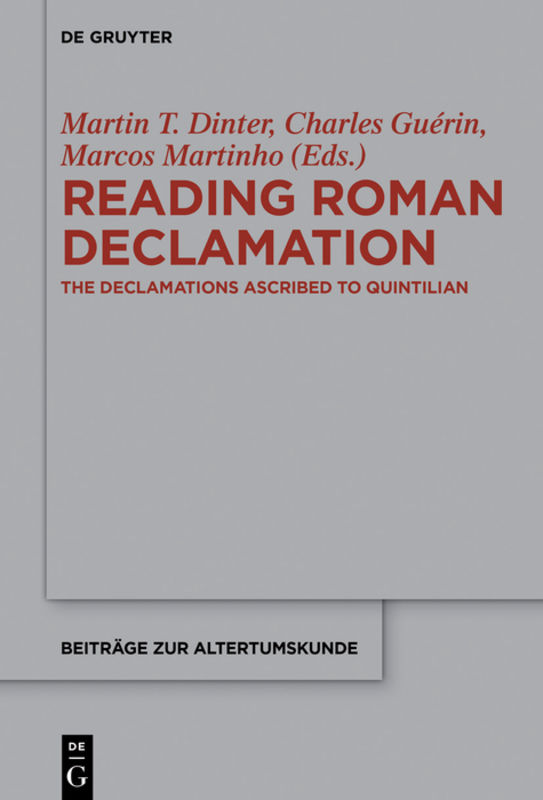
Reading Roman Declamation
As a genre situated at the crossroad of rhetoric and fiction, declamatio offers the freedom to experiment with new forms of discourse. Placing the literariness of declamatio into the spotlight, this volume showcases declamation as a realm of genuine literary creation with its own theoretical underpinning, literary technique and generic conventions. Focusing on the oeuvre of (Ps)Quintilian, this volume demonstrates that these texts constitute a genre on their own, the rhetorical and literary framework of which remains not yet fully mapped. It is of interest to students and scholars of Rhetoric and Roman Literature.
eBook


A Companion to the Neronian Age
An authoritative overview and helpful resource for students and scholars of Roman history and Latin literature during the reign of Nero. * The first book of its kind to treat this era, which has gained in popularity in recent years * Makes much important research available in English for the first time * Features a balance of new research with established critical lines * Offers an unusual breadth and range of material, including substantial treatments of politics, administration, the imperial court, art, archaeology, literature and reception studies * Includes a mix of established scholars and groundbreaking new voices * Includes detailed maps and illustrations
eBook


Epic from Epigram: The Poetics of Valerius Flaccus' \Argonautica\
This article makes the case for the importance of epigram, in terms of both form and content, for Valerius Flaccus' \"Argonautica\". In the battle scenes of Books 3 and 6, in particular, recurrent allusions to epigrammatic themes unveil Valerius' poetics of epigram that evoke the dead for poetic purposes. As part of this, the apostrophe te quoque serves as an epitaphic gesture that marks the \"Argonautica\", with its recurrent civil war imagery, as an epitaph on the golden age. In addition, Valerius employs these epitaphic markers as an organising device, a narrative \"glue\" that makes the Iliadic and the Odyssean parts of his narrative hang together.
Journal Article
