
Catalogue Search | MBRL


Are you sure you want to remove the book from the shelf?

{{itemTitle}}
345
result(s) for
"Dionne, Georges"
Sort by:

Risk Management: History, Definition, and Critique
The study of risk management began after World War II. Risk management has long been associated with the use of market insurance to protect individuals and companies from various losses associated with accidents. Other forms of risk management, alternatives to market insurance, surfaced during the 1950s when market insurance was perceived as very costly and incomplete for protection against pure risk. The use of derivatives as risk management instruments arose during the 1970s, and expanded rapidly during the 1980s, as companies intensified their financial risk management. International risk regulation began in the 1980s, and financial firms developed internal risk management models and capital calculation formulas to hedge against unanticipated risks and reduce regulatory capital. Concomitantly, governance of risk management became essential, integrated risk management was introduced, and the chief risk officer positions were created. Nonetheless, these regulations, governance rules, and risk management methods failed to prevent the financial crisis that began in 2007.
Journal Article
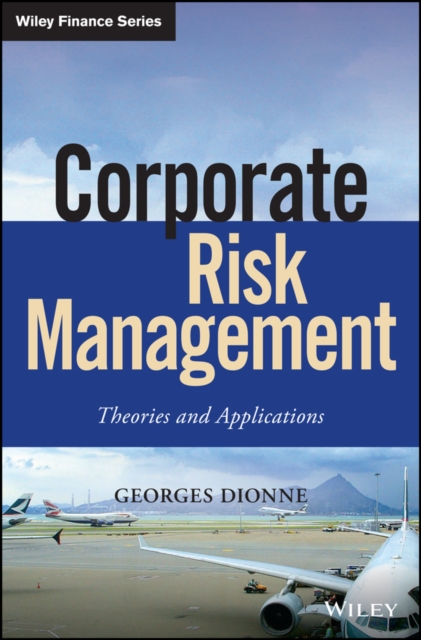
Corporate risk management : theories and applications
An updated review of the theories and applications of corporate risk management
After the financial crisis of 2008, issues concerning corporate risk management arose that demand new levels of oversight. Corporate Risk Management is an important guide to the topic that puts the focus on the corporate finance dimension of risk management. The author—a noted expert on the topic—presents several theoretical models appropriate for various industries and empirically verifies theoretical propositions. The book also proposes statistical modeling that can evaluate the importance of different risks and their variations according to economic cycles.
The book provides an analysis of default, liquidity, and operational risks as well as the failures of LTCM, ENRON, and financial institutions that occurred during the financial crisis. The author also explores Conditional Value at Risk (CVaR), which is central to the debate on the measurement of market risk under Basel III. This important book:
* Includes a comprehensive review of the aspects of corporate risk management
* Presents statistical modeling that addresses recent risk management issues
* Contains an analysis of risk management failures that lead to the 2008 financial crisis
* Offers a must-have resource from author Georges Dionne the former editor of The Journal of Risk and Insurance
Corporate Risk Management provides a modern empirical analysis of corporate risk management across industries. It is designed for use by risk management professionals, academics, and graduate students.
eBook
Corporate Risk Management
An updated review of the theories and applications of corporate risk managementAfter the financial crisis of 2008, issues concerning corporate risk management arose that demand new levels of oversight. Corporate Risk Management is an important guide to the topic that puts the focus on the corporate finance dimension of risk management. The author—a noted expert on the topic—presents several theoretical models appropriate for various industries and empirically verifies theoretical propositions. The book also proposes statistical modeling that can evaluate the importance of different risks and their variations according to economic cycles.The book provides an analysis of default, liquidity, and operational risks as well as the failures of LTCM, ENRON, and financial institutions that occurred during the financial crisis. The author also explores Conditional Value at Risk (CVaR), which is central to the debate on the measurement of market risk under Basel III. This important book:Includes a comprehensive review of the aspects of corporate risk managementPresents statistical modeling that addresses recent risk management issuesContains an analysis of risk management failures that lead to the 2008 financial crisisOffers a must-have resource from author Georges Dionne the former editor of The Journal of Risk and InsuranceCorporate Risk Management provides a modern empirical analysis of corporate risk management across industries. It is designed for use by risk management professionals, academics, and graduate students.
eBook

Nonparametric Testing for Information Asymmetry in the Mortgage Servicing Market
Our objective is to test for evidence of information asymmetry in the mortgage servicing market. Does the sale of mortgage servicing rights (MSR) by the initial lender to a second servicing institution unveil any residual asymmetric information? We are the first to analyze the originator’s selling choice of MSR. We use a large sample of U.S. mortgages that were securitized through the private-label channel during the period of January 2000 to December 2013 (more than 5 million observations). We propose a new nonparametric instrumental variable testing procedure to account for potential endogeneity. For robustness, we present parametric analyses to corroborate our results using instrumental variables. Our empirical results provide strong support for the presence of second-stage asymmetric information in the mortgage servicing market during the period of analysis and before the risk retention reform of 2014.
Journal Article
Coherent Diversification Measures in Portfolio Theory: An Axiomatic Foundation
We provide an axiomatic foundation for the measurement of correlation diversification in a one-period portfolio model. We propose a set of eight desirable axioms for this class of diversification measures. We name the measures satisfying these axioms coherent correlation diversification measures. We study the compatibility of our axioms with rank-dependent expected utility theory. We also test them against the two most frequently used methods for measuring correlation diversification in portfolio theory: portfolio variance and the diversification ratio. Lastly, we provide an example of a functional representation of a coherent correlation diversification measure.
Journal Article

Corporate Risk Management
Cover -- Title Page -- Copyright -- Contents -- Foreword -- Introduction -- General Presentation -- Contents of the Book -- Acknowledgments -- General References -- Chapter 1 Risk Management: Definition and Historical Development -- 1.1 History of Risk Management -- 1.2 Milestones in Financial Risk Management -- 1.3 Current Definition of Corporate Risk Management -- 1.4 Conclusion -- References -- Chapter 2 Theoretical Determinants of Risk Management in Non‐Financial Firms -- 2.1 Value of Risk Management -- 2.1.1 Expected Default Costs -- 2.1.2 Risk Premium to Stakeholders -- 2.1.3 Expected Tax Payments -- 2.2 Comparative Advantages in Risk Taking -- 2.3 Risk Management and Capital Structure -- 2.4 Risk Management and Managerial Incentives -- 2.5 Conclusion -- References -- Chapter 3 Risk Management and Investment Financing -- 3.1 Basic Model -- 3.2 Illustration with the Standard Debt Contract -- 3.3 Model with Two Random Variables -- 3.4 Conclusion -- References -- Appendix A: Value of dI*/dw -- Appendix B: Standard Debt Contract -- Chapter 4 Significant Determinants of Risk Management of Non‐Financial Firms -- 4.1 Rationale for the Research -- 4.2 Significant Determinants -- 4.2.1 Target Variable or Dependent Variable -- 4.2.2 Main Determinants and Their Measurement -- 4.2.3 Results of Estimations -- 4.3 Governance and Endogeneity of Debt -- 4.3.1 Model -- 4.3.2 Statistical Analysis -- 4.3.3 Empirical Results -- 4.4 Conclusion -- References -- Appendix: Construction of the Tax‐Save Variable -- Chapter 5 Value at Risk -- 5.1 Example of VaR -- 5.2 Numerical Method -- 5.3 Parametric Method -- 5.4 Taking Time Periods into Consideration -- 5.5 Confidence Interval of the VaR -- 5.6 CVaR -- 5.7 Conclusion -- References -- Chapter 6 Choice of Portfolio and VaR Constraint -- 6.1 Optimal Benchmark Portfolio of the Firm.
Book

Economic Effects of Risk Classification Bans
Risk classification refers to the use of observable characteristics by insurers to group individuals with similar expected claims, to compute the corresponding premiums, and thereby to reduce asymmetric information. Permitting risk classification may reduce informational asymmetry-induced adverse selection and improve insurance market efficiency. It may also have undesirable equity consequences and undermine the implicit insurance against reclassification risk, which legislated restrictions on risk classification could provide. We use a canonical insurance market screening model to survey and to extend the risk classification literature. We provide a unified framework for analysing the economic consequences of legalised vs banned risk classification, both in static-information environments and in environments in which additional information can be learned, by either side of the market, through potentially costly tests.
Journal Article
Optimal form of retention for securitized loans under moral hazard
We address the moral hazard problem of securitization using a principal-agent model where the investor is the principal and the lender is the agent. Our model considers structured asset-backed securitization with a credit enhancement (tranching) procedure. We assume that the originator can affect the default probability and the conditional loss distribution. We show that the optimal form of retention must be proportional to the pool default loss even in the absence of systemic risk when the originator can affect the conditional loss given default rate, yet the current regulations propose a constant retention rate.
Journal Article
Health care workers' risk perceptions and willingness to report for work during an influenza pandemic
The ability and willingness of health care workers to report for work during a pandemic are essential to pandemic response. The main contribution of this article is to examine the relationship between risk perception of personal and work activities and willingness to report for work during an influenza pandemic. Data were collected through a quantitative Web-based survey sent to health care workers on the island of Montreal. Respondents were asked about their perception of various risks to obtain index measures of risk perception. A multinomial logit model was applied for the probability estimations, and a factor analysis was conducted to compute risk perception indexes (scores). Risk perception associated with personal and work activities is a significant predictor of intended presence at work during an influenza pandemic. This means that correcting perceptual biases should be a public policy concern. These results have not been previously reported in the literature. Many organizational variables are also significant.
Journal Article
Production flexibility and hedging
We extend the analysis on hedging with price and output uncertainty by endogenizing the output decision. Specifically, we consider the joint determination of output and hedging in the case of flexibility in production. We show that the risk-averse firm always maintains a short position in the futures market when the futures price is actuarially fair. Moreover, in the context of an example, we show that the presence of production flexibility reduces the incentive to hedge for all risk averse agents.
Journal Article