
Catalogue Search | MBRL


Are you sure you want to remove the book from the shelf?

{{itemTitle}}
115
result(s) for
"Donskis, Leonidas"
Sort by:

Fifty letters from the troubled modern world : a philosophical-political diary, 2009-2012
Happy are those epochs that had clear dramas, dreams, and doers of good or evil. Today technology has surpassed politics, the latter having in part become a supplement to technology and threatening to bring the creation of a technological society to completion. This society with its determinist consciousness regards a refusal to participate in the technological innovations and social networks (so indispensable for the exercise of social and political control) as sufficient grounds to remove all those who lag behind in the globalization process (or have disavowed its sanctified idea) to the margins of society. This is the message of the Lithuanian philosopher and politician Leonidas Donskis's new book. Donskis echoes Jean Baudrillard in his assumption that an epoch of fragmentation calls for fragmentary writing. A short essay for a friend, a sketch, or a letter from nowhere, as if it was meant to be found in the bottle in the middle of the sea or on the coast of a remote country, can shed new light on the way in which we perceive ourselves and the world around us. About the author: Leonidas Donskis is a Member of the European Parliament (2009-2014) and acts as a visiting professor of politics at Vytautas Magnus University in Kaunas, Lithuania. He combines political theory, history of ideas, philosophy of culture, philosophy of literature, and essayistic style. Among other books, he is coauthor (together with Zygmunt Bauman) of Moral Blindness: The Loss of Sensitivity in Liquid Modernity (2013), and the author of Modernity in Crisis: A Dialogue on the Culture of Belonging (2011), Troubled Identity and the Modern World (2009), Power and Imagination: Studies in Politics and Literature (2008), and Forms of Hatred: Troubled Imagination in Modern Philosophy and Literature (2003).
eBook


A Small Map of Experience
To entail, scan and embrace more knowledge of \"what is\" and \"what ought to be done\" in fewer words -- to make a statement as short, concise, terse and pithy as possible while rendering the sights it opens as vast as possible -- is the principal intention of the practitioners of the difficult art of the aphorism. Many writers have tried it, few have succeeded. A successful aphorism, true to its mission, allows a small step to go a long, perhaps an infinitely long, way. But as knowledge needed to find one's way in our increasingly crowded and complex world grows at a mind-boggling pace, so do the difficulties on the road to success. In our liquid-modern times horizons tend to break up or dissolve as soon as they are drawn. It is this unprecedented quality of our condition that Leonidas Donskis attempts to grasp and convey by resurrecting the badly missed and badly needed art of the aphorism, injecting into it a new impetus, a perfect match to the vertiginous pace of our life, and bringing that art up to the gravity and grandiosity of the challenge we confront. We should all be grateful to him for this exquisitely harrowing task he has performed.
eBook


The Thing and Art
On the grounds of the interpretation of Rainer Maria Rilke's poetry and Paul Cézanne's paintings the book attempts to approach the work of art as a thing. This lets to overcome a one-sided aesthetical interpretation of the origin of the work of art and to indicate its place in the cosmos of uncreated, i.e. not hominized things. So, the second fundamental issue raised is a try to point out a metaphysical difference between a hominized and not hominized (natural) thing. Such a non-aesthetical point of view is called ontotopy by the author and is opposed to traditional ontology and the philosophy of art.
eBook
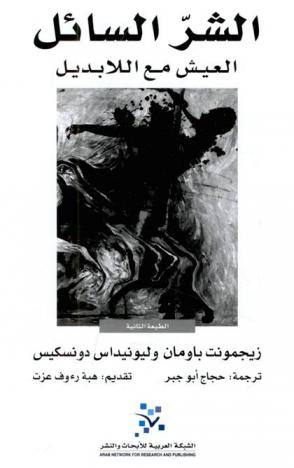
الشر السائل : العيش مع اللا بديل
يتناول الكتاب أنه ليس كتابا في لاهوت الشر ولا في دراسة الشياطين، بل هو كتاب في سوسيولوجيا العمى الأخلاقي، وإن كان يستعين بكل ذلك في رسم معالم هذا العمى. فالشر في الوجدان الإنساني هو عكس الخير، وهو جزء أساس من الخريطة الإدراكية التي ترسم العالم في ثنائيات صلبة متعارضة، مثل النور والظلام، الجمال والقبح، الحق والباطل، الإنسانية والبربرية، الحقيقة والخرافة، العلم والجهل.. وكانت هذه الثنائيات تستمد تماسكها من مركز صلب، إلهي أو بشري، يحدد معالمها وحدودها، ومع اختفاء هذه المراكز الصلبة، تحول الشر من مرحلة الصلابة إلى مرحلة السيولة. الشر السائل كتاب جديد من كتب باومان حول هذا العصر الذي نعيشه والذي تتسم ظواهره بالسيولة.
BOOK

Loyalty, dissent, and betrayal : modern Lithuania and East-Central European moral imagination
Loyalty and betrayal are among key concepts of the ethic of nationalism. Marriage of state and culture, which seems the essence of the congruence between political power structure and collective identity, usually offers a simple explanation of loyalty and dissent. Loyalty is seen as once-and-for-all commitment of the individual to his or her nation, whereas betrayal is identified as a failure to commit him or herself to a common cause or as a diversion from the object of political loyalty and cultural/linguistic fidelity. For conservative or radical nationalists, even social and cultural critique of one's people and state can be regarded as treason, whereas for their liberal counterparts it is precisely what constitutes political awareness, civic virtue, and a conscious dedication to the people and culture. \"This book is the first attempt to provide a discursive map of Lithuanian liberal and conservative nationalism. Analyzing the works and views of dissenters and critics of society and culture, we can reveal a mode of being of liberal nationalism as a social and cultural criticism. This volume is of interest for intellectual historians, social theorists, students of East-Central European thought, and anyone interested in Baltic studies and the new members of the EU. Dissent: act of betrayal, or loyalty? Leonidas Donskis' new remarkable study is one consistent, thorough and dedicated effort to provide an answer to that question.\" - Zygmunt Bauman (from the Preface).
eBook

Names of Nihil
In this book, probably for the first time in Western philosophy, an attempt has been made to point out and systematically explicate the problem scope of the Nothing (which is called Nihil in the book) and to try to explain the springhead of the excessive negativity, inherent only in the human being, or in other words, the springhead of the human's natural nihilism. Nihilism is treated here not as a posture, pose, or an ideological attitude, but as the spread of the human metaphysical nucleus, of Nihil. Nihilistic annihilation, manifesting itself as the road of the naming of Nihil and of the production of thingly crystals (artificial world) as a result of that naming, usually is called \"history\". Names of Nihil (language phenomena), being the antithesis of Nihil, falsify and cover up Nihil itself, turning it into \"supreme\" being, e.g. into \"the One\", \"God\", \"Substance\", \"Matter\", \"Spirit\", ad infinitum. This book should be interesting not only to philosophers or humanitarians, but also to all those who concern themselves with the total human condition.
eBook

After Communism: Identity and Morality in the Baltic Countries
Eastern European countries seem locked mentally somewhere between the discovery of the intrinsic logic of capitalism characteristic of the nineteenth century and the post-Weimar Republic period. This is a period characterized by an incredibly fast economic growth and a passionate advocacy of the values of free enterprise and capitalism, accompanied by a good deal of anomie, fission of the body social, stark social contrasts, shocking degrees of corruption, a culture of poverty (to recall Oscar Lewis's term which refers to low trust, self-victimization, disbelief in social ties and networks, contempt for institutions, and so on), and cynicism.
Book Chapter