
Catalogue Search | MBRL


Are you sure you want to remove the book from the shelf?

{{itemTitle}}
245
result(s) for
"Drew, Allison"
Sort by:


We are no longer in France
This book recovers the lost history of colonial Algeria’s communist movement. Meticulously researched – and the only English-language book on the Parti Communiste Algérien – it explores communism’s complex relationship with Algerian nationalism. During international crises, such as the Popular Front and Second World War years, the PCA remained close to its French counterpart, but as the national liberation struggle intensified, the PCA’s concern with political and social justice attracted growing numbers of Muslims. When the Front de Libération Nationale launched armed struggle in November 1954, the PCA maintained its organisational autonomy – despite FLN pressure. They participated fully in the national liberation war, facing the French state’s wrath. Independence saw two conflicting socialist visions, with the PCA’s incorporated political pluralism and class struggle on the one hand, and the FLN demand for a one-party socialist state on the other. The PCA’s pluralist vision was shattered when it was banned by the one-party state in November 1962. This book is of particular interest to students and scholars of Algerian history, French colonial history and communist history.
eBook

Identification of a CARM1 Inhibitor with Potent In Vitro and In Vivo Activity in Preclinical Models of Multiple Myeloma
CARM1 is an arginine methyltransferase with diverse histone and non-histone substrates implicated in the regulation of cellular processes including transcriptional co-activation and RNA processing. CARM1 overexpression has been reported in multiple cancer types and has been shown to modulate oncogenic pathways in
in vitro
studies. Detailed understanding of the mechanism of action of CARM1 in oncogenesis has been limited by a lack of selective tool compounds, particularly for
in vivo
studies. We describe the identification and characterization of, to our knowledge, the first potent and selective inhibitor of CARM1 that exhibits anti-proliferative effects both
in vitro
and
in vivo
and, to our knowledge, the first demonstration of a role for CARM1 in multiple myeloma (MM). EZM2302 (GSK3359088) is an inhibitor of CARM1 enzymatic activity in biochemical assays (IC
50
= 6 nM) with broad selectivity against other histone methyltransferases. Treatment of MM cell lines with EZM2302 leads to inhibition of PABP1 and SMB methylation and cell stasis with IC
50
values in the nanomolar range. Oral dosing of EZM2302 demonstrates dose-dependent
in vivo
CARM1 inhibition and anti-tumor activity in an MM xenograft model. EZM2302 is a validated chemical probe suitable for further understanding the biological role CARM1 plays in cancer and other diseases.
Journal Article
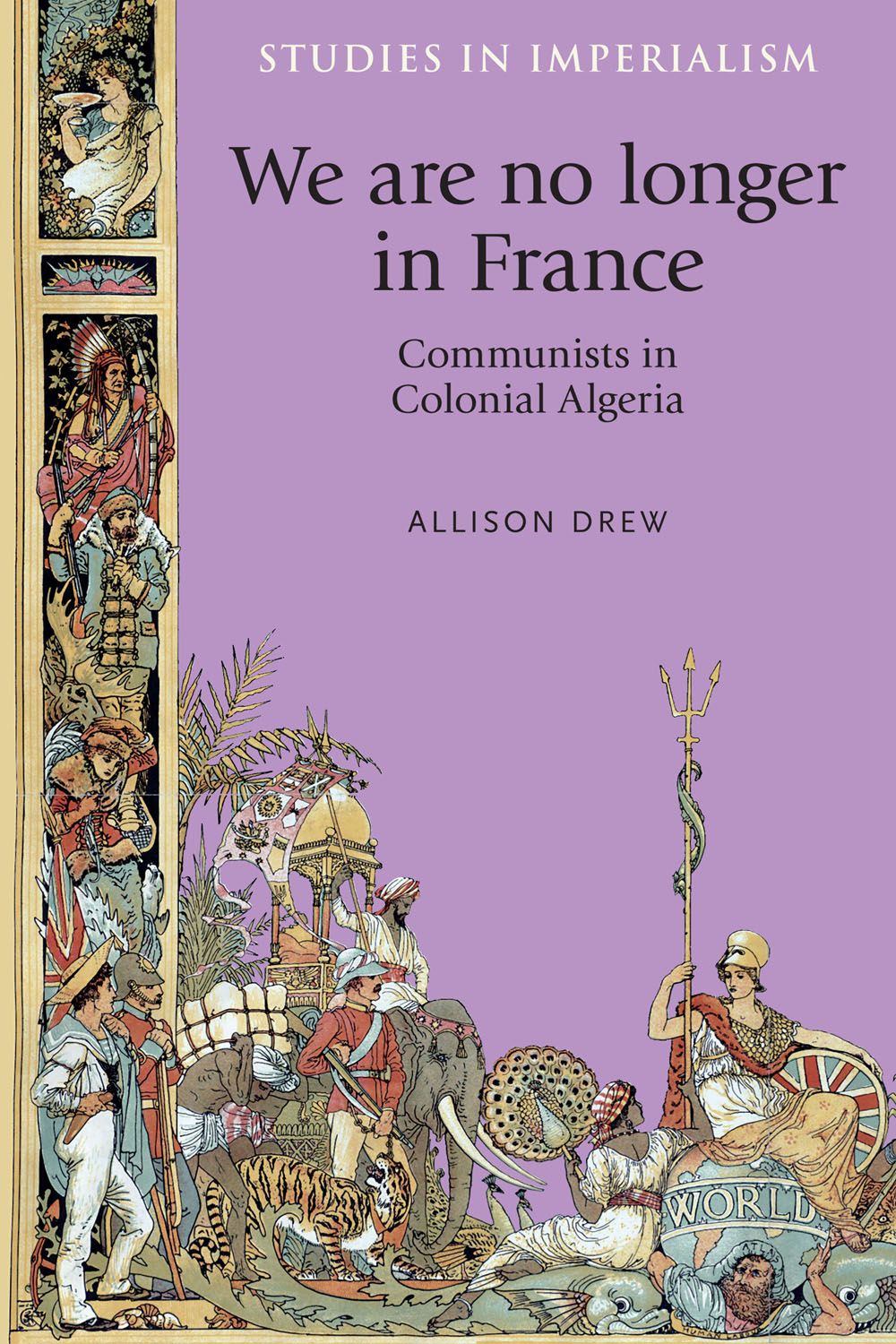
We are no longer in France
This book recovers the lost history of colonial Algeria’s communist movement. Meticulously researched – and the only English-language book on the Parti Communiste Algérien – it explores communism’s complex relationship with Algerian nationalism. During international crises, such as the Popular Front and Second World War years, the PCA remained close to its French counterpart, but as the national liberation struggle intensified, the PCA’s concern with political and social justice attracted growing numbers of Muslims. When the Front de Libération Nationale launched armed struggle in November 1954, the PCA maintained its organisational autonomy – despite FLN pressure. They participated fully in the national liberation war, facing the French state’s wrath. Independence saw two conflicting socialist visions, with the PCA’s incorporated political pluralism and class struggle on the one hand, and the FLN demand for a one-party socialist state on the other. The PCA’s pluralist vision was shattered when it was banned by the one-party state in November 1962. This book is of particular interest to students and scholars of Algerian history, French colonial history and communist history.
eBook

A Gendered Approach to the Yu Chi Chan Club and National Liberation Front during South Africa's Transition to Armed Struggle
South Africa's anti-apartheid struggle reflected an ideal of heroic masculinity that ignored and depreciated women as active political agents. This has contributed to a post-apartheid social order that accepts formal gender equality but that perpetuates gender inequality by discounting women's experiences. This article examines the little-known and short-lived Yu Chi Chan Club (YCCC) and National Liberation Front (NLF). Tiny Cape Peninsula-based breakaways from the Non-European Unity Movement – an African National Congress rival – the YCCC and NLF were exceptional amongst early 1960s underground groups in their systematic attempts to theorize guerrilla struggle and assess its applicability to South African conditions and, in the NLF's case, to build a cell structure through political education. Although the NLF's idealized notion of revolutionary life was premised on an abstract individual with traits then associated with public and vocal male activists, nonetheless women participated as equal abstract individuals. The NLF's relatively horizontal cell structure, small cell size, and lack of hierarchy made participation easier for both women and men, allowing women to operate equally within the political space. From their gendered upbringing and early experiences in hierarchical organizations to their brief experience of equality within the YCCC and NLF, the women were then forced into a prison system with an extremely rigid and unequal gender divide. Subjected to the state's regendering project, the political space available to the NLF's women prisoners shrank far more than it did for their male comrades, whose prison experiences became the measure of anti-apartheid politics.
Journal Article

Visions of liberation: the Algerian war of independence and its South African reverberations
The launch of South Africa's armed struggle has been portrayed as the action of urban-based South African Communist Party (SACP) and African National Congress (ANC) members; scholarly debates concern the relative importance of the SACP, ANC and the Soviet Union. Yet the Left was fluid and eclectic during this transitional period. Seeking new approaches and methods to address the rapidly evolving political environment, left-wing activists drew on political and personal contacts to build new underground networks. Their arguments came not from the Soviets but from the experiences of guerrilla struggles, such as Algeria's war of independence. They sought, unsuccessfully, to integrate insights from Algeria into their strategies.
Journal Article

Floral dimorphism, pollination, and self-fertilization in gynodioecious GERANIUM RICHARDSONII (Geraniaceae)
The selective maintenance of gynodioecy depends on the relative fitness of the male-sterile (female) and hermaphroditic morphs. Females may compensate for their loss of male fitness by reallocating resources from male function (pollen production and pollinator attraction) to female function (seeds and fruits), thus increasing seed production. Females may also benefit from their inability to self-fertilize if selfing and inbreeding depression reduce seed quality in hermaphrodites. We investigated how differences in floral resource allocation (flower size) between female and hermaphroditic plants affect two measures of female reproductive success, pollinator visitation and pollen receipt, in gynodioecious populations of Geranium richardsonii in Colorado. Using emasculation treatments in natural populations, we further examined whether selfing by autogamy and geitonogamy comprises a significant proportion of pollen receipt by hermaphrodites. Flowers of female plants are significantly smaller than those of hermaphrodites. The reduction in allocation to pollinator-attracting structures (petals) is correlated with a significant reduction in pollinator visitation to female flowers in artificial arrays. The reduction in attractiveness is further manifested in significantly less pollen being deposited on the stigmas of female flowers in natural populations. Autogamy is rare in these protandrous flowers, and geitonogamy accounts for most of the difference in pollen receipt between hermaphrodites and females. Female success at receiving pollen was negatively frequency dependent on the relative frequency of females in populations. Thus, two of the prerequisites for the maintenance of females in gynodioecious populations, differences in resource allocation between floral morphs and high selfing rates in hermaphrodites, occur in G. richardsonii.
Journal Article

Sparking an insurrection
The mountainousbled es sibaor dissident lands unleashed armed struggle against French colonialism at 1.15 a.m. on 1 November 1954, as the country’s European Catholics celebrated All Saints’ Day. The first African armed struggle launched since the outbreak of Kenya’s 1952 Mau Mau uprising, Algeria’s war of independence was inaugurated by a wave of some sixty synchronised sabotage attacks on police stations and garrisons around the country.¹ Its focal point was the Aurès mountains in eastern Algeria – ‘a treeless wilderness where it looks as if nothing but stone will grow’. Stone villages in stone mountains provided camouflage for
Book Chapter
This land is not for sale
In the 1930s impoverished rural Algerians swarmed into already densely populated urban areas. The traditional medina became both ruralised and Europeanised. The new urbanites maintained tight networks with their rural relatives, linking town and countryside ever more closely. However, urban youth spent more time in the streets by comparison with their parents, congregating at cafés, barbers’ shops, shoemakers’ stalls, cinemas and meeting halls. While rural women became farm workers, their urban counterparts left their homes for factory and domestic work. Urban public space expanded, noisy with voices speaking in Arabic, Berber, French and sometimes Spanish. In the concentrated medinas, First
Book Chapter
The mountain “was going communist”
For the PCF’s Algerian region, 1930 represented the pinnacle of repression. Public political space contracted sharply. Communists and trade unionists were subjected to a state of siege – hounded, imprisoned and deported south. This continued into 1931.Lutte socialewas repeatedly seized. When it appeared, Boualem’s name figured prominently, promoting the decisions of the Comintern’s Sixth Congress. Trade union and neighbourhood cells produced small mimeographed papers such asL’Esclave du rail(railway workers),Le Disque rouge(postal workers) andLa Cantara rouge(Bab el Oued).¹ But national coordination was impossible without a national paper. Indeed, the PCF’s Algerian region remained
Book Chapter