
Catalogue Search | MBRL


Are you sure you want to remove the book from the shelf?

{{itemTitle}}
50
result(s) for
"Dronamraju, Krishna R"
Sort by:


Popularizing Science
Evaluates Haldane's social and political background, as well as his scientific creativity and accomplishments.
eBook
Emerging consequences of biotechnology
The commercialization of biotechnology has resulted in an intensive search for new biological resources for the purposes of increasing food productivity, medicinal applications, energy production, and various other applications. Although biotechnology has produced many benefits for humanity, its applications have also resulted in some undesirable consequences such as diminished species biodiversity as well as diminished agrobiodiversity, environmental contamination, and the exploitation of intellectual property rights and patents in appropriating the biodiversity of developing countries.
eBook
Infectious Disease and Host-Pathogen Evolution
This book, originally published in 2004, is concerned with the links between human evolution and infectious disease. It has long been recognised that an important factor in human evolution has been the struggle against infectious disease and, more recently, it was revealed that complex genetic polymorphisms are the direct result of that struggle. As molecular biological techniques become more sophisticated, a number of breakthroughs in the area of host-pathogen evolution led to an increased interest in this field. From the historical beginnings of J. B. S. Haldane's original hypothesis to more recent research, this book strives to evaluate infectious diseases from an evolutionary perspective. It provides a survey of information regarding host-pathogen evolution related to major infectious diseases and parasitic infections, including malaria, influenza and leishmaniasis. Written by leading authorities in the field, and edited by a former pupil of Haldane, Infectious Disease and Host-Pathogen Evolution will be valuable for those working in related areas of microbiology, parasitology, immunology and infectious disease medicine, as well as genetics, evolutionary biology and epidemiology.
eBook
Emerging Consequences Of Biotechnology
The commercialization of biotechnology has resulted in an intensive search for new biological resources for the purposes of increasing food productivity, medicinal applications, energy production, and various other applications. Although biotechnology has produced many benefits for humanity, its applications have also resulted in some undesirable consequences such as diminished species biodiversity as well as diminished agrobiodiversity, environmental contamination, and the exploitation of intellectual property rights and patents in appropriating the biodiversity of developing countries.This book discusses the role of biological, ecological, environmental, ethical, and economic issues in the interaction between biotechnology and biodiversity, using different contexts. No other book has discussed all of these issues in a comprehensive manner. Of special interest is their impact when biotechnology is shared between developed and developing countries, and the lack of recognition of the rights of indigenous populations and traditional farmers in developing countries by large multinational corporations.Sample Chapter(s)Foreword (834 KB)Introduction (89 KB)Chapter 1: Impact of GM Crops on Biodiversity and the Environment (2,368 KB)Contents:Impact of GM Crops on Biodiversity and the EnvironmentBiodiversity LossBioprospecting or Biopiracy?Global Appeal Against Patents on Conventional Seeds and CropsPatenting LifeTraditional Knowledge and Intellectual Property RightsImpact of GMOs in Developing CountriesAgricultural BiodiversityGMOs and the LawHuman Rights and Ethical IssuesReadership: All scientists (especially biologists), legal professionals, and anyone interested in the future of the planet and quality of life.
eBook

Recollections of J.B.S. Haldane, with special reference to Human Genetics in India
This paper is a brief account of the scientific work of J.B.S. Haldane
(1892-1964), with special reference to early research in Human
Genetics. Brief descriptions of Haldane's background, his important
contributions to the foundations of human genetics, his move to India
from Great Britain and the research carried out in Human Genetics in
India under his direction are outlined. Population genetic research on
Y-linkage in man, inbreeding, color blindness and other aspects are
described.
Journal Article
Infectious diseases and host-pathogen evolution
This book, originally published in 2004, is concerned with the links between human evolution and infectious disease. It has long been recognised that an important factor in human evolution has been the struggle against infectious disease and, more recently, it was revealed that complex genetic polymorphisms are the direct result of that struggle. As molecular biological techniques become more sophisticated, a number of breakthroughs in the area of host-pathogen evolution led to an increased interest in this field. From the historical beginnings of J. B. S. Haldane's original hypothesis to more recent research, this book strives to evaluate infectious diseases from an evolutionary perspective. It provides a survey of information regarding host-pathogen evolution related to major infectious diseases and parasitic infections, including malaria, influenza and leishmaniasis. Written by leading authorities in the field, and edited by a former pupil of Haldane, Infectious Disease and Host-Pathogen Evolution will be valuable for those working in related areas of microbiology, parasitology, immunology and infectious disease medicine, as well as genetics, evolutionary biology and epidemiology.
eBook

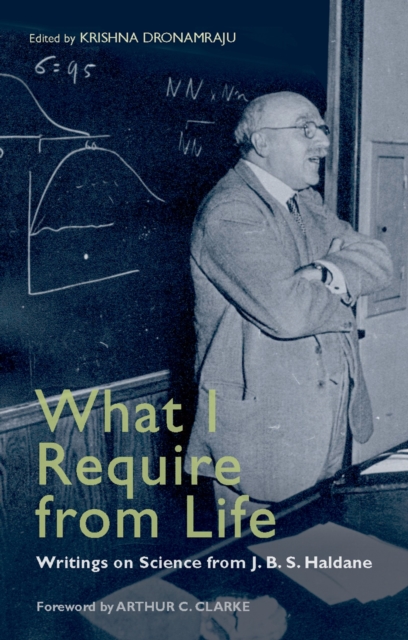
What I require from life : writings on science and life from J.B.S. Haldane
J. B. S. Haldane (1892-64) was one of the scientific giants of the 20th century. A polymath who made important contributions to sciences ranging from physiology to genetics and biochemistry, he was also a highly skilled writer and an extraordinary character - brilliant, witty, idealistic, funny, and pugnacious. What I Require From Life is a compilation of his popular scientific essays written from the 1940s to last years of his life, that reflect not only his masterful ability to communicate scientific understanding, but also his deep commitment to socialism. The essays included here fall into two groups; those written by Haldane during the 1940s when he embraced Marxism, and those written during his last years in India (1957-64), and they range from An Autobiography in Brief (written three years before his death), to his Marxist view of evolution The Chicken or the Egg? , to his poignant poem Cancer is a Funny Thing. Edited with an introduction by Haldane's last graduate pupil, Professor Krishna Dronamraju, this collection of thought-provoking and beautifully-written science writing also comes with a Preface written by the late Sir Arthur C. Clarke, who provides a personal perspective on Haldane's unique place in 20th century science.
eBook

Emerging consequences of biotechnology : biodiversity loss and IPR issues / Krishna Dronamraju
The commercialization of biotechnology has resulted in a search for biological resources for the purposes of increasing food productivity, medicinal applications, and energy production. This book discusses the role of biological, ecological, environmental, ethical, and economic issues in the interaction between biotechnology and biodiversity.
eBook