
Catalogue Search | MBRL


Are you sure you want to remove the book from the shelf?

{{itemTitle}}
26
result(s) for
"Drumwright, Minette E."
Sort by:

The Effect of Corporate Social Responsibility on Customer Donations to Corporate-Supported Nonprofits
Both theory and recent research evidence suggest that a corporation's socially responsible behavior can positively affect consumers' attitudes toward the corporation. The effect occurs both directly and indirectly through the behavior's effect on customer-corporation identification. The authors report the results of four studies designed to replicate and extend these findings. Using a field survey design, Study 1 provides evidence that perceived corporate social responsibility affects not only customer purchase behavior through customer-corporate identification but also customer donations to corporate-supported nonprofit organizations. Using experimental designs, Studies 2 and 3 replicate and extend the Study 1 findings by providing additional evidence for the mediating role of customer-corporate identification on the relationship between corporate social responsibility and customer donations. However, the combined results of Studies 2 and 3 also show that because of a \"perceived opportunity to do good\" by supporting a company that is changing its ways, consumers are more likely to donate to a corporate-supported nonprofit when the corporation has a weaker historical record of socially responsible behavior. Finally, Study 4 tests the relationship between the nonprofit domain and the domain of the corporation's socially responsible behavior as a boundary condition for this effect.
Journal Article

The Current State of Advertising Ethics: Industry and Academic Perspectives
Given the dynamic change and radical transformation of the advertising industry, we interviewed industry and academic leaders to seek their perspectives on the current state of advertising ethics. We also analyzed advertising agency Web sites, reviewed advertising textbooks, and surveyed the academic literature. We distinguish the ethics of the advertising message from the ethics of the advertising agency business. New and perplexing ethical issues related to advertising messages have emerged with the advent and growth of new and nontraditional media. Because of the more complex organizational structures of global communication agency networks, the temptations, risks, and rewards of unethical behavior in the business of advertising are greater than ever. We recommend that both industry and academia become more proactive, individually and in consultation with one another, in dealing with ethical problems and in setting norms.
Journal Article

Networks of complicity: social networks and sex harassment
PurposeThe purpose of this paper is to explore the question of why sex harassment persists in organizations for prolonged periods – often as an open secret.Design/methodology/approachIn-depth interviews were conducted with 28 people in diverse organizations experiencing persistent sex harassment. Data were analyzed using standard qualitative methods.FindingsThe overarching finding was that perpetrators were embedded in networks of complicity that were central to explaining the persistence of sex harassment in organizations. By using power and manipulating information, perpetrators built networks that protected them from sanction and enabled their behavior to continue unchecked. Networks of complicity metastasized and caused lasting harm to victims, other employees and the organization as a whole.Research limitations/implicationsThe authors used broad, open-ended questions and guided introspection to guard against the tendency to ask for information to confirm their assumptions, and the authors analyzed the data independently to mitigate subjectivity and establish reliability.Practical implicationsTo stop persistent sex harassment, not only must perpetrators be removed, but formal and informal ties among network of complicity members must also be weakened or broken, and victims must be integrated into networks of support. Bystanders must be trained and activated to take positive action, and power must be diffused through egalitarian leadership.Social implicationsUnderstanding the power of networks in enabling perpetrators to persist in their destructive behavior is another step in countering sex harassment.Originality/valueSocial network theory has rarely been used to understand sex harassment or why it persists.
Journal Article

Consumer emotional intelligence and its effects on responses to transgressions
This research suggests that consumer emotional intelligence (CEI) is an important construct in explaining why some consumers react destructively to conflicts in consumer-brand relationships whereas others approach them constructively. The results of the study show that (1) when encountering transgressions in relationships with brands, consumers low in CEI are more likely to respond to transgressions destructively than those who are high in CEI; (2) the effects of CEI on destructive responses are greater if a transgression affects consumers' self interests rather than society's interests; and (3) low CEI consumers are more likely to attribute negative intentions to the company and are therefore more likely to respond destructively than high CEI consumers.
Journal Article
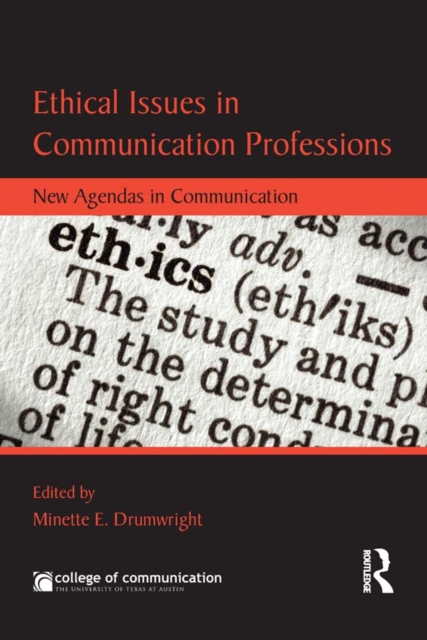
Ethical Issues in Communication Professions
Dynamic, rapid, and radical changes are transforming the communication professions, provoking major implications for ethics. Traditional boundaries blur as media converge; relentless competitive pressures cause some forms of communication to atrophy and permit others to explode; and technological advances occur daily. In this volume, a new generation of scholars take a fresh look at the manner in which ethical issues manifest themselves in their areas of research and suggest new agendas for future research.
This book addresses a wide range of questions from a variety of communication professions. Contributors tackle such issues as how to define a journalist in an era when anyone can disseminate information to a global audience; how to use \"advergames,\" crowdsourcing, and facial recognition technology in advertising responsibly; and how to respond ethically in situations of public crisis communication, among many others. This volume will be critical reading for scholars and professionals in media, communication, and digital arts, as well as philosophy, government, public policy, business, and law.
eBook
How Advertising Practitioners View Ethics: Moral Muteness, Moral Myopia, and Moral Imagination
This study examines how advertising agency personnel perceive, process, and think about ethical issues. We conducted in-depth, elite interviews with advertising practitioners at all levels in 29 agencies in eight cities. Many of our informants reported few ethical concerns in their own work or in advertising in general. They exhibited \"moral myopia,\" a distortion of moral vision that prevents moral issues from coming into focus, and \"moral muteness,\" meaning that they rarely talk about ethical issues. We find that the reasons for moral muteness and moral myopia are categorizable. There were, however, \"seeing/talking\" advertising practitioners who demonstrated \"moral imagination\" when responding to ethical problems. We compare the manner in which the ethically sensitive practitioners contemplate and respond to ethical issues with those characterized as having moral muteness and moral myopia. We also find that the agency context in which advertising practitioners work is important in terms of ethical sensitivity. We discuss implications for theory, research, practice, and education.
Journal Article

The New Marketing Myopia
During the past half century, in general, marketers have heeded Levitt's (1960) advice to avoid \"marketing myopia\" by focusing on customers. In this article, the authors argue that marketers have learned this lesson too well, resulting today in a new form of marketing myopia, which also causes distortions in strategic vision and can lead to business failure. This \"new marketing myopia\" stems from three related phenomena: (1) a single-minded focus on the customer to the exclusion of other stakeholders, (2) an overly narrow definition of the customer and his or her needs, and (3) a failure to recognize the changed societal context of business that necessitates addressing multiple stakeholders. The authors illustrate these phenomena and then offer a vision of marketing management as an activity that engages multiple stakeholders in value creation, suggesting that marketing can bring a particular expertise to bear. They offer five propositions for practice that will help marketers correct the myopia: (1) map the company's stakeholders, (2) determine stakeholder salience, (3) research stakeholder issues and expectations and measure impact, (4) engage with stakeholders, and (5) embed a stakeholder orientation. The authors conclude by noting the implications for research.
Journal Article
Socially Responsible Organizational Buying: Environmental Concern as a Noneconomic Buying Criterion
The greening of corporate America has added a new and different type of criterion to some organizational buying decisions-social responsibility. Scholars have given little attention to such noneconomic buying criteria. On the basis of a study of 35 buying processes in ten organizations and an in-depth examination of 21 of those processes, the author addresses how and why socially responsible buying comes about in organizations. The findings suggest that two factors have been key to the success of socially responsible buying initiatives. One factor is the presence of a skillful policy entrepreneur. Policy entrepreneurs are found to have many of the same characteristics as business entrepreneurs, but invest their resources in instituting new organizational policies. Their zeal for socially responsible buying is rooted in a commitment based on a complex and often difficult process of moral reasoning. The second factor influencing the success of socially responsible buying is the organizational context within which policy entrepreneurs operate. The author differentiates organizational contexts on the basis of whether the socially responsible buying is part of a deliberate corporate strategy and further classifies them through a framework and identifies themes observed across the contexts. Guidance is offered for vendors marketing socially responsible products and services.
Journal Article
Company Advertising with a Social Dimension: The Role of Noneconomic Criteria
The author examines company advertising campaigns with social dimensions and compares them to matched standard, or nonsocial, campaigns. The author investigates the managers' objectives for the campaigns with social dimensions, examines the processes creating them, and develops a model for explaining success factors. Most campaigns have mixed objectives, both economic and social, which have many implications. Although these campaigns are not particularly effective in achieving traditional economic objectives, such as increasing sales, they are highly effective in achieving company-oriented objectives, such as motivating the work force or communicating the essence of the company's mission. Drawing on research and theory related to organizational identification, the author discusses causal mechanisms underlying social campaigns' effectiveness with company-oriented objectives and presents directions for further research. Ethical considerations and managerial implications are discussed, as well.
Journal Article
