
Catalogue Search | MBRL


Are you sure you want to remove the book from the shelf?

{{itemTitle}}
6
result(s) for
"Duhamel, Denise, author"
Sort by:


Blowout
Finalist, National Book Critics Circle Award.InBlowout,Denise Duhamel asks the same question that Frankie Lyman & the Teenagers asked back in 1954-\"Why Do Fools Fall in Love?\" Duhamel's poems readily admit that she is a love-struck fool, but also embrace the \"crazy wisdom\" of the Fool of the Tarot deck and the fool as entertainer or jester. From a kindergarten crush to a failed marriage and beyond, Duhamel explores the nature of romantic love and her own limitations. She also examines love through music, film, and history-Michelle and Barak Obama's inauguration and Cleopatra's ancient sex toy. Duhamel chronicles the perilous cruelties of love gone awry, but also reminds us of the compassion and transcendence in the aftermath. In \"Having a Diet Coke with You,\" she asserts that \"love poems are the most difficult poems to write / because each poem contains its opposite its loss / and that no matter how fierce the love of a couple / one of them will leave the other / if not through betrayal / then through death.\" Yet, inBlowout,Duhamel fiercely and foolishly embraces the poetry of love.
eBook

Scald
When her \"smart\" phone keeps asking her to autocorrect her name to Denise Richards, Denise Duhamel begins a journey that takes on celebrity, sex, reproduction, and religion with her characteristic wit and insight. The poems inScaldengage feminism in two ways-committing to and battling with-various principles and beliefs. Duhamel wrestles with foremothers and visionaries Shulamith Firestone, Andrea Dworkin, and Mary Daly as well as with pop culture figures such as Helen Reddy, Cyndi Lauper, and Bikini Kill. In dialogue with artists and writers such as Catherine Opie, Susan Faludi, and Eve Ensler, Duhamel tries to understand our cultural moment. While Duhamel'sScaldcan burn, she has more importantly taken on the role of the ancient Scandinavian \"Skald,\" one who pays tribute to heroic deeds. In Duhamel's case, her heroes are also heroines.
eBook

The Star-Spangled Banner
The Star-Spangled Banner, Denise Duhamel's sixth book of poems, is about falling in love, American-style, with someone who is not American.   In the title poem, a small American girl mishears the first line of The Star-Spangled Banner as José, can you see?, which leads her to imagine a foreign lover of an American woman dressed in a star-spangled gown. The misunderstandings caused by language recur throughout the book: contemplating what yes means in different cultures; watching Nickelodeon's Nick at Nite with a husband who grew up in the Philippines and never saw The Patty Duke Show ; misreading another poet's title The Difference Between Pepsi and Coke as The Difference Between Pepsi and Pope and concluding that Pepsi is all for premarital sex. / The Pope won't stain your teeth. Misunderstandings also abound as characters mingle with others from different classes. In Cockroaches, a father-in-law refers to budget-minded American college students backpacking in Europe as cockroaches, not realizing his daughter-in-law was once, not so long ago, such a student/roach herself.   With welcome levity and refreshing irreverence, The Star-Spangled Banner addresses issues of ethnicity, class, and gender in America.
eBook
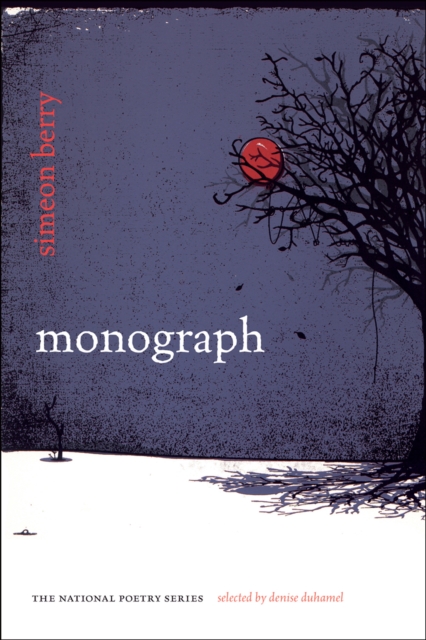
Monograph
Written in narrow sections that blur the distinction between flash fiction and prose poetry, between memoir and meditation, Monograph veers from the elliptical to the explosive as it dissects the Gordian knot of a marriage’s intellectual, sexual, and domestic lives. Invoking Raymond Chandler, Pythagoras, Joan Didion, and Virginia Woolf as presiding spirits, Simeon Berry curates the negative space of each wry tableau, destabilizing the high seriousness of every lyric aside and slipping quantum uncertainty into the stark lineaments of loss.
eBook

Insomnia Diary
\"The most potent ingredient in virtually every one of Bob Hicok's compact, well-turned poems is a laughter as old as humanity itself, a sweet waggery that suggests there's almost no problem that can't be solved by this poet's gentle humor.\"-New York Times Book Review
eBook