
Catalogue Search | MBRL


Are you sure you want to remove the book from the shelf?

{{itemTitle}}
160
result(s) for
"Dullien, Sebastian"
Sort by:

Why Current EU Proposals for Corona-Related Financial Aid Cannot Replace Coronabonds
With public debt-to-GDP levels now set to surpass post-war records and Italy's ratio approaching levels reached in Greece on the eve of the country's debt restructuring in early 2012, fears of a return of the sovereign debt crisis have emerged.
Journal Article

Economic Implications of the Corona Crisis and Economic Policy Measures
The corona crisis started in China and had great consequences for public health and the economy. In the meantime, high and rapidly growing numbers of cases of infections with SARS-CoV-2 have also been recorded in Japan, Korea, Italy, Germany, Great Britain, France, Spain and above all in the USA. Forecasts of economic growth have been massively revised downwards and governments around the world are struggling to find the right economic policy response. This article describes basic short-term options for the German government to react to the corona shock and briefl y assesses the package of measures “Schutzschirm für Beschäftigte und Unternehmen” presented on 13 March 2020 by the German Finance Minister Olaf Scholz and the German Economics Minister Peter Altmaier.
Journal Article
The Transatlantic Trade Conflict and the German Economy: It Matters how Long It Takes
International trade conflicts continue to simmer in times of the coronavirus crisis. Most recently, in mid-May, the US government tightened export restrictions for suppliers to the Chinese technology company Huawei. Against the background of the dramatic slump in consumer demand for automobiles, US President Donald Trump might revive his protectionist idea of tariffs on cars and car parts from the EU, escalating the transatlantic trade conflict. Economic policy simulations show that such an escalation has the potential to dampen the economic recovery in Germany after the pandemic shock. Fiscal rules limit the ability to counterbalance the macroeconomic impact of a trade war, putting Germany potentially at a relative disadvantage in this conflict.International trade conflicts continue to simmer in times of the coronavirus crisis. Most recently, in mid-May, the US government tightened export restrictions for suppliers to the Chinese technology company Huawei. Against the background of the dramatic slump in consumer demand for automobiles, US President Donald Trump might revive his protectionist idea of tariffs on cars and car parts from the EU, escalating the transatlantic trade conflict. Economic policy simulations show that such an escalation has the potential to dampen the economic recovery in Germany after the pandemic shock. Fiscal rules limit the ability to counterbalance the macroeconomic impact of a trade war, putting Germany potentially at a relative disadvantage in this conflict.
Journal Article
Quick Exit or Deliberate Loosening? On the Future of Contact Restrictions in the COVID-19Crisis
How important is the relaxation of contact restrictions for the recovery of the German economy and what conclusions can be drawn for the appropriate level of contact restrictions in the coming months? In considering these issues, an attempt will be made to assess what significance the contact restriction measures introduced by the federal and state governments since mid-March 2020 will actually have for the current slump in economic activity in Germany. In addition, the various plausible scenarios for the spread and containment of infection are presented with different options for easing contact restrictions.
Journal Article
Shifting Views on Trade Liberalisation: Beyond Indiscriminate Applause
In the US, the negative consequences of increased trade with China, and of globalisation in general, have been associated with a turn towards populism and ultimately the election of Donald Trump as president in November 2016.
Journal Article
Socially Acceptable CO.sub.2 Prices/Sozialvertragliche CO.sub.2-Preise
This article considers the conditions under which a carbon tax or other C[O.sub.2] emissions pricing mechanisms can be seen as \"socially balanced\" and the appropriate economic policy instruments to achieve this goal. A broad set of instruments should be used that not only address relative price changes in the consumption basket but also potential job losses in the transition towards a carbonneutral economy. Unter Okonom:innen ist es inzwischen schon fast eine Binsenweisheit, dass ein robuster C[O.sub.2]Preis ein \"zentrales Instrument\" in der Bekampfung des Klimawandels sein sollte. Gleichzeitig sind C[O.sub.2]-Preise politisch oft unbeliebt, selbst, wenn gleichzeitig die Bevolkerung eigentlich von der Notwendigkeit des Klimaschutzes uberzeugt ist. Eine zentrale Kritik an hohen C[O.sub.2]-Preisen ist dabei oft, dass diese \"unsozial\" seien, weil sie armere Haushalte starker belasten als reichere Haushalte und damit die bestehende Ungleichheit bei Einkommen, Lebensstandards und letztlich Lebenschancen verscharfen.
Journal Article
Socially Acceptable CO2 Prices
Abstract This article considers the conditions under which a carbon tax or other CO2 emissions pricing mechanisms can be seen as “socially balanced” and the appropriate economic policy instruments to achieve this goal. A broad set of instruments should be used that not only address relative price changes in the consumption basket but also potential job losses in the transition towards a carbon-neutral economy.
Journal Article
Ten Lessons from a Decade of Debating an EUBS: Robust Findings, Popular Myths and Remaining Dilemmas
The modern debate on a potential EUBS began in earnest around a decade ago, just prior to the onset of the global financial crisis. In the mid-2000s, current account imbalances and diverging unit labour costs triggered a new debate about transfer systems between euro area countries and, particularly, a European unemployment insurance.
Journal Article
High Time for a Gas Price Cap: An Important Instrument in the Fight Against Energy Price Burdens
Abstract The explosive increase of the price of natural gas is a key driver of inflation in Germany. At the same time, physical gas shortages in the fall or winter are a plausible scenario. A policy response is urgently needed that protects households from skyrocketing heating costs while at the same time maintaining price incentives to save gas. We have proposed a gas price cap for households’ basic consumption and market prices for all demand above that guaranteed base. Our proposal has been widely discussed by economists and policy makers. In this article, we respond to some criticisms, provide details on the feasibility of our proposal, and urge for swift political action.
Journal Article
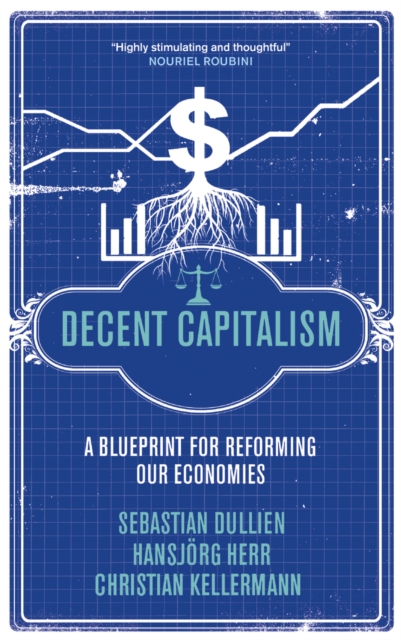
Decent Capitalism
The recent crisis, created by finance capitalism, has brought us to the economic abyss. The excessive freedom of international markets has rapidly transformed into international panic, with states struggling to rescue and bail out a globalised financial sector. Reform is promised by our leaders, but in governments dominated by financial interests there is little hope of meaningful change. Decent Capitalism argues for a response that addresses capitalism’s systemic tendency towards crisis, a tendency which is completely absent from the mainstream debate. The authors develop a concept of a moderated capitalism that keeps its core strengths intact while reducing its inherent destructive political force in our societies. This book argues that reforming the capitalist system will have to be far more radical than the current political discourse suggests. Decent Capitalism is a concept and a slogan that will inspire political activists, trade unionists and policy makers to get behind a package of reforms that finally allows the majority to master capitalism.
eBook