
Catalogue Search | MBRL


Are you sure you want to remove the book from the shelf?

{{itemTitle}}
8
result(s) for
"Dumouchel, Paul, 1951-"
Sort by:


The Ambivalence of Scarcity and Other Essays
First published in French in 1979, \"The Ambivalence of Scarcity\" was a groundbreaking work on mimetic theory. Now expanded upon with new, specially written, and never-before-published conference texts and essays, this revised edition explores René Girard's philosophy in three sections: economy and economics, mimetic theory, and violence and politics in modern societies. The first section argues that though mimetic theory is in many ways critical of modern economic theory, this criticism can contribute to the enrichment of economic thinking. The second section explores the issues of nonviolence and misrecognition (méconnaissance), which have been at the center of many discussions of Girard's work. The final section proposes mimetic analyses of the violence typical of modern societies, from high school bullying to genocide and terrorist attacks. Politics, Dumouchel argues, is a violent means of protecting us from our own violent tendencies, and it can at times become the source of the very savagery from which it seeks to protect us. The book's conclusion analyzes the relationship between ethics and economics, opening new avenues of research and inviting further exploration. Dumouchel's introduction reflects on the importance of René Girard's work in relation to ongoing research, especially in social sciences and philosophy.
eBook
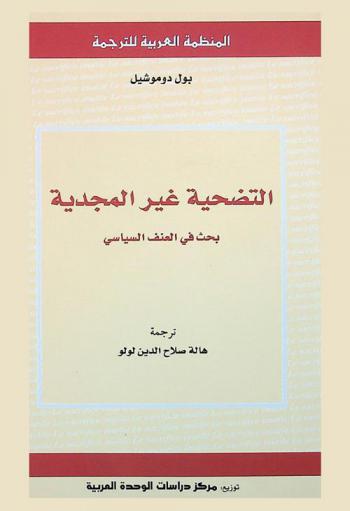
التضحية غير المجدية : بحث في العنف السياسي
يوضح الكتاب أن على الرغم من الحديث عن الأخطار المناخية وشح الغذاء وسيل التنبؤات حول جدب الأرض وغور المياه، غير أن الشبح الأكبر بلا منازع هو (العنف) بكل أشكاله، الإرهابي منه والإجرامي والسياسي وبات ترف أي مجتمع يقاس بمستوى أمنه أولا ؛ ومن ثم تأتي بقية المعايير الأخرى وبرغم مشاهدة أحداث عنف كبيرة بشرق آسيا ومذابح جماعية لا تعقل في أفريقيا وحروب أهلية بالشرق الأوسط ومجازر استثنائية في أوروبا وغالبها عنف عرقي وسياسي، فإن إرهاب الحركات الراديكالية الذي طبع أواخر القرن العشرين وأبحر سابحا بالدماء منذ بدء الألفية الجديدة وإلى اليوم يعتبر أكثر شراسة وذلك لمخاتلته ولطريقة حركته وتجدد خططه، فهو ليس عنفا إجراميا يمكن حصره ولجمه، بل عنف أيديولوجي ليس له هدف مادي دنيوي محدد وإنما يغدو القتل هدفا والانتحار غاية، حتى وإن رفعت شعارات الدولة الإسلامية، أو إقامة نماذج متخيلة من خلافة أو مجتمع حق طاهر يحكم الشريعة. لا تتعلق المسألة بالتحليل الاعتيادي لمعنى العنف ولا التعليل الاجتماعي، أو النفسي، فضلا عن السياسي، بل عن العلاقة بين العنف وفكرته، بين الإرهابي ومقدسه وذلك انطلاقا من أصل التضحية، تلك كانت ميزة مقاربة رينيه جيرار في كتابه (العنف والمقدس) وهو بحث أنثربولوجي يسبر أصول العنف والتضحية ليس انطلاقا من التأويلات للنصوص المؤسسة بل والمتخلقة برحم الثقافات وهو يبحث في العلاقات بين التضحية والمقدس والعنف.
BOOK

Social bonds as freedom
Central to discussions of multiculturalism and minority rights in modern liberal societies is the idea that the particular demands of minority groups contradict the requirements of equality, anonymity, and universality for citizenship and belonging. The contributors to this volume question the significance of this dichotomy between the universal and the particular, arguing that it reflects how the modern state has instituted the basic rights and obligations of its members and that these institutions are undergoing fundamental transformations under the pressure of globalization. They show that the social bonds uniting groups constitute the means of our freedom, rather than obstacles to achieving the universal.
eBook

Living with robots
Living with Robots recounts a foundational shift in the field of robotics, from artificial intelligence to artificial empathy, and foreshadows an inflection point in human evolution. Today's robots engage with human beings in socially meaningful ways, as therapists, trainers, mediators, caregivers, and companions. Social robotics is grounded in artificial intelligence, but the field's most probing questions explore the nature of the very real human emotions that social robots are designed to emulate. Social roboticists conduct their inquiries out of necessity--every robot they design incorporates and tests a number of hypotheses about human relationships. Paul Dumouchel and Luisa Damiano show that as roboticists become adept at programming artificial empathy into their creations, they are abandoning the conventional conception of human emotions as discrete, private, internal experiences. Rather, they are reconceiving emotions as a continuum between two actors who coordinate their affective behavior in real time. Rethinking the role of sociability in emotion has also led the field of social robotics to interrogate a number of human ethical assumptions, and to formulate a crucial political insight: there are simply no universal human characteristics for social robots to emulate. What we have instead is a plurality of actors, human and nonhuman, in noninterchangeable relationships. As Living with Robots shows, for social robots to be effective, they must be attentive to human uniqueness and exercise a degree of social autonomy. More than mere automatons, they must become social actors, capable of modifying the rules that govern their interplay with humans.-- Provided by publisher
Book

The Barren Sacrifice
According to political theory, the primary function of the modern state is to protect its citizens-both from each other and from external enemies. Yet it is the states that essentially commit major forms of violence, such as genocides, ethnic cleansings, and large-scale massacres, against their own citizens. In this book Paul Dumouchel argues that this paradoxical reversal of the state's primary function into violence against its own members is not a mere accident but an ever-present possibility that is inscribed in the structure of the modern state. Modern states need enemies to exist and to persist, not because they are essentially evil but because modern politics constitutes a violent means of protecting us against our own violence. If they cannot-if we cannot-find enemies outside the state, they will find them inside. However, this institution is today coming to an end, not in the sense that states are disappearing, but in the sense that they are increasingly failing to protect us from our own violence. That is why the violent sacrifices that they ask from us, in wars and even in times of peace, have now become barren.
eBook

Utopies, fictions et satires politiques II. Cycle de conférences H-2018. Cahiers Verbatim, volume III
Dès l'Antiquité, puis ensuite à l’âge classique, se développe toute une littérature qui aborde des questions relatives à la politique au travers de récits de fiction, satires ou utopies. Le récit est alors utilisé comme un moyen d’éviter la censure dans l’analyse critique du régime en place ou du discours dominant ; comme une façon de mettre en scène des expériences philosophiques sur des sociétés imaginaires, ou encore comme une manière détournée d’éveiller l’intelligence politique du lecteur.
eBook

The barren sacrifice: an essay on political violence / Paul Dumouchel ; translated by Mary Baker
According to political theory, the primary function of the modern state is to protect its citizens-both from each other and from external enemies. Yet it is the states that essentially commit major forms of violence, such as genocides, ethnic cleansings, and large-scale massacres, against their own citizens. In this book Paul Dumouchel argues that this paradoxical reversal of the state's primary function into violence against its own members is not a mere accident but an ever-present possibility that is inscribed in the structure of the modern state. Modern states need enemies to exist and to persist, not because they are essentially evil but because modern politics constitutes a violent means of protecting us against our own violence. If they cannot-if we cannot-find enemies outside the state, they will find them inside. However, this institution is today coming to an end, not in the sense that states are disappearing, but in the sense that they are increasingly failing to protect us from our own violence. That is why the violent sacrifices that they ask from us, in wars and even in times of peace, have now become barren.
eBook