
Catalogue Search | MBRL


Are you sure you want to remove the book from the shelf?

{{itemTitle}}
10
result(s) for
"Durano, Marina"
Sort by:


Negotiating Boundaries of Power in the Global Governance for Care
The centrality of building care economies as a necessary step towards gender justice requires a reassessment of global economic governance and state-centred multilateralism. Globalized structures of power can no longer be seen solely as matters of political borders of nation-states, which is the traditional remit of foreign policy. Rather than geography, it is negotiations over the boundaries of power that must be interrogated for the possibility of redrawing borders and boundaries as these are expressed in social relations where care functions are performed. Five spheres of engagement are identified and discussed. A short note on limitarianism raises a question about its value in a care economy and how ethics of care links to it.
Journal Article
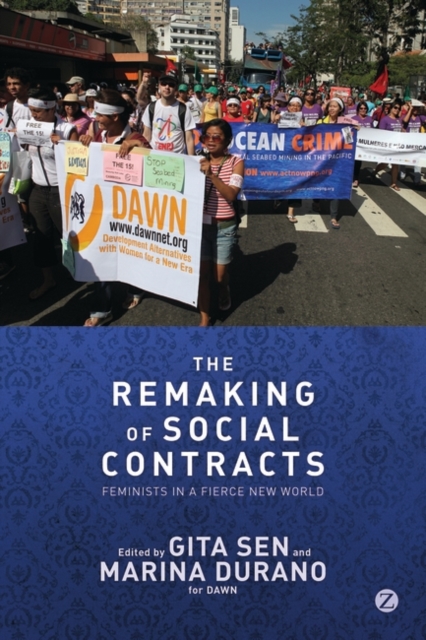
The Remaking of Social Contracts
Development Alternatives with Women for a New Era (DAWN) argues that social contracts must be recreated if they are to fulfil the promise of human rights. In The Remaking of Social Contracts, leading thinkers and activists address a wide range of concerns - global economic governance, militarism, ecological tipping points, the nation state, movement-building, sexuality and reproduction, and religious fundamentalism. These themes are of wide-ranging importance for the survival and well-being of us all, and reflect the many dimensions and inter-connectedness of our lives. Using feminist lenses, the book puts forward a holistic and radical understanding of the synergies, tensions and contradictions between social movements and global, regional and local power structures and processes, and it points to other alternatives and possibilities for this fierce new world.
eBook
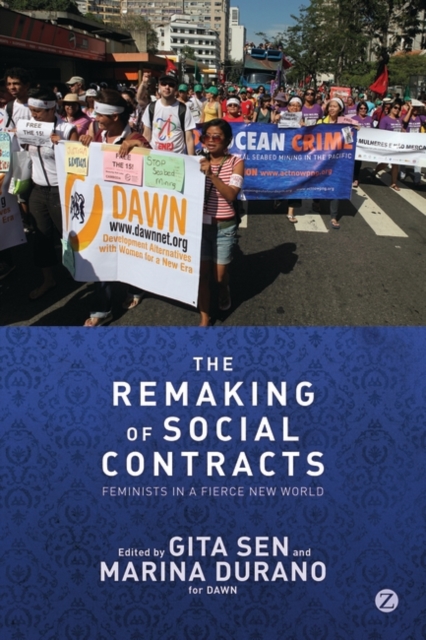
The Remaking of Social Contracts: Global Feminists in the Twenty-First Century
In the context of a powerful analytic framework that takes account of the changing circumstances and issues confronting women at the beginning of the 21st century, this book argues from a feminist perspective for reinventing social contracts to fulfil the promise of human rights.
eBook
A Feminist Perspective on the Follow-Up Process for Financing for Development
The FfD follow-up needs to be the space where UN member states seek to transform the relationship among financial, productive, and socially reproductive spheres of activities into one that fulfills human rights, generates capabilities and reduces global inequality. Enhancing the integration of the various parts of the UN system dealing with human rights and with other key development issues is pivotal to the reform of the international financial architecture. More importantly, women’s empowerment and the meaningful participation of feminists and women’s organizations contribute to the strengthening of the accountability of the multilateral system to humanity.
Journal Article

Gender-equitable public policy
Many commentators see the current global economic and financial crisis as spawning opportunities for reform and transformation for a better world. Specifi- cally reacting to the origins of the crisis, a \"Bretton Woods moment\" has been declared by those seeking structural changes in the international financial archi- tecture. Others have declared the demise of the neoliberal consensus, which was headlined by policies promoting privatization, liberalization and deregulation, and the implementation of structural adjustment programs during the latter decades of the twentieth century.
Book Chapter
Reclaiming Institutional and Policy Space amidst Crisis
Marina Durano, Gigi Francisco and Gita Sen representing Development Alternatives with Women for a New Era (DAWN) argue that the critical question now is not only policies to overcome the current crisis, but also which global institutions should play what roles. They argue that in this time of unprecedented crisis, the UN in order to play a renewed and vigorous role needs women as much as women have historically needed the UN.
Journal Article
Rights and Capabilities: Reading the Philippines Magna Carta of Women from the Perspective of the Capabilities Approach
The Magna Carta of Women (R.A. 7910) is the Philippines comprehensive women's human rights law. The Magna Carta of Women is found to be consistent with Rawlsian notions of justice, particularly when it undertakes inequality evaluation in primary goods. Identity-based inequality evaluation is also present in the Magna Carta of Women as implied in its definition of discrimination and marginalization. With the state as the primary duty bearer, the Magna Carta of Women gives prominence to an instrumental view of agency since participation is mediated through state mechanisms and institutions. The Magna Carta of Women fails to acknowledge the contributions of care work and the implications of the gendered division of labor. The capabilities approach highlights the challenges attached to these observations. Where human rights are viewed as ethical demands, the MCW succeeds in giving attention to aspects of women's lives that require state support.
Paper

Three Perspectives on Institutions and the Trade in Services
The rise of the services sector in the developed countries of the North is attributed to increased outsourcing of services by manufacturing and the international fragmentation of production to developing countries in the South. This phenomenon has led to the creation of a new type of centre-periphery relations called knowledge-intensive industrial dependency of the South. A manifestation of this dependency is the segmentation of the global labour market along skill and mobility lines. The knowledge-intensive services sector of the North fills their labour shortages with highly skilled labour from the South. This demand is providing the impetus for the liberalisation of regulations on the temporary movement of persons. Meanwhile, the internationally immobile labour of the South is the low-skilled labour needed for the requirements of the fragmented production blocks controlled in the North. These production blocks are coordinated by the service links that comprise the trade in services. These service links also require highly mobile skilled labour adding to their demand. Outsourcing is the result of make-or-buy decisions of firms in the North. The Coasean theory of firm is used to analyse the conceptual basis for classifying international factor movements as trade in services. A tangible good is distinguished from an intangible service action and vertical integration distinguishes actions performed by labour from actions performed by service suppliers. Product and process are indistinguishable in services so that by the rules of origin of tradable commodities, services are non-tradable. Thus, the conceptual basis of the GATS becomes questionable and the political underpinnings of trade negotiations are highlighted. The GATS was formulated to facilitate capital movements for the establishment of production blocks and service links as well as to facilitate the release of highly skilled labour from migration constraints. An empirical test on whether regulatory measures are trade barriers for the movement of skilled labour shows that migration laws are binding constraints. While occupational licensing deters the mobility of migrants, its negative impact is overpowered by the pull factor of per capita income. Negotiations in the GATS concentrating on the minimisation of domestic regulation will not meet the stated objective of liberalisation because migration rules are more important for the liberalisation of the movement of persons. Prioritising domestic regulation is meant to ensure that the quality of skilled labour is standardised before migration rules are brought down. These developments only serve to lock the South into a state of knowledge-intensive industrial dependence with the North.
Dissertation