
Catalogue Search | MBRL


Are you sure you want to remove the book from the shelf?

{{itemTitle}}
185
result(s) for
"Duranti, Alessandro"
Sort by:


The Handbook of Language Socialization
Documenting how in the course of acquiring language children become speakers and members of communities, The Handbook of Language Socialization is a unique reference work for an emerging and fast-moving field.
* Spans the fields of anthropology, education, applied linguistics, and human development
* Includes the latest developments in second and heritage language socialization, and literary and media socialization
* Discusses socialization across the entire life span and across institutional settings, including families, schools, work places, and churches
* Explores data from a multitude of cultures from around the world
eBook


A companion to linguistic anthropology
A Companion to Linguistic Anthropology provides a series of in-depth explorations of key concepts and approaches by some of the scholars whose work constitutes the theoretical and methodological foundations of the contemporary study of language as culture.
Provides a definitive overview of the field of linguistic anthropology, comprised of original contributions by leading scholars in the field
Summarizes past and contemporary research across the field and is intended to spur students and scholars to pursue new paths in the coming decades
Includes a comprehensive bibliography of over 2000 entries designed as a resource for anyone seeking a guide to the literature of linguistic anthropology
eBook
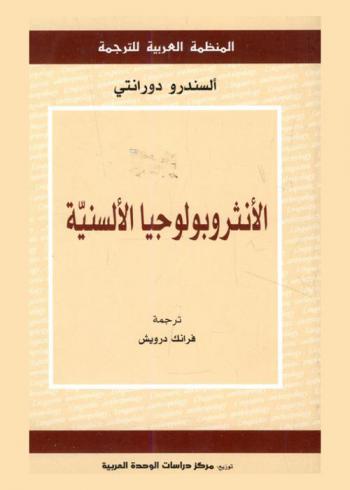
الأنثروبولوجيا الألسنية
في هذا الكتاب المبدع، يعرف ألسندرو دورانتي بالأنثروبولوجيا الألسنية كحقل معرفة متشعب، يهتم بدراسة اللغة كمصدر ثقافي والكلام كممارسة ثقافية. يعرف المؤلف بنظريات ومناهج الأنثروبولوجيا الألسنية في حديثه عن التنوع اللغوي، والنحو في الاستعمال، ودور الكلام في التفاعل الاجتماعي، وتنظيم التركيبات التحادثية ومعانيها، وفكرة المشاركة كوحدة تحليلية. وهو يكرس فصلا كاملا لمفهوم الثقافة. كما نجد فصولا قيمة عن مناهج الأثنوغرافيا والنسخ. وسيجد الطلاب المبتدئون وطلاب الدراسات العليا كتاب الأنثروبولوجيا الألسنية مميزا ومبدعا، وفي الوقت نفسه شديد الوضوح وسهل القراءة.
BOOK

Universal and Culture-Specific Properties of Greetings
The literature on greetings includes several commonly made claims that require an agreed-upon definition of what constitutes a greeting exchange. I propose six criteria for identifying greetings across languages and speech communities. Applying these criteria to a speech community in Western Samoa, I identify four types of greeting exchanges there. These exchanges show, contra claims in the greetings literature, that not all greetings are devoid of propositional content and that they need not be \"expressive\" acts of the type proposed by speech act theory. In greetings, Samoans accomplish various social acts, including searching for new information and sanctioning social behavior.
Journal Article
The Relevance of Husserl's Theory to Language Socialization
This article suggests that the theory of language socialization could benefit from adopting some key concepts originally introduced by the philosopher Edmund Husserl in the first part of the twentieth century. In particular, it focuses on Husserl's notion of \"(phenomenological) modification,\" to be understood as a change in \"the natural attitude\" that humans have toward the phenomenal world, their own actions included. After providing examples of different kinds of modifications in interpreting language and listening to music, Husserl's notion of \"theoretical attitude\" (a modification of \"the natural attitude\") is introduced and shown to be common in adult conversations as well as in interactions between adults and young children. A reanalysis of an exchange previously examined by Platt (1986) between a Samoan mother and her son is provided to show the benefits of an integration of phenomenological and interactional perspectives on adult-child discourse. Finally, it is suggested that the failure sometimes experienced by children and adults to adopt new ways of being may be due to the accumulated effects of modifications experienced earlier in life which make it difficult if not impossible to retrieve earlier, premodificational ways of being.
Journal Article

Narrating the political self in a campaign for U.S. Congress
On the basis of data collected during a year-long study of a
Congressional campaign in California in the mid-1990s, this article uses
semantic, pragmatic, and narrative analysis to show how candidates for
political office construct and defend the coherence of their actions,
including their choice to run for office. First, semantic and pragmatic
analysis is used to discuss two charges of lack of coherence against one
candidate. Second, three discursive strategies used by candidates for
building existential coherence are identified: (i) constructing a
narrative of belonging; (ii) casting the present as a natural extension of
the past; and (iii) exposing potential contradictions in order to show how
to solve them. After examining the extent to which each strategy is common
across candidates and situations, it is shown that candidates who frame
themselves as “independent” tend to use these strategies more
than those who choose to identify more closely with a party's
platform and ideology.The research on which
this article is based was in part supported by two small grants from the
University of California, Los Angeles (UCLA) in 1996–1997 and
1997–1998, and by a John Simon Guggenheim Foundation Fellowship
supplemented by funds from UCLA during the 1999–2000 academic year.
An earlier version of this article was presented at the Discourse Lab in
the Department of Anthropology at UCLA on 2 June 2004. I thank my
colleagues and students for their generous feedback and comments. Among my
research assistants over the years, special thanks go to Jeff Storey,
Sarah Meacham, and Jennifer Reynolds for their help in transcribing the
talk in dozens of videotapes I recorded. I am also indebted to Anjali
Browning for her careful reading of the first draft of this article. Some
of the data and ideas presented in this article were first introduced in a
number of seminars, workshops, and conferences at the University of Rome
“La Sapienza,” the University of Florence, and the University
of California at Santa Barbara. I would like to thank the participants in
those events for their engagement with this material and their comments. I
am also grateful to Jane Hill, former editor of Language in
Society, and three anonymous reviewers for specific suggestions on
how to improve the organization and content of the
article. A number of people made the
project on which this article is based possible and a rewarding
experience. First and foremost, I am deeply indebted to the late Walter
Capps and to his wife Lois Capps – now Rep. Lois Capps
(D-California) – and to their extended family for letting me enter
their home and giving me access to their lives as they experienced an
extraordinary series of events. I am also very grateful to Walter's
brother, Doug Capps, who was Walter's campaign manager in 1996 and
has continued over the years to be my liaison with the rest of the Capps
family. Others members of the Capps-for-Congress campaign staff I could
rely on for information include Bryant Wieneke, always most generous with
his time, Steve Boyd, Thu Fong, and Lindsey Capps. After Walter
Capps's death, I benefited from conversations with Capps's
colleague and friend Richard Hecht, professor and former chair of the
Department of Religious Studies at UCSB. I am also grateful to the
1995–1996 Independent candidate Steven Wheeler, who, in June 1998,
consented to meet with me and to being interviewed. This project was born
out of conversations with Walter Capps's daughter Lisa while she was
a graduate student at UCLA. She remained a strong supporter of my efforts
to capture her father's adventure in politics after she accepted a
position in psychology at the University of California, Berkeley, and even
during the last year of her life, as she struggled with cancer. This
article is dedicated to her memory.
Journal Article

Linguistic Anthropology
In this textbook, first published in 1997, Alessandro Duranti introduces linguistic anthropology as an interdisciplinary field which studies language as a cultural resource and speaking as a cultural practice. The theories and methods of linguistic anthropology are introduced through a discussion of linguistic diversity, grammar in use, the role of speaking in social interaction, the organisation and meaning of conversational structures, and the notion of participation as a unit of analysis. An entire chapter is devoted to the notion of culture, and there are invaluable methodological chapters on ethnography and transcription. Original in its treatment and yet eminently clear and readable, Linguistic Anthropology will appeal to both upper-level undergraduate and graduate students.
eBook
Action and its parts
The concept of action (hereafter “CoA”) by Nick Enfield and Jack Sidnell is a welcome discussion of two key theoretical and methodological issues in the study of language-mediated interaction, namely, (a) whether or not speakers need access to an inventory of types of acts in order to produce or respond to a meaningful act (in the form of an utterance or gesture or combination of the two), and (b) the impact of language-specific grammatical or lexical forms (e.g., words, pronouns, particles, tense-aspect markers) on how speakers understand or carry out a particular type of action (e.g., agreeing, requesting, claiming previous knowledge). [...]the nature of indexes (e.g., address forms, pointing gestures, regional accents) is such that they “may be transposed from the current context into other ones, recalled, imagined or merely projected” (Hanks 2001: 121, emphasis added). There has also been criticism for the exclusive focus on “interaction” or “talk-in-interaction” (Schegloff 1988)—as opposed to “society,” “language,” “mind,” “power,” “inequality,” and other concepts traditionally studied by social or cognitive scientists—as well as for the rejection by most conversation analysts of findings based on traditional methods like participant-observation, elicitation, interviews, or sampling techniques. According to this approach, participants do not need to know or decide the type of act of a particular utterance because its interpretation is distributed across semiotic and material resources such that no one participant or “agent” is in full control.
Journal Article