
Catalogue Search | MBRL


Are you sure you want to remove the book from the shelf?

{{itemTitle}}
204
result(s) for
"Durgnat, Raymond"
Sort by:

A mirror for England : British movies from austerity to affluence
\"Raymond Durgnat's classic study of British films from the 1940s to the 1960s, first published in 1970, remains one of the most important books ever written on British cinema. In his introduction, Kevin Gough-Yates writes: 'Even now, it astounds by its courage and its audacity; if you think you have an 'original' approach to a filmor a director's work and check it against A Mirror for England, you generally discover that Raymond Durgnat had said it already.' Durgnat himself said about the book that 'the main point was arranging a kind of rendezvous between thinking about movies and thinking, not so much about sociology, as about the experiences that people are having all the time.' Durgnat used Mirror to assert the validity of British cinema against its dismissal by the critics of Cahiers du cinâema and Sight and Sound. His analysis takes in classics such as In Which We Serve (1942), A Matter of Life and Death (1946) and The Blue Lamp (1949), alongside 'B' films and popular genres such as Hammer horror. Durgnat makes a cogent and compelling case for the success of British films in reflecting British predicaments, moods and myths, at the same time as providing some disturbing new insights into a national character by whose enigmas and contradictions we continue to be perplexed and fascinated\"-- Provided by publisher.
Book
A Long Hard Look at 'Psycho'
Upon its release in 1960, Alfred Hitchcock's Psycho divided critical opinion, with several leading film critics condemning Hitchcock's apparent encouragement of the audience's identification with the gruesome murder that lies at the heart of the film. Such antipathy did little to harm Psycho's box-office returns, and it would go on to be acknowledged as one of the greatest film thrillers, with scenes and characters that are among the most iconic in all cinema. In his illuminating study of Psycho, Raymond Durgnat provides a minute analysis of its unfolding narrative, enabling us to consider what happens to the viewer as he or she watches the film, and to think afresh about questions of spectatorship, Hollywood narrative codes, psycho-analysis, editing and shot composition. In his introduction to the new edition, Henry K. Miller presents A Long Hard Look at 'Psycho' as the culmination of Durgnat's decades-long campaign to correct what he called film studies' 'Grand Error'. In the course of expounding Durgnat's root-and-branch challenge to our inherited shibboleths about Hollywood cinema in general and Hitchcock in particular, Miller also describes the eclectic intellectual tradition to which Durgnat claimed allegiance. This band of amis inconnus, among them William Empson, Edgar Morin and Manny Farber, had at its head Durgnat's mentor Thorold Dickinson. The book's story begins in the early 1960s, when Dickinson made the long hard look the basis of his pioneering film course at the Slade School of Fine Art, and Psycho became one of its first objects.
eBook

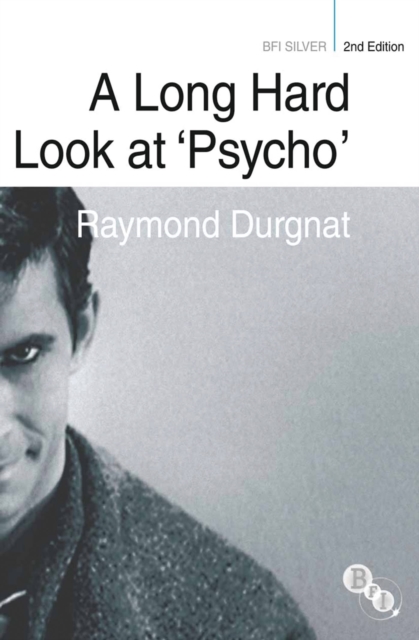
A Long Hard Look at ‘Psycho’
Upon its release in 1960, Alfred Hitchcock's Psycho divided critical opinion, with several leading film critics condemning Hitchcock's apparent encouragement of the audience's identification with the gruesome murder that lies at the heart of the film. Such antipathy did little to harm Psycho's box-office returns, and it would go on to be acknowledged as one of the greatest film thrillers, with scenes and characters that are among the most iconic in all cinema. In his illuminating study of Psycho, Raymond Durgnat provides a minute analysis of its unfolding narrative, enabling us to consider what happens to the viewer as he or she watches the film, and to think afresh about questions of spectatorship, Hollywood narrative codes, psycho-analysis, editing and shot composition. In his introduction to the new edition, Henry K. Miller presents A Long Hard Look at ‘Psycho’ as the culmination of Durgnat's decades-long campaign to correct what he called film studies' ‘Grand Error’. In the course of expounding Durgnat's root-and-branch challenge to our inherited shibboleths about Hollywood cinema in general and Hitchcock in particular, Miller also describes the eclectic intellectual tradition to which Durgnat claimed allegiance. This band of amis inconnus, among them William Empson, Edgar Morin and Manny Farber, had at its head Durgnat's mentor Thorold Dickinson. The book's story begins in the early 1960s, when Dickinson made the long hard look the basis of his pioneering film course at the Slade School of Fine Art, and Psycho became one of its first objects.
eBook


Tonite Let's All Make Love in London Review, Films and Filming, 1968
Some of the other interviewers are less enlightening (Andrew Oldham, Mick Jagger, Julie Christie) not because their thought isn't sensible, but because the easy En glish use of words is rooted in social and moral outlooks which no longer apply. [...]Alan Aldridge, shown painting fl ower and butterfl y patterns on a girl's nude body, is asked if he doesn't think it's \"psychic masturbation,\" and can respond only with a sceptical shrug.3 The best accounts of themselves are given by the artists. David Hockney is almost the star of the fi lm- apart, of course, from the camera- and Edna O'Brien is quite interesting- though not more so than the anonymous Cockney dollygirl who, having no image to bother about, just declares she doesn't believe in love, and draws all the common sense conclusions as to how a girl ought to behave.4 One might have expected the freer, more varied canvas of a whole generation to have provided a \"bigger\" fi lm than the poetry reading of Wholly Communion. Personally, I can't help wishing Whitehead had printed the introductory credits over that extraordinary fi lm of his which was part of Oh! at the Jeanetta Cochrane Theatre- when he simply took his colour camera down the underground and fi lmed all the real- life people, looking so strangely cowed and tired, as if all the responsiveness had been drained from them, into the neon- signs.5 And it might have fi tted the \"hall of mirrors\" effect of the electric media to have fi lmed himself fi lming, and preparing his interviewers for the actual interviews, or lightly skating over the shadows . . The idea of \"tromboning\" the zoom lens to and fro in time to the strains of the national anthem is another example of Whitehead's brilliant improvisations; his approach to editing is (whether in the camera or at the machine) much as George Martin and the Beatles use the sound produced by their instruments, playing it backwards, recutting it, using fuzz and reverberations as part of the sound, switching speed and pitch.
Journal Article
Wholly Communion: Films and Filming Review, 1966
Some roughnesses of reporting, concentrated mainly in the fi rst half of the fi lm, help to recapture the actual atmosphere of the occasion, which was as improvised as a jam- session; and the fi lm is not just a newsreel so much as a piece of cinéma- vérité, as it penetrates, through the \"event,\" to feelings and hopes, as in the spirited exchanges between the chairman (Alexander Trocchi), a heckling spectator, and the poet Harry Fainlight, anguishedly [sic] persevering in reading his brilliant and nightmarish anti- epic of LSD visions, \"The Spider.\" [...]there is a long, astonishing sequence where Allen Ginsberg's reading is accompanied by the strange, writhing, haunting movements, something between hand- jive and Swan Lake, performed by an anonymous, lovely girl in the audience, movements which, more eloquently than any ballet, because of their very naturalness, are terrifying in their quiet revelation of anguish, beautiful in their abstruse, serene generosity, and poignantly eerie in their combination of the two moods. In an atmosphere encouraging of wild effects, the camera is admirably restrained; there are no unnecessary zoom- shots (except one or two where the photographer was having to guess what would happen next), the use of \"frozen- frame\" is discriminatingly linked to the poetic text, the moments of black screen are very successful, and the fade- out line both witty and touching.
Journal Article