
Catalogue Search | MBRL


Are you sure you want to remove the book from the shelf?

{{itemTitle}}
26
result(s) for
"Dwyre, Diana"
Sort by:

The Origin and Evolution of Super PACs: a Darwinian Examination of a Campaign Finance Species
A series of campaign finance rulings, most notably the Supreme Court’s 2010 Citizens United decision, set off a sea change in how electoral politics are funded in the United States. The result is an evolutionary break that disrupted the campaign finance environment in ways that allowed a new species of organization, the super PAC, to thrive. Other traditional campaign finance organizations, such as political parties and political action committees, have not adapted as well and now play a reduced role relative to the new “super species.”
Journal Article
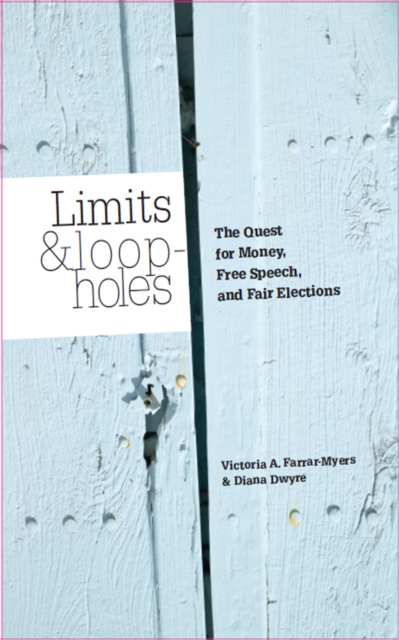
Limits and loopholes : the quest for money, free speech, and fair elections
From the authors of Legislative Labyrinth: Congress and Campaign Finance Reform. Elections, the basic mechanism of representative democracy, should be untainted by corruption and provide a platform for free speech. But running for office takes money--a lot of it, usually--which means campaign finance has become a pitched battle over the fundamental political values of free speech versus fair elections. With insiders′ perspectives, Farrar-Myers and Dwyre tell the story of what it took to pass campaign finance legislation, provide analysis of the subsequent court action, and explore the regulatory and electoral outcomes of reform efforts. Limits and Loopholes is a story about incremental policymaking and inter-branch struggle, about institutional design and unintended consequences, about the influence of interest groups and the media, and about the health of our representative democracy. Bringing together discussions of core values and the policymaking process, this book serves as an excellent case study that traces an issue from inception, through legislation and litigation, and finally to implementation.
eBook
Party Money in the 2012 Elections
Although many commentators predicted that political parties in America would be weakened by the passage of the Bipartisan Campaign Reform Act of 2002 (BCRA), American parties proved their ability to adapt to changing legal, technical, economic, and political circumstances. Despite receiving minimal press, political parties continued to play a pivotal role in the financing and conduct of the 2012 elections. Parties received little attention in part because of the media obsession with Super PACs—their creation and their activities in the 2012 elections. Owing to a fundamental misunderstanding of the termcorporationand the avenues already available to corporations to
Book Chapter

Spinning Straw into Gold: Soft Money and U. S. House Elections
Our understanding of congressional campaign finance and party behavior is incomplete because scholars have not yet examined the millions spent in soft money by the national parties. This analysis of soft-money spending shows that federalism and campaign finance regulations provide both opportunities and constraints that influence the parties' ability to turn soft-money \"straw\" into hard-money \"gold.\" A party's level of hard-money wealth significantly shapes how it spends soft money and helps explain why the parties pursue different strategies. The analysis suggests that the parties play a larger role in congressional campaign finance than has been previously reported, since parties spend soft money in ways that can benefit House candidates.
Journal Article

Financing the 2000 Election
Since the 1960 national election, the nonpartisan Citizens¡¯ Research Foundation (CRF) has published a series of Financing the Election volumes, compiling reliable data on the costs and trends of campaign finance. For the 2000 edition, CRF and the Center for the Study of Elections and Democracy at Brigham Young University assembled leading political science scholars to analyze this historic election season where campaign finance was critically important. Candice J. Nelson of American University compares spending estimates in 2000 with previous election cycles, and discusses the implications of increased spending. John C. Green and Nathan S. Bigelow of the Roy Bliss Institute at the University of Akron look at the presidential nomination campaigns, while Anthony Corrado of Colby College explores the financing of the general election, including the unprecedented Florida recount battle. Paul S. Herrnson of the University of Maryland and Kelly D. Patterson of Brigham Young University review the close party balance in the House and Senate and its effect on the financing of congressional elections. Diana Dwyre of California State University-Chico and Robin Kolodny of Temple University put the role of political parties and their use of soft money in perspective. Alan J. Cigler of the University of Kansas investigates the ways interest groups attempt to influence elections. Anthony Gierzynski of the University of Vermont analyzes the impact of redistricting on gubernatorial and state legislative elections, while Roy A. Schotland of Georgetown University Law School examines the recent history and rising costs of judicial campaigns. Finally, Thomas Mann of the Brookings Institution discusses lessons the 2000 elections should teach us about the realities of financing elections and the implications for reform that emerged from this remarkable election. In setting forth the contours of American political finance, Financing the 2000 Election provides a unique resource for students of elections, reformers, journalists, and interested citizens.
eBook

A New Rule Book
For all the challenges of the 2004 elections, political party organizations at the national, state, and local levels came through the experience with an impressive adaptability. The long-promised campaign finance reform bill signed into law in March 2002 for the 2004 campaign cycle left party committees facing many uncertainties. Although they had the law’s provisions before them to help guide their fundraising and expenditure planning, they would spend much of 2003 waiting for court decisions and specific rules from the Federal Election Commission (FEC) to see if their plans would still be legal. Consequently, the cycle was filled with dire
Book Chapter
Throwing Out the Rule Book
After the 1996 election, the political parties’ campaign finance activities were characterized as “spitting on the umpire” because of the major parties’ “contempt” for the Federal Election Commission’s (FEC) attempts to enforce the rules governing campaign finance.¹ The parties got around many of those rules and stretched the limits of the law. In 2000 the parties went even further. The major parties threw out the rule book altogether by conducting a good deal of campaign finance activities outside of the campaign finance laws. This marked a turning point in party campaign finance, characterized not by a real change in the
Book Chapter