
Catalogue Search | MBRL


Are you sure you want to remove the book from the shelf?

{{itemTitle}}
19
result(s) for
"Eco, Umberto author"
Sort by:

Chronicles of a liquid society
Posthumously collects short essays from the author that reflect on the changing modern world, touching on such topics as popular culture, politics, being seen, conspiracies, the old and the young, new technologies, mass media, racism, and good manners.
Book

Confessions of a Young Novelist
Umberto Eco published his first novel, The Name of the Rose, in 1980, when he was nearly fifty. In these \"confessions,\" the author, now in his late seventies, looks back on his long career as a theorist and his more recent work as a novelist, and explores their fruitful conjunction.
He begins by exploring the boundary between fiction and nonfiction—playfully, seriously, brilliantly roaming across this frontier. Good nonfiction, he believes, is crafted like a whodunnit, and a skilled novelist builds precisely detailed worlds through observation and research. Taking us on a tour of his own creative method, Eco recalls how he designed his fictional realms. He began with specific images, made choices of period, location, and voice, composed stories that would appeal to both sophisticated and popular readers. The blending of the real and the fictive extends to the inhabitants of such invented worlds. Why are we moved to tears by a character's plight? In what sense do Anna Karenina, Gregor Samsa, and Leopold Bloom \"exist\"?
At once a medievalist, philosopher, and scholar of modern literature, Eco astonishes above all when he considers the pleasures of enumeration. He shows that the humble list, the potentially endless series, enables us to glimpse the infinite and approach the ineffable. This \"young novelist\" is a master who has wise things to impart about the art of fiction and the power of words.
eBook

The book of legendary lands
\"A fascinating illustrated tour of the fabled places in literature and folklore that have awed, troubled, and eluded us through the ages\"--Provided by publisher.
Book

From the tree to the labyrinth : historical studies on the sign and interpretation
How we create and organize knowledge is the theme of this major achievement by Umberto Eco. Demonstrating once again his inimitable ability to bridge ancient, medieval, and modern modes of thought, he offers here a brilliant illustration of his longstanding argument that problems of interpretation can be solved only in historical context.
eBook

Numero zero
From the author of The Name of the Rose and The Prague Cemetery, a novel about the murky world of media politics, conspiracy, and murder.
Book

How to Write a Thesis
By the time Umberto Eco published his best-selling novelThe Name of the Rose, he was one of Italy's most celebrated intellectuals, a distinguished academic and the author of influential works on semiotics. Some years before that, in 1977, Eco published a little book for his students,How to Write a Thesis, in which he offered useful advice on all the steps involved in researching and writing a thesis -- from choosing a topic to organizing a work schedule to writing the final draft. Now in its twenty-third edition in Italy and translated into seventeen languages,How to Write a Thesishas become a classic. Remarkably, this is its first, long overdue publication in English. Eco's approach is anything but dry and academic. He not only offers practical advice but also considers larger questions about the value of the thesis-writing exercise.How to Write a Thesisis unlike any other writing manual. It reads like a novel. It is opinionated. It is frequently irreverent, sometimes polemical, and often hilarious. Eco advises students how to avoid \"thesis neurosis\" and he answers the important question \"Must You Read Books?\" He reminds students \"You are not Proust\" and \"Write everything that comes into your head, but only in the first draft.\" Of course, there was no Internet in 1977, but Eco's index card research system offers important lessons about critical thinking and information curating for students of today who may be burdened by Big Data.How to Write a Thesisbelongs on the bookshelves of students, teachers, writers, and Eco fans everywhere. Already a classic, it would fit nicely between two other classics:Strunk and WhiteandThe Name of the Rose.This MIT Press edition will be available in three different cover colors.ContentsThe Definition and Purpose of a ThesisChoosing the TopicConducting ResearchThe Work Plan and the Index CardsWriting the ThesisThe Final Draft
eBook
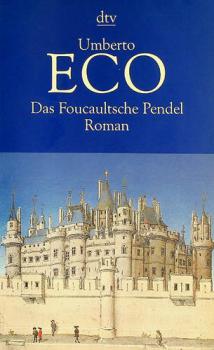
Das Foucaultsche Pendel : Roman
Italienischer Autor (1932-2016). - Die ebenso anspruchsvolle wie komplizierte Geschichte einer angeblichen \"Weltverschwèorung\", die ihren Entdeckern zum Verhèangnis wird.

On the Medieval Theory of Signs
In the course of the long debate on the nature and the classification of signs, from Boethius to Ockham, there are at least three lines of thought: the Stoic heritage, that influences Augustine, Abelard, Francis Bacon; the Aristotelian tradition, stemming from the commentaries on De Interpretatione; the discussion of the grammarians, from Priscian to the Modistae. Modern interpreters are frequently misled by the fact that the various authors regularly used the same terms. Such a homogeneous terminology, however, covers profound theoretical differences. The aim of these essays is to show that the medieval theory of signs does not represent a unique body of semiotic notions: there are diverse and frequently alternative semiotic theories. This book thus represents an attempt to encourage further research on the still unrecognized variety of the semiotic approaches offered by the medieval philosophies of language.
eBook

The name of the rose
In 1327, finding his sensitive mission at an Italian abbey further complicated by seven bizarre deaths, Brother William of Baskerville turns detective.
Book

Serendipities
Best-selling author Umberto Eco's latest work unlocks the riddles of history in an exploration of the \"linguistics of the lunatic,\" stories told by scholars, scientists, poets, fanatics, and ordinary people in order to make sense of the world. Exploring the \"Force of the False,\" Eco uncovers layers of mistakes that have shaped human history, such as Columbus's assumption that the world was much smaller than it is, leading him to seek out a quick route to the East via the West and thus fortuitously \"discovering\" America. The fictions that grew up around the cults of the Rosicrucians and Knights Templar were the result of a letter from a mysterious \"Prester John\" -- undoubtedly a hoax -- that provided fertile ground for a series of delusions and conspiracy theories based on religious, ethnic, and racial prejudices. While some false tales produce new knowledge (like Columbus's discovery of America) and others create nothing but horror and shame (the Rosicrucian story wound up fueling European anti-Semitism) they are all powerfully persuasive.
In a careful unraveling of the fabulous and the false, Eco shows us how serendipities -- unanticipated truths -- often spring from mistaken ideas. From Leibniz's belief that the I Ching illustrated the principles of calculus to Marco Polo's mistaking a rhinoceros for a unicorn, Eco tours the labyrinth of intellectual history, illuminating the ways in which we project the familiar onto the strange.
Eco uncovers a rich history of linguistic endeavor -- much of it ill-conceived -- that sought to \"heal the wound of Babel.\" Through the Middle Ages and the Renaissance, Greek, Hebrew, Chinese, and Egyptian were alternately proclaimed as the first language that God gave to Adam, while -- in keeping with the colonial climate of the time -- the complex language of the Amerindians in Mexico was viewed as crude and diabolical. In closing, Eco considers the erroneous notion of linguistic perfection and shrewdly observes that the dangers we face lie not in the rules we use to interpret other cultures but in our insistence on making these rules absolute.
With the startling combination of erudition and wit, bewildering anecdotes and scholarly rigor that are Eco's hallmarks,Serendipitiesis sure to entertain and enlighten any reader with a passion for the curious history of languages and ideas.
eBook