
Catalogue Search | MBRL


Are you sure you want to remove the book from the shelf?

{{itemTitle}}
114
result(s) for
"Egan, Gabriel"
Sort by:

Shakespeare and ecocritical theory
\"Combining the latest scientific and philosophical understanding of humankind's place in the world with interpretative methods derived from other politically inflected literary criticism, ecocriticism is providing new insights into literary works both ancient and modern. With case-study analyses of the Tragedies, the Comedies, the History Plays and the late Romances as well as the Sonnets, this book is a wide-ranging introduction to reading Shakespeare in light of contemporary ecocritical theory. Shakespeare and Ecocritical Theory also features a glossary of key critical terms and guides to further reading and online resources, making this an essential resource for students and scholars of Shakespeare at all levels\"-- Provided by publisher.
Book

Changes in the length of speeches in the plays of William Shakespeare and his contemporaries: A mixed models approach
Since 2007 a number of investigators have compiled statistics on the length in words of speeches in plays by William Shakespeare and his contemporaries, focusing on a change to shorter speeches around 1600. In this article we take account of several potentially confounding factors in the variation of speech lengths in these works and present a model of this variation in the period 1538–1642 through Linear Mixed Models. We confirm that the mode of speech lengths in English plays changed from nine words to four words around 1600, and that Shakespeare’s plays fit this wider pattern closely. We establish for the first time: that this change is independent of authorship, dramatic genre, theatrical company, and the proportion of verse in a play’s dialogue; that the chosen time span can be segmented into pre-1597 plays (with high modes), 1597–1602 plays (with mixed high and low modes), and post-1602 plays (with low modes); that some additional secondary modes are evident in speech lengths, at 16 and 24 words, suggesting that the length of a standard blank verse line (around 8 words) is an underlying unit in speech length; and that the general change to short speeches also holds true when the data is viewed through the perspective of the median and the mean. The change in speech lengths is part of a collective drift in the plays towards liveliness and verisimilitude and is evidence of a hitherto hidden constraint on the playwrights: whether or not they were aware of the fact, playwrights as a group were conforming to a structure for the distribution of speech lengths peculiar to the era they were writing in. The authors hope that the full modelling of this variation in the article will help bring this change to the attention of scholars of Shakespeare and his contemporaries.
Journal Article
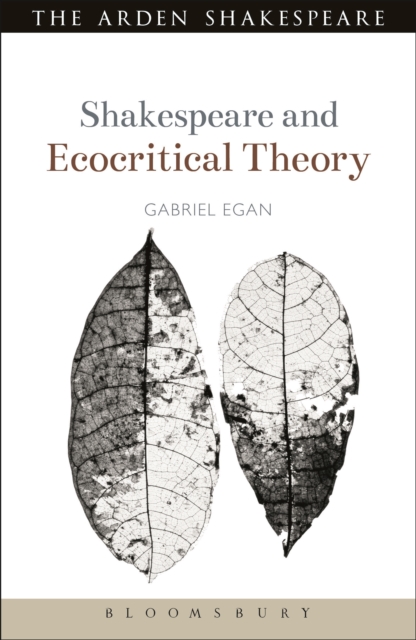
Shakespeare and ecocritical theory
Combining the latest scientific and philosophical understanding of humankind's place in the world with interpretative methods derived from other politically inflected literary criticism, ecocriticism is providing new insights into literary works both ancient and modern.
eBook


Shakespeare and Marx
Marxist cultural theory underlies much teaching and research in university departments of literature and has played a crucial role in the development of recent theoretical work. Feminism, New Historicism, cultural materialism, postcolonial theory, and queer theory all draw upon ideas about cultural production which can be traced to Marx, and significantly each also has a special relation with Renaissance literary studies. This book explores the past and continuing influence of Marx’s ideas in work on Shakespeare. Marx’s ideas about cultural production and its relation to economic production are clearly explained, together with the standard terminology and concepts such as base/superstructure, ideology, commodity fetishism, alienation, and reification. The influence of Marx’s ideas on the theory and practice of Shakespeare criticism and performance is traced from the Victorian age to the present day. The continuing importance of these ideas is illustrated via new Marxist readings of King Lear, hamlet, The Merchant of Venice, Timon of Athens, The Comedy of Errors, All’s Well that Ends Well, and The Winter’s Tale.
eBook
The Closure of the Theatres
The closing of the theatres in1642looks, from one perspective, like the silencing of aradicalcultural form that had for sixty-six years dramatized early modern Londoners' debates about life, God, government, sex and other pressing concerns. But literary historians are not agreed about whether the drama itself promoted any particular line —subversiveorconservative— in these debates, and some theatre historians see in the form of theatre as much as the content its power to challenge dominant ideas. This article reconsiders the reasons for the closure of the theatres and the aftermath of this action in theInterregnumthat followed. Just what did it mean forEnglish societyto find itself without this forum for ideas? And what happened to those players, playwrights, and shareholders in the immediate aftermath? Some key figures were still around and ready to resume their old roles when the theatres reopened in1660.
Journal Article

Attributing the Authorship of the \Henry VI\ Plays by Word Adjacency
Brian Vickers's method is essentially the same except that, rather than running every short phrase in his sample text through the search engine by hand, he relies on plagiarism detection software to find the matches between the sample and the large corpus of solidly attributed works. To separate them out reduces language to a severely limited lexicon.5 One reason that Craig, Burrows, and Kinney count words rather than phrases and collocations is that the process may be computerized by well-defined and publicly declared algorithms rather than relying upon the investigator to perform manual searches, as Jackson does, or depending upon the operation of an unpublished plagiarism-detection algorithm, as Vickers does.
Journal Article