
Catalogue Search | MBRL


Are you sure you want to remove the book from the shelf?

{{itemTitle}}
14
result(s) for
"El-Anis, Imad"
Sort by:


Regional Integration and National Disintegration in the Post-Arab Spring Middle East
This edited collection explores the processes of change currently shaping the Middle East in the post-Arab Spring context. The national and transnational challenges that have emerged since the uprisings in 2011 - particularly the increase in extremism, and the emergence and intensification of civil wars - have garnered significant attention in both media coverage and academic research. However, simultaneous (and far older) processes of regional integration - varying in form from free trade agreements like the Greater Arab Free Trade Area to economic and political unions like the Gulf Cooperation Council - have also been influenced by the changes of the past few years. This text draws together innovative new research from different fields to explore how far the changes shaping the Middle East are leading to the region's polarisation between states that are integrating politically and economically with each other on the one hand, and states that are disintegrating internally on the other. The book includes contributions from scholars and practitioners from around the world, and who work in different fields including Middle Eastern studies, international relations, international political economy, foreign policy studies, and security studies. Chapters vary in focus and approach, with the first section focusing on security-related issues, particularly civil wars and terrorism. A second group of chapters looks at political economy in the region, and examines domestic, regional and global practices and processes, including foreign aid, trade, and development. A final group of chapters investigates socio-political and socio-cultural issues, including the role of civil society in the region, migration, and international law.
eBook
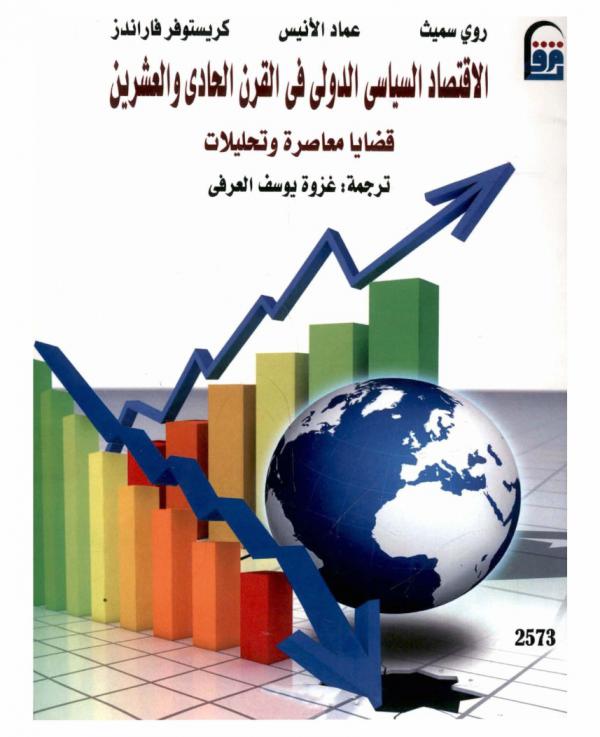
الاقتصاد السياسي الدولي في القرن الحادي والعشرين : قضايا معاصرة وتحليلات
يقدم الكتاب شرحا لكيفية تطور علم الاقتصاد السياسي الدولي عبر الزمن وكم هو وثيق الصلة ببعض العلوم السابقة التي لاتزال قائمة حتى يومنا هذا وينطلق الكتاب من أسئلة مثل هل تقدم كتابات «آدم سميث» و«دافيد ريكاردو» و«كارل ماركس» و«جرامشي» وحتى «جون ماينارد كينز» تبصرات مفيدة في السياسة والاقتصاد في القرن الحادي والعشرين؟ أم أنهم مجرد وجوه تاريخية قامت بتطوير مفهومنا حول تنوع وتطور الفكرين السياسي والاقتصادي مع قليل من التبصر فيما يخص الشؤون المعاصرة.
BOOK
Security and Insecurity in the Middle East
This volume draws together a number of research papers presented at a conference titled \"Security, Insecurity and Prospects for Peace in the Middle East and North Africa\", organised by Nottingham Trent University's Middle East and North Africa Research cluster in April 2016. The conference focused on questions pertinent to what may be termed the 'post-Arab Spring' era, in which the Middle East is experiencing unprecedented national and transnational challenges. Conflict, instability, radicalisation and the mass displacement of people have become increasingly salient features of the political and economic landscape of the region.The contributions here analyse a range of political, economic, security and socio-cultural issues that the authors argue lie at the heart of the instability that the region is currently experiencing. Re-thinking issues of security and insecurity in the Middle East not only allows us to explain what might have led to current instability, but also allows us to posit possible solutions to these security issues. In doing so, this book goes beyond the concepts of security and insecurity as a standard account of perpetrator versus victim, in a state-centric and violence-centric manner, to a broader and more complex understanding of the underlying processes informing security and insecurity in the region. The contributors include scholars from around the world working in a variety of different fields, including Middle Eastern studies, international relations and international political economy, providing an eclectic discussion of the state of the region.
eBook

The Political Economy of Energy Security and Nuclear Energy in Jordan
In 2007 the Jordanian government announced its intention to build one nuclear power plant by 2015 and a number of others by 2030. The objective of this nuclear energy programme was to provide a sustainable domestic energy supply and relieve the burden of reliance on external energy sources. This burden has led to a massive strain on the government budget as well as domestic discontent, due to rising living costs which has negatively affected regime stability - this latter point is especially important in light of the current geopolitical changes sweeping across the Middle East and North Africa (MENA). This work explores the political economy of energy security in Jordan and the potential role of nuclear energy in the coming decades and argues that there is an energy security dilemma in Jordan and this determines the nature of nuclear technology proliferation there. In this study a number of theoretical assumptions are posited concerning the impact of resource scarcity on economic and political stability which help shed light on Jordanian interests and policies. The nature of energy security and resource scarcity in other states in the MENA are often very similar. As such this case study offers some insights into the political economy of other nuclear energy programmes which have been announced in the past few years in that region, such as in Yemen and Egypt.
Journal Article

Making sense of mixed-embeddedness in migrant informal enterprising
PurposeThe purpose of this paper is to discuss how informal migrant entrepreneurs with different legal statuses interpret their mixed-embeddedness in social and economic contexts. Legal status represents a key determinant in shaping accessible social networks and market opportunities that in turn influence entrepreneurial choices.Design/methodology/approachThe paper adopts an interpretative stance to explore how migrant entrepreneurs interpret mixed-embeddedness. It draws on the empirical evidence from a cross-sectional sample of 26 asylum seekers that engaged with enterprising activities in the city of Nottingham in the UK. A recursive hermeneutic process guided the iterative readings of the accounts to develop theoretical insights on how these agents reinvent their relationship with structure.FindingsA novel theoretical framework emerges from the data analysis to present how these particular migrants use understandings of community and notions of capital to make sense of their mixed-embeddedness. The main theoretical contribution of the framework is to illustrate how groups with different legal statuses produce unique interpretations of mixed-embeddedness. This, in turn, reflects onto specific forms of enterprising and innovative entrepreneurial choices. The framework also produces an empirical contribution as it re-centres the analysis of mixed-embeddedness around the migrant entrepreneur from previous meso- and macro-level perspectives that dominated recent research.Research limitations/implicationsThe paper expands knowledge on the notion of mixed-embeddedness by providing insights on how informal migrant entrepreneurs make sense of it. This can form the basis for allowing scholars to address empirically how migrant entrepreneurs reconcile their embeddedness in both social and economic contexts. In terms of practical implications, the paper paves the way for policy-makers to re-evaluate the current approach to the right of asylum seekers to pursue entrepreneurial activities.Originality/valueThe notion of mixed-embeddedness is central to research on informal migrant enterprising. Nevertheless, the concept remains fuzzy and difficult to operationalise. The paper offers an opportunity to understand how migrant entrepreneurs make sense of mixed-embeddedness so that future scholars can better explore how mixed-embeddedness reconciles agency and structure.
Journal Article

Food insecurity coping strategies in conflict-affected Libya
This article explored whether there were lessons to be learnt for food security assessment and interventions by studying household food insecurity coping strategies in conflict contexts. Data were collected using 55 in-depth interviews during 2016-2017 from three regions in Libya - a country affected by protracted conflicts since 2011. Thematic analyses revealed eight major categories of coping strategies, some of which resembled those reported in the global literature. However, some strategies, both negative and positive, were unique to the conflict context. The implications of the findings for food security assessment and interventions in areas of protracted conflicts are discussed.
Journal Article
Making sense of mixed-embeddedness in migrant informal enterprising
Purpose
The purpose of this paper is to discuss how informal migrant entrepreneurs with different legal statuses interpret their mixed-embeddedness in social and economic contexts. Legal status represents a key determinant in shaping accessible social networks and market opportunities that in turn influence entrepreneurial choices.
Design/methodology/approach
The paper adopts an interpretative stance to explore how migrant entrepreneurs interpret mixed-embeddedness. It draws on the empirical evidence from a cross-sectional sample of 26 asylum seekers that engaged with enterprising activities in the city of Nottingham in the UK. A recursive hermeneutic process guided the iterative readings of the accounts to develop theoretical insights on how these agents reinvent their relationship with structure.
Findings
A novel theoretical framework emerges from the data analysis to present how these particular migrants use understandings of community and notions of capital to make sense of their mixed-embeddedness. The main theoretical contribution of the framework is to illustrate how groups with different legal statuses produce unique interpretations of mixed-embeddedness. This, in turn, reflects onto specific forms of enterprising and innovative entrepreneurial choices. The framework also produces an empirical contribution as it re-centres the analysis of mixed-embeddedness around the migrant entrepreneur from previous meso- and macro-level perspectives that dominated recent research.
Research limitations/implications
The paper expands knowledge on the notion of mixed-embeddedness by providing insights on how informal migrant entrepreneurs make sense of it. This can form the basis for allowing scholars to address empirically how migrant entrepreneurs reconcile their embeddedness in both social and economic contexts. In terms of practical implications, the paper paves the way for policy-makers to re-evaluate the current approach to the right of asylum seekers to pursue entrepreneurial activities.
Originality/value
The notion of mixed-embeddedness is central to research on informal migrant enterprising. Nevertheless, the concept remains fuzzy and difficult to operationalise. The paper offers an opportunity to understand how migrant entrepreneurs make sense of mixed-embeddedness so that future scholars can better explore how mixed-embeddedness reconciles agency and structure.
Journal Article

Freshwater scarcity, interdependence and institutionalism in Jordanian foreign policy: towards conflict or cooperation?
Freshwater scarcity is an increasingly important aspect of the international relations of the Middle East and North Africa, and is magnified when sources are shared between states. In the Jordanian, Israeli and Syrian cases, most of their freshwater sources are shared. At the same time, cooperation between these states has emerged. This paper examines inter-state cooperation by considering freshwater scarcity issues in Jordanian-Israeli-Syrian relations. This study argues that three factors help determine whether freshwater scarcity leads to conflict or cooperation between riparian states: the nature and intensity of the scarcity, the level of interdependence between the actors sharing this resource, and their level of engagement in international institutions. It concludes that cooperation is possible between states (even those with difficulties in other areas of their relationship) when the scarcity experienced is intense, they are interdependent in this and other spheres, and they engage with each other through international institutions. Adapted from the source document.
Journal Article
