
Catalogue Search | MBRL


Are you sure you want to remove the book from the shelf?

{{itemTitle}}
260
result(s) for
"El-Halwagi, Mahmoud M"
Sort by:

Sustainable Design through Process Integration - Fundamentals and Applications to Industrial Pollution Prevention, Resource Conservation, and Profitability Enhancement
This book is professional reference that shows how mass integration techniques are used to maximize efficiency and sustainability and minimize the pollution of process systems and plants. Plant and unit operations professionals will save time and money by using the detailed tools and applications as part of their understanding of systematic process development. More generally it will be an important resource for those working with what commonly referred to as P2 (Pollution Prevention) technology. In addition to practitioners developing new systems and, more commonly, retrofitting old systems, the book will also find a significant market as a reference for researchers, and graduate level students taking courses in sustainable process systems/process integration/process synthesis and optimization/mass integration and related topics. The author is recognized as a foremost expert on mass integration for process efficiency and pollution prevention. No other reference is available on this fast developing topic.
eBook
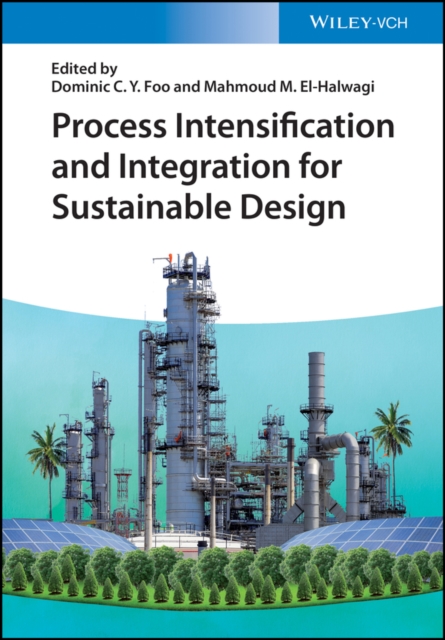
Process Intensification and Integration for Sustainable Design
Presents comprehensive coverage of process intensification and integration for sustainable design, along with fundamental techniques and experiences from the industry Drawing from fundamental techniques and recent industrial experiences, this book discusses the many developments in process intensification and integration and focuses on increasing sustainability via several overarching topics such as Sustainable Manufacturing, Energy Saving Technologies, and Resource Conservation and Pollution Prevention Techniques. Process Intensification and Integration for Sustainable Design starts discussions on: shale gas as an option for the production of chemicals and challenges for process intensification; the design and techno-economic analysis of separation units to handle feedstock variability in shale gas treatment; RO-PRO desalination; and techno-economic and environmental assessment of ultrathin polysulfone membranes for oxygen-enriched combustion. Next, it looks at process intensification of membrane-based systems for water, energy, and environment applications; the design of internally heat-integrated distillation column (HIDiC); and graphical analysis and integration of heat exchanger networks with heat pumps. Decomposition and implementation of large-scale interplant heat integration is covered, as is the synthesis of combined heat and mass exchange networks (CHAMENs) with renewables. The book also covers optimization strategies for integrating and intensifying housing complexes; a sustainable biomass conversion process assessment; and more. * Covers the many advances and changes in process intensification and integration * Provides side-by-side discussions of fundamental techniques and recent industrial experiences to guide practitioners in their own processes * Presents comprehensive coverage of topics relevant, among others, to the process industry, biorefineries, and plant energy management * Offers insightful analysis and integration of reactor and heat exchanger network * Looks at optimization of integrated water and multi-regenerator membrane systems involving multi-contaminants Process Intensification and Integration for Sustainable Design is an ideal book for process engineers, chemical engineers, engineering scientists, engineering consultants, and chemists.
eBook
Process Integration
With growing global competition, the process industries must spare no effort in insuring continuous process improvement in terms of Increasing profitability; Conservation of resources and Prevention of pollution.The question is how can engineers achieve these goals for a given process with numerous units and streams?.
eBook

Natural Gas Processing from Midstream to Downstream
A comprehensive review of the current status and challenges for natural gas and shale gas production, treatment and monetization technologies Natural Gas Processing from Midstream to Downstream presents an international perspective on the production and monetization of shale gas and natural gas. The authors review techno-economic assessments of the midstream and downstream natural gas processing technologies. Comprehensive in scope, the text offers insight into the current status and the challenges facing the advancement of the midstream natural gas treatments. Treatments covered include gas sweeting processes, sulfur recovery units, gas dehydration and natural gas pipeline transportation. The authors highlight the downstream processes including physical treatment and chemical conversion of both direct and indirect conversion. The book also contains an important overview of natural gas monetization processes and the potential for shale gas to play a role in the future of the energy market, specifically for the production of ultra-clean fuels and value-added chemicals. This vital resource: * Provides fundamental chemical engineering aspects of natural gas technologies * Covers topics related to upstream, midstream and downstream natural gas treatment and processing * Contains well-integrated coverage of several technologies and processes for treatment and production of natural gas * Highlights the economic factors and risks facing the monetization technologies * Discusses supply chain, environmental and safety issues associated with the emerging shale gas industry * Identifies future trends in educational and research opportunities, directions and emerging opportunities in natural gas monetization * Includes contributions from leading researchers in academia and industry Written for Industrial scientists, academic researchers and government agencies working on developing and sustaining state-of-the-art technologies in gas and fuels production and processing, Natural Gas Processing from Midstream to Downstream provides a broad overview of the current status and challenges for natural gas production, treatment and monetization technologies.
eBook

A novel CO2 utilization technology for the synergistic co-production of multi-walled carbon nanotubes and syngas
Dry reforming of methane (DRM) is a well-known process in which CH
4
and CO
2
catalytically react to produce syngas. Solid carbon is a well-known byproduct of the DRM but is undesirable as it leads to catalyst deactivation. However, converting CO
2
and CH
4
into solid carbon serves as a promising carbon capture and sequestration technique that has been demonstrated in this study by two patented processes. In the first process, known as CARGEN technology (CARbon GENerator), a novel concept of two reactors in series is developed that separately convert the greenhouse gases (GHGs) into multi-walled carbon nanotubes (MWCNTs) and syngas. CARGEN enables at least a 50% reduction in energy requirement with at least 65% CO
2
conversion compared to the DRM process. The second process presents an alternative pathway for the regeneration/reactivation of the spent DRM/CARGEN catalyst using CO
2
. Provided herein is the first report on an experimental demonstration of a 'switching' technology in which CO
2
is utilized in both the operation and the regeneration cycles and thus, finally contributing to the overall goal of CO
2
fixation. The following studies support all the results in this work: physisorption, chemisorption, XRD, XPS, SEM, TEM, TGA, ICP, and Raman analysis.
Journal Article

A return on investment metric for incorporating sustainability in process integration and improvement projects
A new approach is proposed for the inclusion of sustainability issues in the assessment and prioritization of process improvement projects. It is based on extending the conventional economic return on investment to include the beneficial or detrimental impacts of a project on sustainability early in the design process. The concept of aggregate sustainability metrics is coupled with economic profitability and process integration targets (benchmarks) to develop a unified metric that evaluates the augmented value of the project profitability and contribution to sustainability relative to the capital investment. Because of the return on investment nature of the proposed metric and because of its augmented inclusion of economic and other sustainability factors, it can be readily incorporated in typical process engineering activities and can be used by decision makers to make informed decisions regarding the viability of the projects and their impact on sustainability.
Journal Article

Sustainable Agricultural Practices in Arid Regions: Agrivoltaics and Solar Desalination
In arid regions, agricultural production is critically challenged by water scarcity, elevated temperatures, and high resource dependency. This study assesses an integrated water-energy-food (WEF) nexus approach tailored for small-scale farming to optimize resource use through innovative combinations of open-field, greenhouse, and agrivoltaic systems. Comparing typical farming practices (base case) with a WEF-enhanced scenario, we measured water and power consumption, crop yield, economic returns across three seasons, and conducted a comprehensive cost-benefit analysis. The WEF scenario demonstrated a 5.4% reduction in water use due to efficient irrigation techniques and produced all required power from solar energy. Crop production and profits were higher under the WEF scenario, in which the net profit per unit area was $1.1 greater. The utilization of a reverse osmosis desalination unit was pivotal in reducing water costs and enhancing economic viability. Notably, the study highlighted significant CO2 emission reductions with the WEF approach, underscoring its potential in climate change mitigation. By maximizing land use, diversifying crop types, and extending growing periods, the WEF nexus approach presents a viable solution for enhancing sustainability, profitability, and resource security in arid environments. This research offers crucial insights for stakeholders in optimizing agricultural production within the constraints of water and energy resources.
Journal Article

Rare Earth Elements in the Energy Transition: A Review of the Demand-Sustainability-Risk Nexus and Future Perspectives
The global transition toward renewable energy and decarbonization is intrinsically linked to the management of critical materials. Rare Earth Elements (REEs) are no exception, as they play a strategic role at the center of climate goals. Therefore, this review provides a comprehensive assessment of the REE landscape, explicitly addressing the proposed Demand-Sustainability-Risk Nexus (DSR-Nexus), which integrates technological demand, environmental sustainability, and geopolitical supply risks. A systematic review based on PRISMA methodology was conducted to analyze scientific contributions published between 2015 and 2026, revealing a significant research imbalance. By 2025, while 87% of works focus on resource availability, production, and recycling, only 1.4% address the global supply chain and its geopolitical implications. Key findings highlight that China’s dominance in mining, processing, and refining capacities, accounting for 69.5%, 92%, and 94%, respectively, creates structural vulnerabilities for future environmental goals. In contrast, emerging producers such as Malaysia and the United States are expected to contribute 9% and 8% of refining capacity, respectively. Furthermore, this review discusses environmental trade-offs, including high energy intensity, water consumption, and radioactive byproducts. It also examines mitigation strategies, such as recycling, urban mining, and material substitution. Ultimately, achieving a resilient energy transition requires expanding supply, strengthening circular strategies, and international cooperation.
Journal Article

Resilience Assessment and Sustainability Enhancement of Gas and COsub.2 Utilization via Carbon–Hydrogen–Oxygen Symbiosis Networks
Decarbonizing the industrial sector is essential to achieving net-zero targets and ensuring a sustainable future. Carbon–Hydrogen–Oxygen Symbiosis Networks (CHOSYN) are a set of interconnected hydrocarbon-processing plants that optimize the synergistic use of mass and energy resources in pursuit of both environmental objectives and profitability enhancement. However, this interconnectedness also introduces fragility, arising from technical and administrative dependencies among the participating facilities. In this work, a systematic framework is introduced to incorporate resilience assessment and sustainability enhancement within CHOSYNs. A CHOSYN representation is developed for a proposed industrial cluster, where processes are linked through interceptor units, which facilitate the exchange and conversion of carbon-, hydrogen-, and oxygen-based streams to meet demands. A multi-objective optimization framework is formulated with four competing goals: minimizing cost, minimizing net CO[sub.2] emissions, maximizing internal CO[sub.2] utilization, and minimizing the number of interceptors’ processing steps. The augmented ε-constraint method is used to generate a Pareto front that captures the trade-offs among these objectives. To complement the synthesis, a resilience assessment framework is applied to evaluate network performance under disruption by incorporating inter-plant dependencies and modeling disruption propagation. The results show that even under worst-case scenarios, integration through CHOSYN can achieve significant gains in CO[sub.2] utilization and reductions in raw material procurement requirements. Resilience analysis adds an important dimension by quantifying the economic impacts of disruptions to both highly connected and sparsely connected yet critical nodes, revealing vulnerabilities not evident from topology alone.
Journal Article