
Catalogue Search | MBRL


Are you sure you want to remove the book from the shelf?

{{itemTitle}}
77
result(s) for
"El-Rouayheb, Khaled"
Sort by:


Relational Syllogisms and the History of Arabic Logic, 900-1900
Relational inferences are a well-known problem for Aristotelian logic. This book charts the development of thinking about this problem by logicians writing in Arabic from the ninth to the nineteenth century. It shows that that the development of Arabic logic did not - as is often supposed - come to an end in the fourteenth century.
eBook

Islamic intellectual history in the seventeenth century : scholarly currents in the Ottoman Empire and the Maghreb
\"For much of the twentieth century, the intellectual life of the Ottoman and Arabic-Islamic world in the seventeenth century was ignored or mischaracterized by historians. Ottomanists typically saw the seventeenth century as marking the end of Ottoman cultural florescence, while modern Arab nationalist historians tended to see it as yet another century of intellectual darkness under Ottoman rule. This book is the first sustained effort at investigating some of the intellectual currents among Ottoman and North African scholars of the early modern period. Examining the intellectual production of the ranks of learned ulema (scholars) through close readings of various treatises, commentaries, and marginalia, Khaled El-Rouayheb argues for a more textured--and text-centered--understanding of the vibrant exchange of ideas and transmission of knowledge across a vast expanse of Ottoman-controlled territory\"-- Provided by publisher.
Book
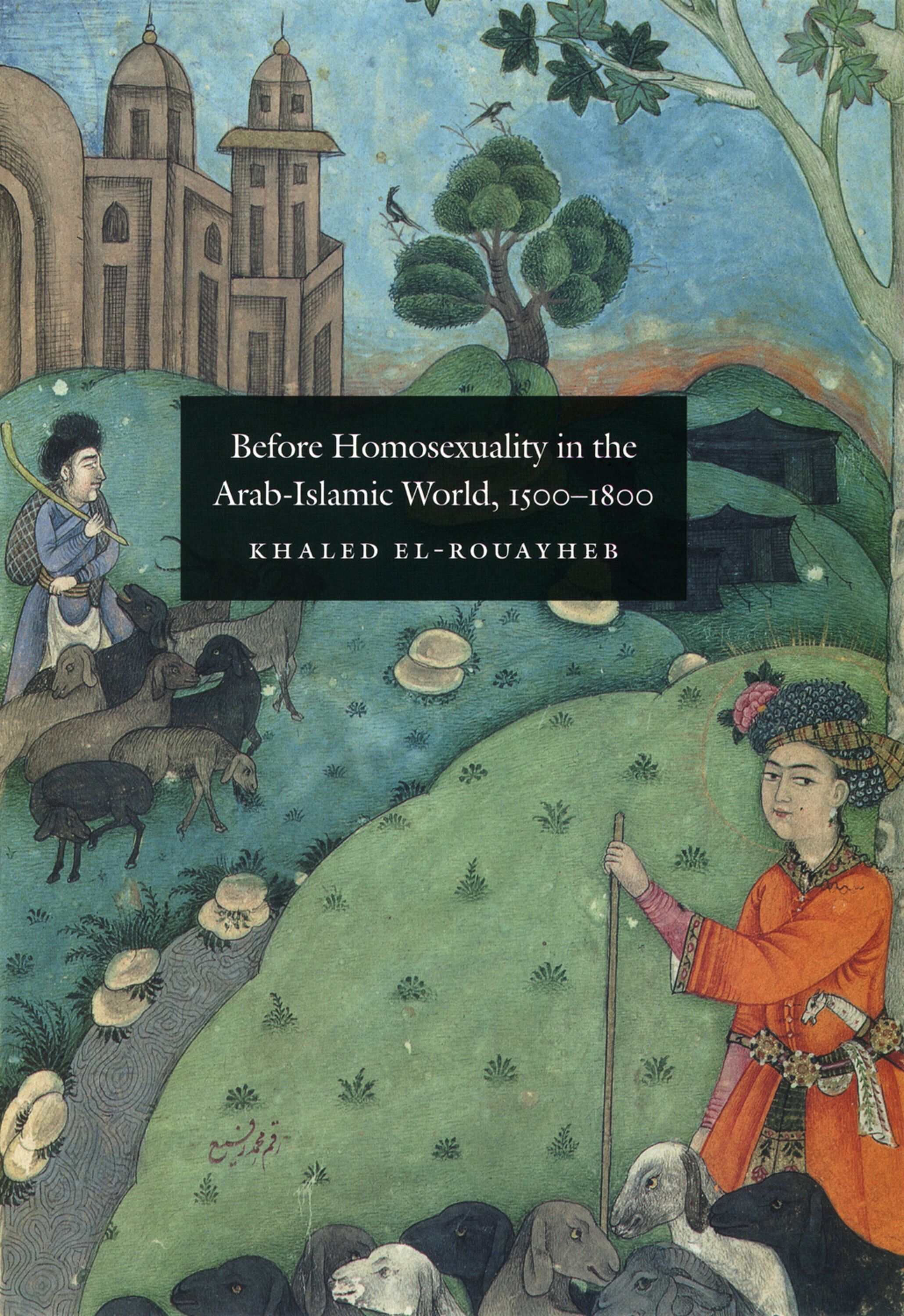
Before homosexuality in the Arab-Islamic world, 1500-1800
Attitudes toward homosexuality in the pre-modern Arab-Islamic world are commonly depicted as schizophrenic—visible and tolerated on one hand, prohibited by Islam on the other. Khaled El-Rouayheb argues that this apparent paradox is based on the anachronistic assumption that homosexuality is a timeless, self-evident fact to which a particular culture reacts with some degree of tolerance or intolerance. Drawing on poetry, biographical literature, medicine, dream interpretation, and Islamic texts, he shows that the culture of the period lacked the concept of homosexuality.
eBook

OPENING THE GATE OF VERIFICATION: THE FORGOTTEN ARAB–ISLAMIC FLORESCENCE OF THE 17TH CENTURY
Little research has been done on the intellectual life of the Arab-Islamic world between the 15th and 19th centuries. This scholarly neglect almost certainly reflects the widespread assumption that intellectual life in the Arab-Islamic world entered a long period of stagnation or “sclerosis” after the 13th or 14th century. This state of affairs is often believed to have lasted until the 19th century, when European military and economic expansion awakened the Arab-Islamic world from its dogmatic slumber, and inaugurated a “reawakening” or “renaissance” (nahḍa). An influential statement of this view of intellectual life in the Arab provinces of the Ottoman Empire before the 19th century is to be found in Gibb and Bowen's Islamic Society and the West. Although they noted that “the barrenness of the period has been greatly exaggerated,” they still stated that Arabic scholarly culture had degenerated, on the whole, into a rote, unquestioning acquisition of a narrow and religiously dominated field of knowledge. No “quickening breath had blown” on Arab-Islamic scholarship for centuries. Isolated even from Persian and Turkish influences, it was reduced to “living on its own past.”
Journal Article

Heresy and Sufism in the Arabic-Islamic world, 1550–1750: Some preliminary observations
The present paper is an attempt to throw preliminary light on heretical Sufi groups in the Arabic-Islamic world in the early-modern period (sixteenth to eighteenth centuries). Previous scholarship on antinomian Sufism has tended to focus on earlier centuries and on Persian- and Turkish-speaking groups. Evidence suggests that there is also a history to be written of antinomian mystical groups in the Arabic-speaking world in later centuries. On the eve of modernity in the Arabic-speaking Middle East, groups and individuals existed who rejected or ignored the prevalent scholarly interpretation of Islam and challenged the authority of the class of religious scholars (ʿulamā'). A number of sources from the period, usually hostile and/or satirical, attest to the existence of such groups and allow us to reconstruct the overall contours of their outlook.
Journal Article

The Myth of “The Triumph of Fanaticism” in the Seventeenth-Century Ottoman Empire
Since Halil İnalcik's classic \"The Ottoman Empire: The Classical Age\" (1973), the received view amongst historians has been that Ottoman scholars lost interest in the rational sciences after around 1600, largely as an effect of the rise of the puritanical Ḳāḍīzādeli movement. In the present article, I argue that there was in fact no decline of interest in the rational sciences amongst seventeenth century Ottoman scholars. On the contrary, interest in logic, dialectic, philosophy and rational theology seems to have been on the rise. Sunni Persian, Azeri and Kurdish scholars fleeing Safavid Iran brought with them new scholarly works in the rational sciences and gained a reputation as accomplished teachers. The number of Ottoman colleges in which works on the rational sciences were studied and taught also seems to have risen dramatically in the course of the 17th century.
Journal Article

“SUBJECT GENERALITY” AND DISTRIBUTION IN MEDIEVAL ARABIC SYLLOGISTIC
A relatively well-known medieval Latin innovation is the doctrine of distributive supposition. This notion came to be used in syllogistic theory in the late medieval and early modern periods, as Latin logicians sought to establish general rules for syllogistic productivity across the various figures. It is much less well-known that some logicians in the medieval Arabic tradition also attempted to establish general rules for the syllogism, appealing to what they called “subject generality.” In the present article, I introduce this use of “subject generality” in some influential Arabic works on logic from the thirteenth century to the sixteenth, specifically Al-ǧumal by Afḍal al-Dīn al-Ḫūnaǧī (d. 1248) and Tahḏīb al-manṭiq by Saʿd al-Dīn al-Taftāzānī (d. 1390) and some of their commentators. I also compare this concept of “subject generality” to the Latin concept of “distribution.”
Journal Article

Qūshjī (d. 1474) and Dawānī (d. 1502) on Truth and Correspondence
The present article presents the views of two fifteenth-century Islamic scholars, ‘Alī al-Qūshjī (d. 1474) and Jalāl al-Dīn al-Dawānī (d. 1502), on the following issue: When we make claims about extramental subjects and predicates, it seems plausible to suggest that such claims are true by virtue of corresponding to extramental reality. But what do we make of claims whose subjects and predicates are not extramental existents, such as philosophical claims like ‘An actual infinity is impossible’ or ‘Existence is a second intention’? It seems problematic to suggest that such claims are made true by mental reality, for one can have false philosophical views. Such considerations led some earlier scholars to postulate that the truth of such propositions consists in correspondence with what is in the Active Intellect. Qūshjī raised objections to such proposals, and his glossator Dawānī developed another account that distinguished between de facto beliefs and the beliefs that are appropriate to our concepts.
Journal Article