
Catalogue Search | MBRL


Are you sure you want to remove the book from the shelf?

{{itemTitle}}
4
result(s) for
"Ellison, Ralph, author"
Sort by:

The selected letters of Ralph Ellison
\"The previously unpublished letters of the ... author of Invisible Man [offer] insights into the riddle of American identity, the writer's craft, and his own life and work\"-- Provided by publisher.
Book

AN ICON THROUGH HISTORY
In this intriguing, witty and often insightful social history of an image, [Joseph Boskin] traces Sambo to 16th-century Europe and Africa. To ''explain'' cultures different from their own, and to assuage their guilt, early European slavers created the view of Africans as ''natural slaves.'' Mr. Boskin, a professor of history and Afro-American studies at Boston University, observes that early on ''Sambo'' was used by whites as a racial label, perhaps because of its currency among Africans themselves: for the Hausa of western Africa it was a name of dignity, meaning ''name of a spirit'' and ''second son in the family''; but in the language of the Mende, also of western Africa, it was a verb meaning ''to disgrace'' or ''to be shameful.'' English slave traders probably also adopted ''Sambo'' as a form of the Hispanic slavers' insulting term ''zambo,'' meaning ''of mixed blood,'' ''bow-legged'' or ''monkey.'' Perhaps, too, since the name ''Sam'' was associated with English popular culture, ''Sambo'' rolled off British tongues with ease. Mr. Boskin's own thesis here situates him squarely in the outworn [Stanley Elkins] camp. Like Mr. Elkins, Mr. Boskin condemns but nonetheless accepts the power of slavery virtually to obliterate black culture and personality. With stereotypes and antiblack humor, Mr. Boskin argues, whites did blacks in. To Mr. Boskin, Sambo was an ''extraordinary type of social control,'' leveled with special force against black men. ''To make the black male into an object of laughter, and, conversely, to force him to devise laughter, was to strip him of masculinity, dignity, and self-possession. . . . The ultimate objective was to effect mastery: to render the black male powerless as a potential warrior, as a sexual competitor, as an economic adversary.'' A chapter called, significantly enough, ''As His Name Is, So Is He,'' discusses whites' changing blacks' names to such cruelly comic ones as ''Bituminous,'' ''Snowrilla,'' and, of course, ''Sambo.'' It clearly suggests that despite some effort to resist, finally the helpless slave victim took ''Sambo'' (or a variant) as his own real name and in his heart accepted the debased role that went with it. He misreads Melville's ''Benito Cereno,'' making even the black slave rebel Babo into some sort of Sambo (Captain Delano sees him that way, not Melville). Mr. Boskin seems unaware of the superb body of criticism, much of it deriving from the poet and critic Sterling A. Brown, on the complex subject of black characters as seen by white authors. In a key article written in 1933, Mr. Brown catalogues black stereotypes as follows: ''the contented slave,'' ''the wretched freedman,'' ''the comic Negro,'' ''the brute Negro,'' ''the tragic mulatto,'' ''the local color Negro'' and ''the exotic primitive.''
Book Review
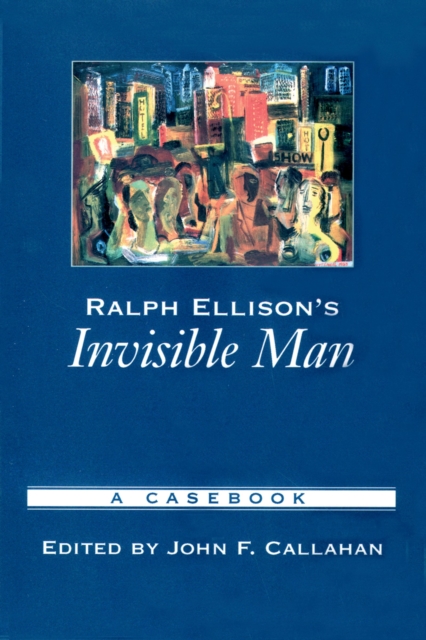
Ralph Ellison's Invisible man : a casebook
Offering students and scholars a variety of interpretations from which to fashion their own views of the novel and the man who created it, this text takes the position that there can be no last word on \"Invisible Man\". The essays share a respect for the novel's fluidity and for every reader's encounter with its narrator, story, and meanings.
eBook