
Catalogue Search | MBRL


Are you sure you want to remove the book from the shelf?

{{itemTitle}}
4
result(s) for
"Emde, Robert N., editor"
Sort by:

Early parenting and prevention of disorder : psychoanalytic research at interdisciplinary frontiers
This book provides insight and findings from leading psychoanalysts who are involved in early prevention research and clinical work. Advances in the sciences of early development have brought a heightened awareness to the crucial importance of early experiences for health and development as well as building strong foundations for education and preventing disorder. New approaches are applied in home visitation, working with immigrant families, and those stressed by trauma, conflicts and economic disadvantage. Examples of clinical application and the implementation of promising programs in an outreach psychoanalysis are also provided.
Book

Early parenting and prevention of disorder
Psychoanalytic understanding of infancy and early childhood has led the way to creating understanding of the human brain as necessarily developing in the context of important social relationships. These relationships - the ones between the child and the parent, as well as the ones between children - provide the material for the emergence of the human mind, which the brain has the potential to create. It is obvious, then, that influencing these relationships can serve either to optimize the achievement of this potential, or to undermine it in critical ways, leading to suboptimal outcomes. It is the aim of this book to orient us towards how we can work more effectively to minimize risk and maximize wellbeing. (DIPF/Orig.).
eBook
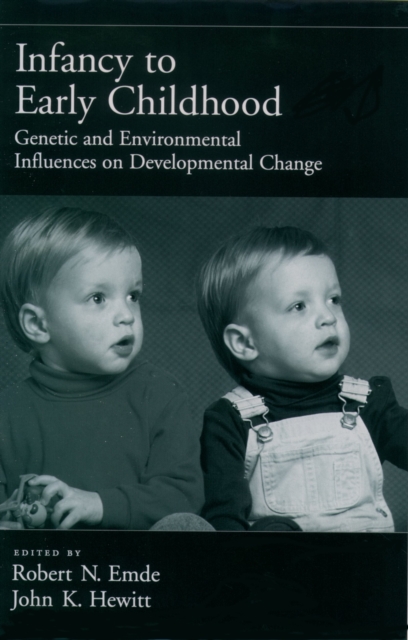
Infancy to Early Childhood
Behavioural genetics is a fast-growing, multidisciplinary field which attempts to explain the influence of genetic and environmental factors on behaviour through the lifespan. The preferred investigative technique for teasing out the differences between genetics and the environment is the longitudinal twin study. This book is the first complete publication from the MacArthur Longitudinal Twin Study (MALTS) that is by far the most ambitious and comprehensive logitudinal twin study to date. The goal of such an in-depth study was merely not to provide thorough descriptions of developmental change between the ages of one and three years, but to offer an original theoretical framework that explains how change occurs in different domains and how genetics and the environment influence those changes. In fact, this rigorous study will set the agenda for developmental psychology and behavioural genetics for decades to come.
eBook
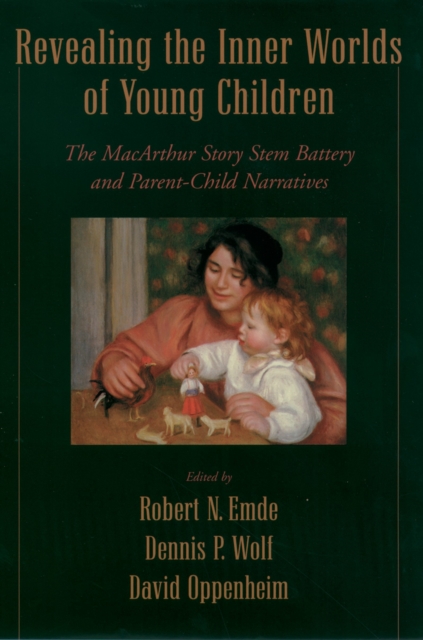
Revealing the inner worlds of young children : the MacArthur story stem battery and parent-child narratives
Typically, we make sense of our experiences and interactions in a way that is guided by emotion and that takes the form of a narrative or a story. Using narratives, we can tell others about our experience, share common meanings, imagine possibilities, and co-construct new meanings. It is thus a momentous development when, at around age three, a child acquires the capacity to construct narratives. The book reports the work of a 20-year collaboration between 36 psychologists who have created and investigated a new tool to elicit and analyze children’s narratives. This tool is the MacArthur Story Stem Battery, a systematic collection of story beginnings that are referred to as ‘stems.’ These stems are designed to elicit information from children about their representational worlds. This method is particularly exciting because using it allows developmental psychologists to gain information directly from children about their emotional states and what they are able to understand, and in turn, to use this information to explore significant emotional differences among children.
eBook