
Catalogue Search | MBRL


Are you sure you want to remove the book from the shelf?

{{itemTitle}}
413
result(s) for
"Emerson, Caryl"
Sort by:


Philosophy as novelistic fiction in the work of two old friends: Mikhail Epstein and Vladimir Sharov
Mikhail Epstein (b. 1950) and Vladimir Sharov (1952–2018) became close friends in Moscow in 1980. Epstein emigrated in 1990 to become a professor of cultural studies at Emory University; in 1991 Sharov, trained as a historian of medieval Rus’, published the first of his nine novels. With increasing urgency, both writers explored the myth, now backed by military force, that Russia is called to an apocalyptic, salvational global mission. This essay juxtaposes Epstein’s quasi-novel The New Sectarianism (1993), with its plea for poor faith or “minimal religion,” with the maximalist plots of Sharov’s novels, peopled by NKVD informers, homespun visionaries, seekers and priests. When a philosopher writes a novel, or when an historian-turned-novelist formulates a political philosophy, how are we to balance the claims of these competing genres? The final segment discusses a highly antagonistic reading by the sociologist Dina Khapaeva of Sharov’s final novel, which suggests that Sharov was emotionally complicit in the horrific events of the Stalinist era. An attempt is made to rebut this reading, and also to locate a way out for all parties that permits novelistic and philosophical art to be moral—but remain art. The essay originated as a paper presented at the 2023 ASEEES Convention, on a panel titled “Contemporary Russian Philosophy: Four Thinkers on Consciousness, Imagination, and Civilizational Crisis.” The argument has been filled in but not updated, and its oral intonation retained.
Journal Article
Impromptu reflections on The Palgrave Handbook of Russian Thought, edited by Marina F. Bykova, Michael N. Forster, Lina Steiner
Russian thought has long been a hybrid of native and imported forms—or more accurately, native values were first conceptualized and systematized according to Western European categories. This essay considers select entries in the Handbook (primarily those discussing Hegel, Solovyov, Tolstoy, and twentieth-century prose writers) not from the perspective of “pure” or abstract philosophy, arguably a Western achievement, but in the context of three traditional Russian virtues: tselostnost’ [wholeness], lichnost’ [personhood], and organichnost’ [organicity]. Each of these virtues, or values, is paradoxical, easily misconstrued, and easily abused. The essay ends speculatively on two studies: the personalist implications of Paul Contino’s exploration of “incarnational realism” in Dostoevsky, and Iain McGilchrist’s work on left- and right-hemispheres of the brain as contexts for the place of Russian thought in the larger world.
Journal Article
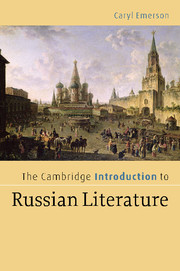
The Cambridge Introduction to Russian Literature
Russian literature arrived late on the European scene. Within several generations, its great novelists had shocked - and then conquered - the world. In this introduction to the rich and vibrant Russian tradition, Caryl Emerson weaves a narrative of recurring themes and fascinations across several centuries. Beginning with traditional Russian narratives (saints' lives, folk tales, epic and rogue narratives), the book moves through literary history chronologically and thematically, juxtaposing literary texts from each major period. Detailed attention is given to canonical writers including Pushkin, Gogol, Dostoevsky, Tolstoy, Chekhov, Bulgakov and Solzhenitsyn, as well as to some current bestsellers from the post-Communist period. Fully accessible to students and readers with no knowledge of Russian, the volume includes a glossary and pronunciation guide of key Russian terms as well as a list of useful secondary works. The book will be of great interest to students of Russian as well as of comparative literature.
eBook
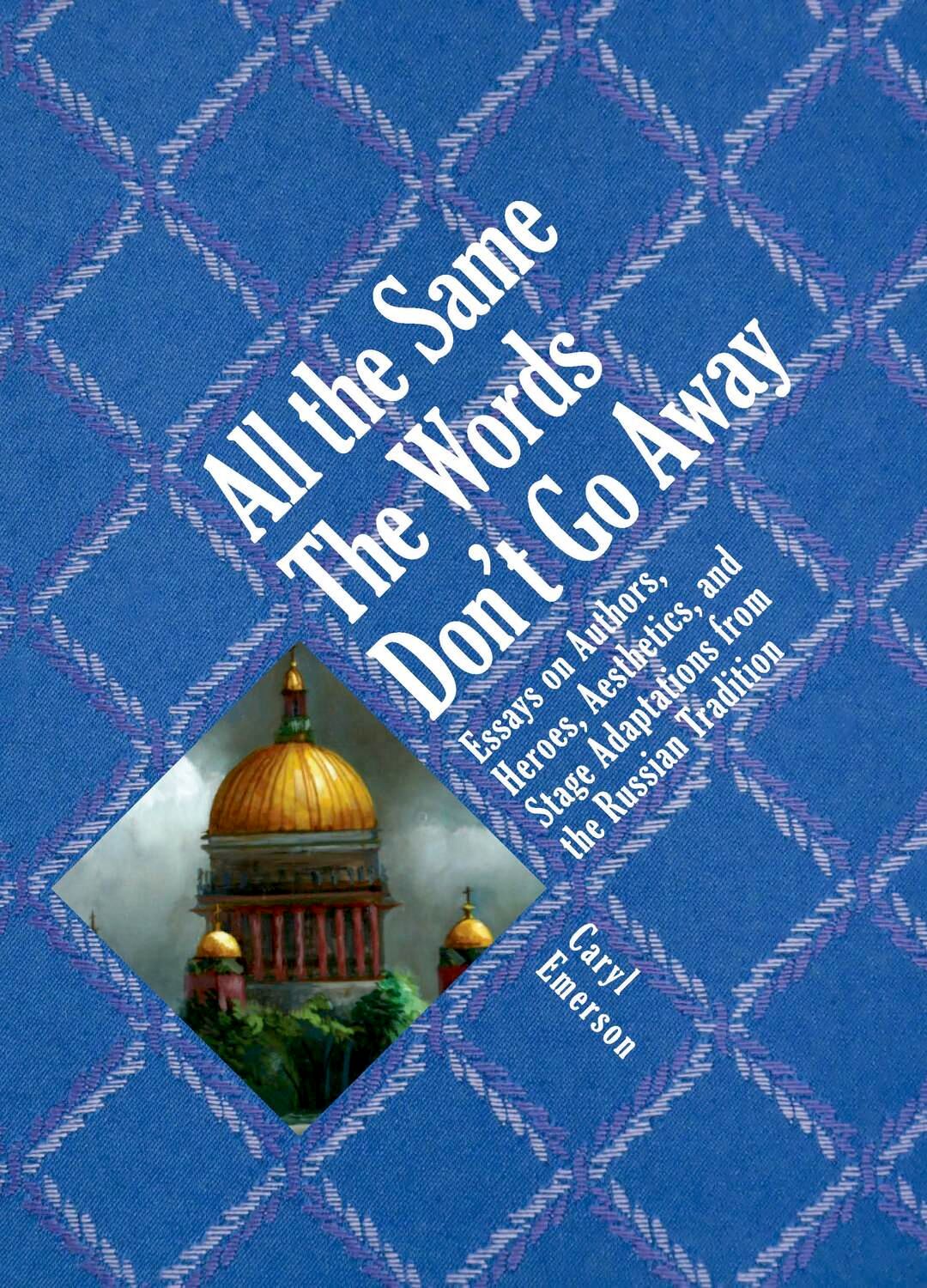
All the Same The Words Don't Go Away
Twenty-five years of essays and reviews, linked loosely by three themes. First is the creative potential inherent in transposing classic literary texts into other genres of media (operatic, dramatic) and the responsibilities, if any, that govern the transposer, audience, and critic. The practice of transposition, however, gives rise to a creative conflict: is there a limit to the amount of ornamentation, pressure, or dilution to which the “mediated” word can be subject? Finally, the more polemical of the essays included here are structured on the Bakhtinian notion of co-existing “plausibilities” and points of view. What a carnival approach can uncover in Pushkin that might have surprised and even pleased the poet, what a libretto or play script brings out that the “true original” hides: here the work of the creator and the critic can overlap in thrilling ways that respect the competencies of each. The book includes an original preface written by David Bethea.
eBook

All the Same The Words Don't Go Away: Essays on Authors, Heroes, Aesthetics, and Stage Adaptations from the Russian Tradition
Twenty-five years of essays and reviews, linked loosely by three themes. First is the creative potential inherent in transposing classic literary texts into other genres of media (operatic, dramatic) and the responsibilities, if any, that govern the transposer, audience, and critic. The practice of transposition, however, gives rise to a creative conflict: is there a limit to the amount of ornamentation, pressure, or dilution to which the “mediated” word can be subject? Finally, the more polemical of the essays included here are structured on the Bakhtinian notion of co-existing “plausibilities” and points of view. What a carnival approach can uncover in Pushkin that might have surprised and even pleased the poet, what a libretto or play script brings out that the “true original” hides: here the work of the creator and the critic can overlap in thrilling ways that respect the competencies of each. The book includes an original preface written by David Bethea.
eBook

TOLSTOEVSKY
Emerson focuses on Russian writers Dostoevsky and Tolstoy. Tolstoy and Dostoevsky have been global for well over a century. They belong first to the world, then to Russia, and only finally to academic industries, which must compete with every other language on the planet in the teaching, and owning, of these Russian prose masters. So the field of Tolstoevsky is uncontrollably huge, even though we (the translators, annotators, and scholarly problematizers) do not always get credit for it. Another interesting shift in Tolstoy-Dostoevsky studies over the last three decades has been the perennial \"One Dostoevsky/Tolstoy, or two?\" The break in biography is different for each, of course: for Dostoevsky it came with his arrest, hard labor and exile in Siberia (the 1850s), for Tolstoy it came after Anna Karenina, the so-called moral crisis or Perevorot of 1877-1884.
Journal Article
