
Catalogue Search | MBRL


Are you sure you want to remove the book from the shelf?

{{itemTitle}}
104
result(s) for
"Ensmenger, Nathan"
Sort by:

The Environmental History of Computing
From Charles Babbage's Difference Engine (a product of an increasingly global British maritime empire) to Herman Hollerith's tabulating machine (designed to solve the problem of \"seeing like a state\" in the newly trans-continental American Republic) to the emergence of the modern petrochemical industry, information technologies have always been closely associated with the human desire to understand and manipulate their physical environment. More recently, humankind has started to realize the environmental impacts of information technology, including not only the toxic byproducts associated with their production, but also the polluting effects of the massive amounts of energy and water required by data centers at Google and Facebook (whose physicality is conveniently and deliberately camouflaged behind the disembodied, ethereal \"cloud\"). This paper grounds the history of information technology in the material world by focusing on the relationship between \"computing power\" and more traditional processes of resource extraction, exchange, management, and consumption.
Journal Article

Is chess the drosophila of artificial intelligence? A social history of an algorithm
Since the mid 1960s, researchers in computer science have famously referred to chess as the 'drosophila' of artificial intelligence (AI). What they seem to mean by this is that chess, like the common fruit fly, is an accessible, familiar, and relatively simple experimental technology that nonetheless can be used productively to produce valid knowledge about other, more complex systems. But for historians of science and technology, the analogy between chess and drosophila assumes a larger significance. As Robert Kohler has ably described, the decision to adopt drosophila as the organism of choice for genetics research had far-reaching implications for the development of 20th century biology. In a similar manner, the decision to focus on chess as the measure of both human and computer intelligence had important and unintended consequences for AI research. This paper explores the emergence of chess as an experimental technology, its significance in the developing research practices of the AI community, and the unique ways in which the decision to focus on chess shaped the program of AI research in the decade of the 1970s. More broadly, it attempts to open up the virtual black box of computer software — and of computer games in particular — to the scrutiny of historical and sociological analysis.
Journal Article

“Beards, Sandals, and Other Signs of Rugged Individualism”: Masculine Culture within the Computing Professions
Over the course of the 1960s and 1970s, male computer experts were able to successfully transform the “routine and mechanical” (and therefore feminized) activity of computer programming into a highly valued, well-paying, and professionally respectable discipline. They did so by constructing for themselves a distinctively masculine identity in which individual artistic genius, personal eccentricity, antiauthoritarian behavior, and a characteristic “dislike of activities involving human interaction” were mobilized as sources of personal and professional authority. This article explores the history of masculine culture and practices in computer programming, with a particular focus on the role of university computer centers as key sites of cultural formation and dissemination.
Journal Article
The Digital Construction of Technology: Rethinking the History of Computers in Society
In recent decades, the history of computing has moved beyond its traditional focus on machines towards a broader study of people, processes, and practices. The study of software in particular has opened up new avenues for exploring questions about gender, labor history, organizational politics, users and use-practices, expertise, and professional identity as they relate to the changing role of computers in society. Beginning with a creative re-imagining of Bruno Latour’s classic study of laboratory life in the context of modern computational biology and bio-informatics, the author argues that the ubiquitous presence of the computer in the material practices of the laboratory reflects a larger shift in the epistemological foundations of science from experiment to simulation. He suggests that by focusing on digitization, rather than computerization, historians can better understand the range of technological and conceptual innovations that have dramatically transformed the work of scientists and engineers in almost every discipline.
Journal Article

The Multiple Meanings of a Flowchart
From the very earliest days of electronic computing, flowcharts have been used to represent the conceptual structure of complex software systems. In much of the literature on software development, the flowchart serves as the central design document around which systems analysts, computer programmers, and end users communicate, negotiate, and represent complexity. And yet the meaning of any particular flowchart was often highly contested, and the apparent specificity of such design documents rarely reflected reality. Drawing on the sociological concept of the boundary object, this article explores the material culture of software development with a particular focus on the ways in which flowcharts served as political artifacts within the emerging communities of practices of computer programming.
Journal Article


The Computer Boys Take Over
This is a book about the computer revolution of the mid-twentieth century and the people who made it possible. Unlike most histories of computing, it is not a book about machines, inventors, or entrepreneurs. Instead, it tells the story of the vast but largely anonymous legions of computer specialists--programmers, systems analysts, and other software developers--who transformed the electronic computer from a scientific curiosity into the defining technology of the modern era. As the systems that they built became increasingly powerful and ubiquitous, these specialists became the focus of a series of critiques of the social and organizational impact of electronic computing. To many of their contemporaries, it seemed the \"computer boys\" were taking over, not just in the corporate setting, but also in government, politics, and society in general. In The Computer Boys Take Over , Nathan Ensmenger traces the rise to power of the computer expert in modern American society. His rich and nuanced portrayal of the men and women (a surprising number of the \"computer boys\" were, in fact, female) who built their careers around the novel technology of electronic computing explores issues of power, identity, and expertise that have only become more significant in our increasingly computerized society. In his recasting of the drama of the computer revolution through the eyes of its principle revolutionaries, Ensmenger reminds us that the computerization of modern society was not an inevitable process driven by impersonal technological or economic imperatives, but was rather a creative, contentious, and above all, fundamentally human development.
eBook
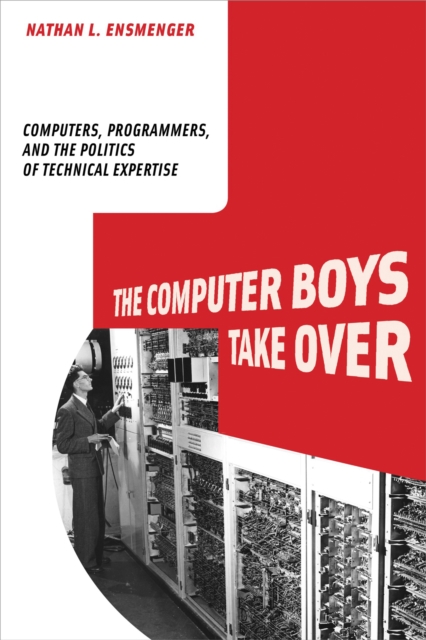
The computer boys take over: computers, programmers, and the politics of technical expertise
This title tells the contentious history of the computer programmers who developed the software that made the computer revolution possible.
eBook
The Multiple Meanings of a Flowchart
From the very earliest days of electronic computing, flowcharts have been used to represent the conceptual structure of complex software systems. In much of the literature on software development, the flowchart serves as the central design document around which systems analysts, computer programmers, and end users communicate, negotiate, and represent complexity. And yet the meaning of any particular flowchart was often highly contested, and the apparent specificity of such design documents rarely reflected reality. Drawing on the sociological concept of the boundary object, this article explores the material culture of software development with a particular focus on the ways in which flowcharts served as political artifacts within the emerging communities of practices of computer programming.
Journal Article