
Catalogue Search | MBRL


Are you sure you want to remove the book from the shelf?

{{itemTitle}}
278
result(s) for
"Eyerman, Ron"
Sort by:


Vietnam, A War, Not a Country
Vietnam, A War, Not a Country explores the conflicting ways in which the American-Vietnamese War has been collectively remembered and represented from the perspective of the war's three primary belligerents: the Vietnamese communists, the South Vietnamese, and the Americans. The book examines how the three different collectives memorialize this traumatizing historical event. Within each of these three groups there exists a number of competing narratives, generating not only a sense of shared meaning and community, but also impassioned social conflict. In order to trace these narratives within each collectivity, the authors develop the concept of arenas of memory, distinct discourses that are tied to specific individuals, organizations, and institutions that advocate specific narratives through specific forms of media. Their analysis leads them to make the case as to whether each of these societies experienced a cultural trauma as a result of the way in which the war is remembered.
eBook

Vietnam, A War, Not a Country
Vietnam: A War, Not a Country explores the conflicting ways in which the American-Vietnamese War has been collectively remembered and represented from the perspective of the war's three primary belligerents: the Vietnamese communists, the South Vietnamese, and the Americans. The book examines how the three different collectives memorialize this traumatizing historical event. Within each of these three groups there exists a number of competing narratives, generating not only a sense of shared meaning and community, but also impassioned social conflict. In order to trace these narratives within each collectivity, the authors develop the concept of arenas of memory, distinct discourses that are tied to specific individuals, organizations, and institutions that advocate specific narratives through specific forms of media. Their analysis leads them to make the case as to whether each of these societies experienced a cultural trauma as a result of the way in which the war is remembered.
eBook

Discursive combat: the question of Palestine
This article seeks to explain the growth of identification and support for the Palestinian cause over the last decades from a regional concern to a global movement. What are the mechanisms that made this possible? This problematic is addressed within a cultural sociological framework, focusing on the cultural work of intellectuals and the collective actions of social movements in articulating and dispersing the idea of a distinctive Palestinian identity and cause. This is a form of cultural nationalism, where claims to nationhood are rooted in the idea of a distinctive, ancient culture. Focus is on the role of intellectuals in the articulation of collective identification and the cultural representations through which it is dispersed. The prime data supported this argument consists of aesthetic representations like novels, films, and photography.
Journal Article
Discursive combat: the question of Palestine
This article seeks to explain the growth of identification and support for the Palestinian cause over the last decades from a regional concern to a global movement. What are the mechanisms that made this possible? This problematic is addressed within a cultural sociological framework, focusing on the cultural work of intellectuals and the collective actions of social movements in articulating and dispersing the idea of a distinctive Palestinian identity and cause. This is a form of cultural nationalism, where claims to nationhood are rooted in the idea of a distinctive, ancient culture. Focus is on the role of intellectuals in the articulation of collective identification and the cultural representations through which it is dispersed. The prime data supported this argument consists of aesthetic representations like novels, films, and photography.
Journal Article
Covid-19 as cultural trauma
This paper has two aims. The first is to introduce the concept of compressed cultural trauma, and the second is to apply the theory of cultural trauma in two case studies of the current covid-19 pandemic, Greece and Sweden. Our central question is whether the pandemic will evolve into a cultural trauma in these two countries. We believe the pandemic presents a challenge to cultural trauma theory, which the idea of compressed trauma is meant to address. We conclude that, while the ongoing covid-19 pandemic has had traumatic consequences in Sweden and Greece, it has not evolved into cultural trauma in either country.
Journal Article

Cultural Trauma and Collective Identity
In this collaboratively authored work, five distinguished sociologists develop an ambitious theoretical model of \"cultural trauma\"—and on this basis build a new understanding of how social groups interact with emotion to create new and binding understandings of social responsibility. Looking at the \"meaning making process\" as an open-ended social dialogue in which strikingly different social narratives vie for influence, they outline a strongly constructivist approach to trauma and apply this theoretical model in a series of extensive case studies, including the Nazi Holocaust, slavery in the United States, and September 11, 2001.
eBook

Cultural Trauma and the Transmission of Traumatic Experience
Experiences of loss, tragedy, violence, and upheavals are ubiquitous, with the majority of individuals experiencing several distressing events during their lifetime. Such events may be conceptualized as \"traumatic\" and contribute to negative changes in mental health. Despite decades of research on the study and treatment of trauma, it remains unclear when a negative event becomes traumatic. Although biologically- and psychologically-based models shed light on this question, we propose a more comprehensive and nuanced conceptualization will emerge from the integration of cultural theories into individual-level analysis when examining the evolution of trauma processing across time.
Journal Article
Representing Trauma in the Arts
Applying Jurgen Habermas’ distinction between the three knowledge interests guiding scientific research, this article identifies three approaches to ‘trauma’, a clinical approach, rooted in a medical model, a literary approach, rootedin psychoanalysis, and a cultural sociological approach. After elaborating on each of these perspectives, and the various forms through which trauma is represented aesthetically, the three are applied in an analysis of the film “QuoVadis, Aida?”. It is argued that although they entail different notions of trauma, the three are not mutually exclusive and can be combined in a rich understanding of aesthetic representation.
Journal Article
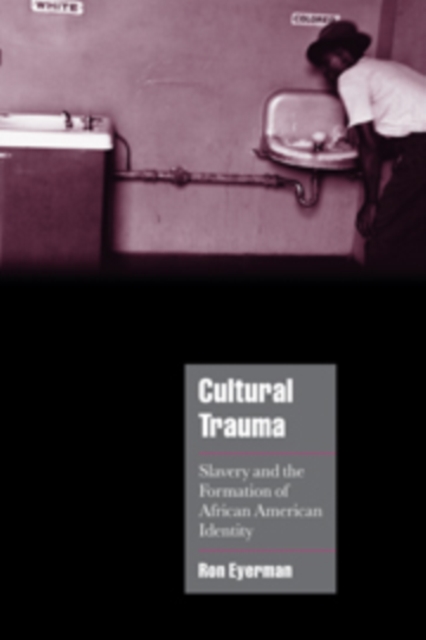
Cultural Trauma: Slavery and the Formation of African American Identity
In this book, Ron Eyerman explores the formation of the African-American identity through the theory of cultural trauma. The trauma in question is slavery, not as an institution or as personal experience, but as collective memory: a pervasive remembrance that grounded a people's sense of itself. Combining a broad narrative sweep with more detailed studies of important events and individuals, Eyerman reaches from Emancipation through the Harlem Renaissance, the Depression, the New Deal and the Second World War to the Civil Rights movement and beyond. He offers insights into the intellectual and generational conflicts of identity-formation which have a truly universal significance, as well as providing a compelling account of the birth of African-American identity. Anyone interested in questions of assimilation, multiculturalism and postcolonialism will find this book indispensable.
eBook