
Catalogue Search | MBRL


Are you sure you want to remove the book from the shelf?

{{itemTitle}}
422
result(s) for
"Fabian, Ann"
Sort by:


The Travails of a \Lady Scientist\
Taken from Museum of Natural History on Complaint of Attendant Mary C. Dickerson, 53 years old of West 118th Street, editor of the bimonthly magazine Natural History, issued by the Museum of Natural History, Central Park West and Seventy-Seventh Street, was sent to Bellevue Hospital last night for observation on complaint of an attendant of the museum. A year earlier, museum directors had named her curator of a newly formed department of herpetology, the first woman at the museum to hold the rank of curator on the institution's scientific staff. In December 1919, when directors of New Yorks American Museum of Natural History appointed Mary Cynthia Dickerson curator of the Department of Herpetology, she had been working at the museum for almost ten years-running the Department of Woods and Forestry, editing the Museum Journal, and working as an associate curator in the Department of Ichthyology and Herpetology. In 1906, Dickerson published the book that earned her a slot in the history of American herpetology and, in a few years, a job at the Museum of Natural History.
Journal Article

Interchange
Whether historians investigate consuls, missionaries, merchants, naval squadrons, or scientists, they can discern a striking transformation in the global reach of the US between the American Revolution and the Civil War. A burgeoning amount of new and forthcoming scholarship on American globalization during this era has created an opportunity to rethink orthodox narratives of American history and globalization. Here, the conversation of historians on how they have been pursuing productive imperatives to move American history beyond the container of the nation-state and how they should reintegrate a globalized US history into the more traditional narratives is presented.
Journal Article

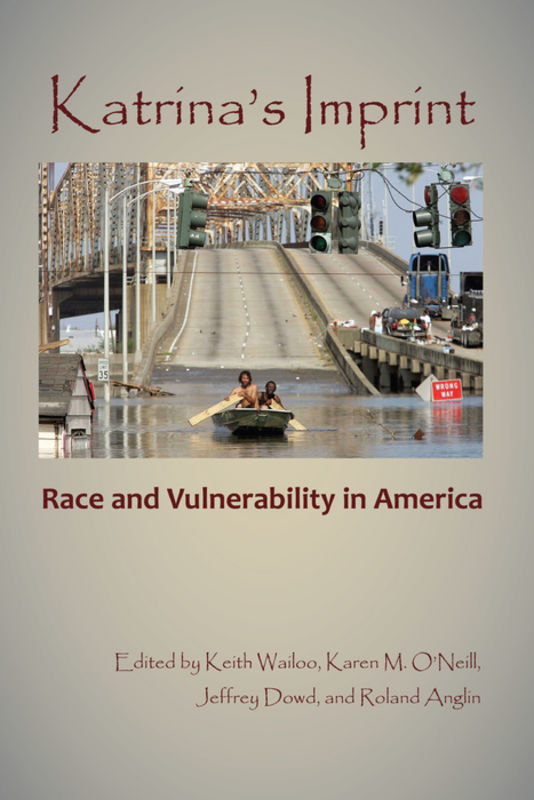
Katrina's Imprint
Katrina's Imprinthighlights the power of this sentinel American event and its continuing reverberations in contemporary politics, culture, and public policy. Published on the fifth anniversary of Hurricane Katrina, the multidisciplinary volume reflects on how history, location, access to transportation, health care, and social position feed resilience, recovery, and prospects for the future of New Orleans and the Gulf region. Essays examine the intersecting vulnerabilities that gave rise to the disaster, explore the cultural and psychic legacies of the storm, reveal how the process of rebuilding and starting over replicates past vulnerabilities, and analyze Katrina's imprint alongside American's myths of self-sufficiency. A case study of new weaknesses that have emerged in our era, this book offers an argument for why we cannot wait for the next disaster before we apply the lessons that should be learned from Katrina.
eBook

Race and Retail
Race has long shaped shopping experiences for many Americans. Retail exchanges and establishments have made headlines as flashpoints for conflict not only between blacks and whites, but also between whites, Mexicans, Asian Americans, and a wide variety of other ethnic groups, who have at times found themselves unwelcome at white-owned businesses.
Race and Retaildocuments the extent to which retail establishments, both past and present, have often catered to specific ethnic and racial groups. Using an interdisciplinary approach, the original essays collected here explore selling and buying practices of nonwhite populations around the world and the barriers that shape these habits, such as racial discrimination, food deserts, and gentrification. The contributors highlight more contemporary issues by raising questions about how race informs business owners' ideas about consumer demand, resulting in substandard quality and higher prices for minorities than in predominantly white neighborhoods. In a wide-ranging exploration of the subject, they also address revitalization and gentrification in South Korean and Latino neighborhoods in California, Arab and Turkish coffeehouses and hookah lounges in South Paterson, New Jersey, and tourist capoeira consumption in Brazil.
Race and Retaililluminates the complex play of forces at work in racialized retail markets and the everyday impact of those forces on minority consumers. The essays demonstrate how past practice remains in force in subtle and not-so-subtle ways.
eBook


The Long Life of William Blanding: Doctor, Apothecary, Naturalist
William Blanding, physician and naturalist, was born in Rehoboth, Massachusetts, in 1773. He graduated from Rhode Island College (Brown University), studied with a Massachusetts doctor and moved to Camden, South Carolina, where he spent the next several decades, treating patients and running an apothecary shop. In the 1830s, he retired to Philadelphia and then finally returned to Massachusetts to die in 1857 on the farm where he'd been born. This essay, based on the 2015 SHEAR presidential address, uses Blanding's correspondence to explore connections between the everyday concerns of this man and his family and the larger economic, political, and cultural issues that shape the history of the Early American Republic. It explores Blanding's place in a network of amateur American naturalists, looks at the importance of his wife's benevolent networks, traces his ties to the slave-based economy of South Carolina and to former slaves settled in Liberia, and, using the Cistuda blandingii (“Blanding's turtle”) that bears his name, teases out histories behind the specimens Blanding collected and donated to Philadelphia's Academy of Natural Sciences.
Journal Article