
Catalogue Search | MBRL


Are you sure you want to remove the book from the shelf?

{{itemTitle}}
182
result(s) for
"Fabozzi, G."
Sort by:

The role of thyroid function in female and male infertility: a narrative review
Purpose
We herein aimed to review the new insights into the impact of impaired thyroid function on male and female fertility, spacing from spontaneous pregnancy to ART, with the objective of providing an updated narrative revision of the literature.
Methods
This narrative review was performed for all available prospective, retrospective and review articles, published up to 2021 in PubMed. Data were extracted from the text and from the tables of the manuscript.
Results
Thyroid dysfunction is frequently associated with female infertility, whereas its link with male infertility is debated. Female wise, impaired function is detrimental to obstetric and fetal outcomes both in spontaneous pregnancies and in those achieved thanks to assisted reproduction technologies (ART). Furthermore, the reference range of TSH in natural pregnancy and ART procedures has recently become a matter of debate following recent reports in this field. On the other hand, the impact of thyroid function on the male reproductive system is less clear, although a possible role is suggested via modulation of Sertoli and Leydig cells function and spermatogenesis.
Conclusion
Thyroid function should be carefully monitored in both male and female, in couples seeking spontaneous pregnancy as well as ART, as treatment is generally immediate and likely to improve chances of success.
Journal Article

The effect of extended cryo-storage following vitrification on embryo competence: a systematic review and meta-analysis
PurposeFew studies explored whether prolonged cryo-storage after vitrification affects embryo competence and perinatal outcomes. This systematic review and meta-analysis aims at highlighting any putative impact of cryo-storage duration on cryo-survival, miscarriage, live birth and major malformations.MethodsA systematic review was performed using MEDLINE (PubMed), ISI Web of Knowledge, Scopus and Embase databases up to June 2021. Data were combined to obtain a pooled OR, and meta-analysis was conducted using a random effects model. Out of 1,389 screened abstracts, 22 papers were assessed for eligibility, and 5 studies were included (N = 18,047 embryos). Prolonged cryo-storage was defined as > 12 months (N = 3389 embryos). Subgroup analysis was performed for untested vitrified cleavage stage embryos (N = 1739 embryos) and for untested and euploid vitrified blastocysts (N = 13,596 and 2712 embryos, respectively).ResultsSurvival rate, miscarriage, live birth and major malformation rates were all similar in the two groups.ConclusionThese data further support the safety of long-term cryo-storage of human embryos beyond 12 months. This is reassuring for good prognosis patients with surplus embryos, couples seeking a second child from supernumerary embryos and women postponing the transfer for clinical or personal reasons.
Journal Article

Adult-onset pulmonary involvement in Niemann-Pick disease type B
Niemann-Pick disease type B is caused by a deficiency in acid sphingomyelise activity; among the six variants of Niemann-Pick disease known to date, it is the most frequently associated with lung involvement, a major cause of morbidity and mortality in this subtype in patients of all ages. Nevertheless, the vast majority of reports in the literature concern infantile forms, while less reported is, for several reasons, the onset in adults being consequently still poorly understood and characterized its clinical, radiographic and functiol manifestations. We report a case of a 37 years-old female patient affected by subtype B since she was an infant, operated for aortic valve replacement two years before and came to our attention for the onset of a worsening exertiol dyspnoea which proved, through a series of functiol tests and radiological exams, to be a consequence of the diffuse lung involvement by the metabolic disorder; we performed a review on this topic through a Medline search of all the available €œadult-onset€ case reports published since the first description in 1964, also considering the possible association between NPDB and, more generally lysosomal storage disorders, and the valvular disease, already suggested by several Authors in previous works.
Journal Article

Erratum to: Ankle fracture: radiographic approach according to the Lauge-Hansen classification
Ankle fractures account for 9 % of fractures (Clare in Foot Ankle Clin 13(4):593-610, 1) representing a significant portion of the trauma workload; proximal femoral fractures are the only lower limb fracture to present more frequently. Ankle fractures have a bimodal age distribution with peaks in younger males and older females (Arimoto and Forrester in AJR Am J Roentgenol 135(5):1057-1063, 2). There has been threefold increase in the incidence among elderly females over the past three decades (Haraguchi and Armiger in J Bone Joint Surg Am 91(4):821-829, 3). In 1950, Lauge-Hansen devised a classification of ankle fractures based on the position of the foot and the deforming force at the time of injury. This has been widely accepted by orthopedists, but is not in general use by radiologists. Identification of the fractures and classification of the type of injury allows diagnosis of the otherwise occult ligamentous injuries. Three radiographic views of the ankle (anteroposterior, mortise, and lateral) are necessary to classify an injury with the Lauge-Hansen system. Two additional criteria are also necessary: the position of the foot at the time of injury and the direction of the deforming force.
Journal Article
Ankle fracture: radiographic approach according to the Lauge-Hansen classification
Ankle fractures account for 9 % of fractures (Clare in Foot Ankle Clin 13(4):593–610,
1
) representing a significant portion of the trauma workload; proximal femoral fractures are the only lower limb fracture to present more frequently. Ankle fractures have a bimodal age distribution with peaks in younger males and older females (Arimoto and Forrester in AJR Am J Roentgenol 135(5):1057–1063,
2
). There has been threefold increase in the incidence among elderly females over the past three decades (Haraguchi and Armiger in J Bone Joint Surg Am 91(4):821–829,
3
). In 1950, Lauge-Hansen devised a classification of ankle fractures based on the position of the foot and the deforming force at the time of injury. This has been widely accepted by orthopedists, but is not in general use by radiologists. Identification of the fractures and classification of the type of injury allows diagnosis of the otherwise occult ligamentous injuries. Three radiographic views of the ankle (anteroposterior, mortise, and lateral) are necessary to classify an injury with the Lauge-Hansen system. Two additional criteria are also necessary: the position of the foot at the time of injury and the direction of the deforming force.
Journal Article
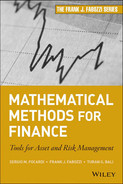
Mathematical Methods for Finance
The mathematical and statistical tools needed in the rapidly growing quantitative finance field
With the rapid growth in quantitative finance, practitioners must achieve a high level of proficiency in math and statistics. Mathematical Methods and Statistical Tools for Finance, part of the Frank J. Fabozzi Series, has been created with this in mind. Designed to provide the tools needed to apply finance theory to real world financial markets, this book offers a wealth of insights and guidance in practical applications.
It contains applications that are broader in scope from what is covered in a typical book on mathematical techniques. Most books focus almost exclusively on derivatives pricing, the applications in this book cover not only derivatives and asset pricing but also risk management—including credit risk management—and portfolio management.
* Includes an overview of the essential math and statistical skills required to succeed in quantitative finance
* Offers the basic mathematical concepts that apply to the field of quantitative finance, from sets and distances to functions and variables
* The book also includes information on calculus, matrix algebra, differential equations, stochastic integrals, and much more
* Written by Sergio Focardi, one of the world's leading authors in high-level finance
Drawing on the author's perspectives as a practitioner and academic, each chapter of this book offers a solid foundation in the mathematical tools and techniques need to succeed in today's dynamic world of finance.
eBook

The basics of financial econometrics : tools, concepts, and asset management applications
An accessible guide to the growing field of financial econometrics
As finance and financial products have become more complex, financial econometrics has emerged as a fast-growing field and necessary foundation for anyone involved in quantitative finance. The techniques of financial econometrics facilitate the development and management of new financial instruments by providing models for pricing and risk assessment. In short, financial econometrics is an indispensable component to modern finance.
The Basics of Financial Econometrics covers the commonly used techniques in the field without using unnecessary mathematical/statistical analysis. It focuses on foundational ideas and how they are applied. Topics covered include: regression models, factor analysis, volatility estimations, and time series techniques.
* Covers the basics of financial econometrics—an important topic in quantitative finance
* Contains several chapters on topics typically not covered even in basic books on econometrics such as model selection, model risk, and mitigating model risk
Geared towards both practitioners and finance students who need to understand this dynamic discipline, but may not have advanced mathematical training, this book is a valuable resource on a topic of growing importance.
eBook

The handbook of commodity investing
Filled with a comprehensive collection of information from experts in the commodity investment industry, this detailed guide shows readers how to successfully incorporate commodities into their portfolios. Created with both the professional and individual investor in mind, The Handbook of Commodity Investments covers a wide range of issues, including the risk and return of commodities, diversification benefits, risk management, macroeconomic determinants of commodity investments, and commodity trading advisors. Starting with the basics of commodity investments and moving to more complex.
eBook

A spontaneous Escherichia coli K12 mutant which inhibits the excision-reintegration process of Mu gem2ts
Escherichia coli K12 strains lysogenic for Mu
gem2ts with the prophage inserted in a target gene (i.e.,
lacZ::Mu
gem2ts lysogenic strains) revert to Lac
+ by prophage precise excision with a relatively high frequency (about 1×10
−6). The revertants obtained are still lysogens with the prophage inserted elsewhere in the bacterial chromosome. We have observed that, with the time of storage in stabs, bacterial cultures lysogenic for Mu
gem2ts lose the ability to excise the prophage. The mutation responsible for this effect was co-transducible with the
gyrB gene. After the removal of the prophage by P1
vir transduction from these strains, one randomly chosen clone, R3538, was further analyzed. It shows an increment of DNA supercoiling of plasmid pAT153, used as a reporter, and a reduced β-galactosidase activity. On the other hand, R3538 is totally permissive to both lytic and lysogenic cycles of bacteriophage Mu.
Journal Article
A spontaneous Escherichia coli K12 mutant which inhibits the excision-reintegration process of Mu gem2ts
Abstract
Escherichia coli K12 strains lysogenic for Mu gem2ts with the prophage inserted in a target gene (i.e., lacZ::Mu gem2ts lysogenic strains) revert to Lac+ by prophage precise excision with a relatively high frequency (about 1×10⁻⁶). The revertants obtained are still lysogens with the prophage inserted elsewhere in the bacterial chromosome. We have observed that, with the time of storage in stabs, bacterial cultures lysogenic for Mu gem2ts lose the ability to excise the prophage. The mutation responsible for this effect was co-transducible with the gyrB gene. After the removal of the prophage by P1 vir transduction from these strains, one randomly chosen clone, R3538, was further analyzed. It shows an increment of DNA supercoiling of plasmid pAT153, used as a reporter, and a reduced β-galactosidase activity. On the other hand, R3538 is totally permissive to both lytic and lysogenic cycles of bacteriophage Mu.
Journal Article