
Catalogue Search | MBRL


Are you sure you want to remove the book from the shelf?

{{itemTitle}}
12
result(s) for
"Fairfield, Paul, 1966-"
Sort by:

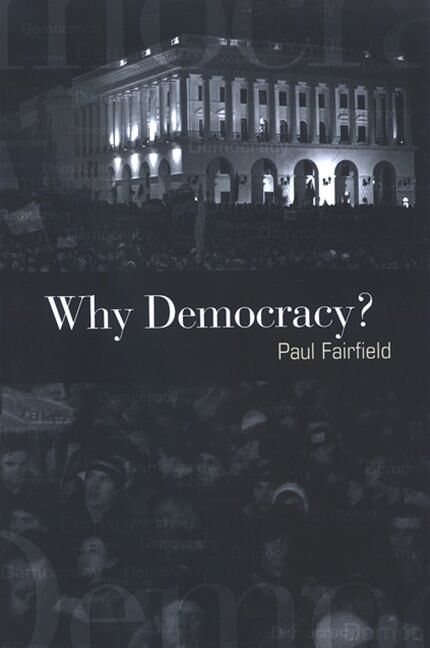
Why Democracy?
While much of the world now embraces the democratic idea—that the people must rule—the philosophical case for democracy has yet to be made convincingly. Why Democracy? not only reexamines the current debates in normative democratic theory, but also challenges popular conceptions that tend toward an uncritical idealization of popular rule. It is not enough to call for more extensive public deliberation, or for greater participation and inclusion in the democratic process, or for a radical extension of the scope of the process. Making the case for democracy requires examining its imaginative and rhetorical dimensions as well. The democratic idea of \"rule by the people\" must be understood less as a definition than as an aspiration, a trope, and the beginning of a narrative that includes, while extending beyond, the domain of government.
eBook

Education after Dewey
\"This study re-examines John Dewey's philosophy of education, and asks how well it stands up today in view of developments in Continental European philosophy\" -- Provided by publisher.
Book
Education, Dialogue and Hermeneutics
Philosophical hermeneutics has rich implications for the theory and practice of education, yet the topic has often been ignored. Education, Dialogue and Hermeneutics takes a variety of principles and themes from philosophical hermeneutics, drawing on insights from major figures such as Martin Heidegger, Hans-Georg Gadamer and Paul Ricoeur, and applies them to issues in education and the philosophy of education. Topics covered include the relevance and nature of dialogue and understanding in an educational setting, the nature of educational experience and the concept of Bildung, narrative and tradition. Timely and original, Education, Dialogue and Hermeneutics draws together eight original chapters written by leading scholars in the field of hermeneutics.
eBook


Death and Life
This erudite reflection strikes home as baby-boomers watch their parents fade (leaving them next in line) and find it hard to go on ignoring the reality of death. It is within our human nature to turn our minds away from death: we focus on our life choic.
eBook

Education and conversation : exploring Oakeshott's legacy
\"Since Michael Oakeshott spoke of education as initiation into \"the conversation of mankind\" more than fifty years ago, the idea has inspired a diverse array of thinkers and continues to be invoked today by those seeking to resist the influence of managerialism and narrow instrumentalism in educational policy and practice. Education and Conversation draws together papers written by scholars from both the analytic and continental philosophical traditions to offer a variety of perspectives on the implications of Oakeshott's educational ideas. The metaphor of the conversation of mankind is explored, together with the roots of Oakeshott's thinking in his early philosophical work, the relevance of his ideas to the concept of Bildung, and the significance of his political conservatism in evaluating the seemingly progressive potential of his educational ideas. In addition, concepts prominent in Oakeshott's thought are taken up and brought to bear on contemporary philosophical discussions about education, learning and development, including the nature of initiation, the phenomenology of listening, and the value of the liberal arts tradition. Education and Conversation shows how the idea of conversation illuminates both the character and the ends of education, yielding insight into the scope and limits of the philosophy of education and the character of philosophical inquiry more generally\"-- Provided by publisher.
Book
Philosophical hermeneutics reinterpreted : dialogues with existentialism, pragmatism, critical theory and postmodernism
In this important new study, Paul Fairfield examines a number of issues of central importance to philosophical hermeneutics. His aim is less to reexamine the basic hypotheses of hermeneutics (Gadamer's hermeneutics in particular) than to understand it in relational terms, by bringing it into closer association with existentialism, pragmatism, critical theory, and postmodernism. Fairfield contends that there are important affinities and areas for critical exchange between hermeneutics and these four schools of thought which have, until now, remained underappreciated. Philosophical Hermeneutics Reinterpreted examines several of these connections by interpreting hermeneutics in relation to specific themes in the writings of key figures within each of these traditions. In so doing, he both clarifies some outstanding issues in hermeneutics and advances the subject beyond what Heidegger, Gadamer, and Ricoeur have given us.
eBook

John Dewey and Continental philosophy
This volume comprises thirteen original essays by prominent scholars, all of which bring the philosophy of John Dewey into conversation with several currents in continental European thought, including Hegel, Nietzsche, Heidegger, Gadamer, Foucault, Derrida, and Deleuze.
eBook
