
Catalogue Search | MBRL


Are you sure you want to remove the book from the shelf?

{{itemTitle}}
110
result(s) for
"Falcon, Andrea"
Sort by:

Aristotelianism in the first century BCE : Xenarchus of Seleucia
\"A full study of the remaining evidence for Xenarchus of Seleucia, one of the earliest interpreters of Aristotle. Andrea Falcon places the evidence in its context, the revival of interest in Aristotle's philosophy that took place in the first century BCE. Xenarchus is often presented as a rebel, challenging Aristotle and the Aristotelian tradition. This book argues that there is more to Xenarchus and his philosophical activity than an opposition to Aristotle; he was a creative philosopher, and his views are best understood as an attempt to revise and update Aristotle's philosophy. By looking at how Xenarchus negotiated different aspects of Aristotle's philosophy, this book highlights elements of rupture as well as strands of continuity within the Aristotelian tradition\"-- Provided by publisher.
Book

Lévy movements and a slowly decaying memory allow efficient collective learning in groups of interacting foragers
Many animal species benefit from spatial learning to adapt their foraging movements to the distribution of resources. Learning involves the collection, storage and retrieval of information, and depends on both the random search strategies employed and the memory capacities of the individual. For animals living in social groups, spatial learning can be further enhanced by information transfer among group members. However, how individual behavior affects the emergence of collective states of learning is still poorly understood. Here, with the help of a spatially explicit agent-based model where individuals transfer information to their peers, we analyze the effects on the use of resources of varying memory capacities in combination with different exploration strategies, such as ordinary random walks and Lévy flights. We find that individual Lévy displacements associated with a slow memory decay lead to a very rapid collective response, a high group cohesion and to an optimal exploitation of the best resource patches in static but complex environments, even when the interaction rate among individuals is low.
Journal Article

Practices of public procurement and the risk of corrupt behavior before and after the government transition in México
Corruption has a significant impact on economic growth, democracy, and inequality. It has sever consequences at the human level. Public procurement, where public resources are used to purchase goods or services from the private sector, are particularly susceptible to corrupt practices. However, government turnover may bring significant changes in the way public contracting is done, and thus, in the levels and types of corruption involved in public procurement. In this respect, México lived a historical government transition in 2018, with the new government promising a crackdown on corruption. In this work, we analyze data from more than 1.5 million contracts corresponding from 2013 to 2020, to study to what extent this change of government affected the characteristics of public contracting, and we try to determine whether these changes affect how corruption takes place. To do this, we propose a statistical framework to compare the characteristics of the contracting practices within each administration, separating the contracts in different classes depending on whether or not they were made with companies that have now been identified as being involved in corrupt practices. We find that while the amount of resources spent with companies that turned out to be corrupt has decreased substantially, many of the patterns followed to contract these companies were maintained, and some of those in which changes did occur, are suggestive of a larger risk of corruption.
Journal Article

Aristotle on longevity
My aim is to examine the extent to which Aristotle achieves his stated goal. I concentrate on the explanatory strategy adopted in the De longitudine et brevitate vitae ( On Length and Shortness of Life ), where Aristotle offers an account of longevity that is not programmatically restricted to animals. I will discuss the prospects, as well as the limits, of this joint study of animals and plants. How much is Aristotle really able to say on the topic of longevity that applies to both animals and plants? Answering this question is at the heart of my essay.
Journal Article


División, definición y diferencia en los \Tópicos\
In the Topics Aristotle makes large use of division and constantly presupposes familiarity with this method on the part of the reader. But he never provides either an official presentation or a direct discussion of division. The author would like to focus on Aristotle's use of division in order to show how it can be exploited to shed some light on the particular method of division which Aristotle implicitly accepts, and relies on, in the Topics in order to get clearer about certain basic rules governing the choice of the differentia in a division.
Journal Article

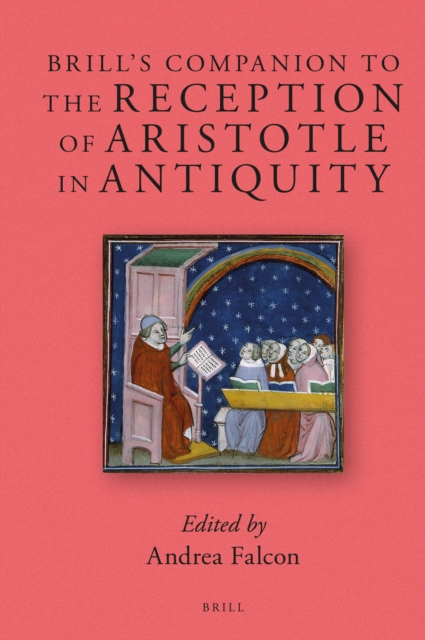
Brill's Companion to the Reception of Aristotle in Antiquity
To date, no comprehensive account has been published to explain the complex phenomenon of the reception of Aristotle's philosophy in Antiquity. This Companion fills this lacuna by offering broad coverage of the subject from Hellenistic times to the sixth century AD.
eBook
