
Catalogue Search | MBRL


Are you sure you want to remove the book from the shelf?

{{itemTitle}}
103
result(s) for
"Fanzo, Jessica"
Sort by:
Equity, technological innovation and sustainable behaviour in a low-carbon future
The world must ambitiously curtail greenhouse gas emissions to achieve climate stability. The literature often supposes that a low-carbon future will depend on a mix of technological innovation—improving the performance of new technologies and systems—as well as more sustainable behaviours such as travelling less or reducing waste. To what extent are low-carbon technologies, and their associated behaviours, currently equitable, and what are potential policy and research implications moving forward? In this Review, we examine how four innovations in technology and behaviour—improved cookstoves and heating, battery electric vehicles, household solar panels and food-sharing—create complications and force trade-offs on different equity dimensions. We draw from these cases to discuss a typology of inequity cutting across demographic (for example, gender, race and class), spatial (for example, urban and rural divides), interspecies (for example, human and non-human) and temporal (for example, future generations) vulnerabilities. Ultimately, the risk of inequity abounds in decarbonization pathways. Moreover, low-carbon innovations are not automatically just, equitable or even green. We show how such technologies and behaviours can both introduce new inequalities and reaffirm existing ones. We then discuss potential policy insights and leverage points to make future interventions more equitable and propose an integrated research agenda to supplement these policy efforts.Low-carbon innovations in technology and behaviour are increasingly prevalent, but they are not always equitable. This Review examines how such innovations can introduce and perpetrate inequalities, and discusses ways to ensure that a low-carbon future is both sustainable and equitable.
Journal Article

Estimating the environmental impacts of 57,000 food products
Understanding and communicating the environmental impacts of food products is key to enabling transitions to environmentally sustainable food systems [El Bilali and Allahyari, Inf. Process. Agric. 5, 456–464 (2018)]. While previous analyses compared the impacts of food commodities such as fruits, wheat, and beef [Poore and Nemecek, Science 360, 987–992 (2018)], most food products contain numerous ingredients. However, because the amount of each ingredient in a product is often known only by the manufacturer, it has been difficult to assess their environmental impacts. Here, we develop an approach to overcome this limitation. It uses prior knowledge from ingredient lists to infer the composition of each ingredient, and then pairs this with environmental databases [Poore and Nemecek Science 360, 987–992 (2018); Gephart et al., Nature 597, 360–365 (2021)] to derive estimates of a food product’s environmental impact across four indicators: greenhouse gas emissions, land use, water stress, and eutrophication potential. Using the approach on 57,000 products in the United Kingdom and Ireland shows food types have low (e.g., sugary beverages, fruits, breads), to intermediate (e.g., many desserts, pastries), to high environmental impacts (e.g., meat, fish, cheese). Incorporating NutriScore reveals more nutritious products are often more environmentally sustainable but there are exceptions to this trend, and foods consumers may view as substitutable can have markedly different impacts. Sensitivity analyses indicate the approach is robust to uncertainty in ingredient composition and in most cases sourcing. This approach provides a step toward enabling consumers, retailers, and policy makers to make informed decisions on the environmental impacts of food products.
Journal Article

Food Environment Typology: Advancing an Expanded Definition, Framework, and Methodological Approach for Improved Characterization of Wild, Cultivated, and Built Food Environments toward Sustainable Diets
The food environment is a critical place in the food system to implement interventions to support sustainable diets and address the global syndemic of obesity, undernutrition, and climate change, because it contains the total scope of options within which consumers make decisions about which foods to acquire and consume. In this paper, we build on existing definitions of the food environment, and provide an expanded definition that includes the parameter of sustainability properties of foods and beverages, in order to integrate linkages between food environments and sustainable diets. We further provide a graphical representation of the food environment using a socio-ecological framework. Next, we provide a typology with descriptions of the different types of food environments that consumers have access to in low-, middle-, and high-income countries including wild, cultivated, and built food environments. We characterize the availability, affordability, convenience, promotion and quality (previously termed desirability), and sustainability properties of food and beverages for each food environment type. Lastly, we identify a methodological approach with potential objective and subjective tools and metrics for measuring the different properties of various types of food environments. The definition, framework, typology, and methodological toolbox presented here are intended to facilitate scholars and practitioners to identify entry points in the food environment for implementing and evaluating interventions that support sustainable diets for enhancing human and planetary health.
Journal Article

Is voluntary certification of tropical agricultural commodities achieving sustainability goals for small-scale producers? A review of the evidence
Over the last several decades, voluntary certification programs have become a key approach to promote sustainable supply chains for agricultural commodities. These programs provide premiums and other benefits to producers for adhering to environmental and labor practices established by the certifying entities. Following the principles of Cochrane Reviews used in health sciences, we assess evidence to evaluate whether voluntary certification of tropical agricultural commodities (bananas, cocoa, coffee, oil palm, and tea) has achieved environmental benefits and improved economic and social outcomes for small-scale producers at the level of the farm household. We reviewed over 2600 papers in the peer-review literature and identified 24 cases of unique combinations of study area, certification program, and commodity in 16 papers that rigorously analyzed differences between treatment (certified households) and control groups (uncertified households) for a wide range of response variables. Based on analysis of 347 response variables reported in these papers, we conclude that certification is associated on average with positive outcomes for 34% of response variables, no significant difference for 58% of variables, and negative outcomes for 8% of variables. No significant differences were observed for different categories of responses (environmental, economic and social) or for different commodities (banana, coffee and tea), except negative outcomes were significantly less for environmental than other outcome categories (p = 0.01). Most cases (20 out of 24) investigated coffee certification and response variables were inconsistent across cases, indicating the paucity of studies to conduct a conclusive meta-analysis. The somewhat positive results indicate that voluntary certification programs can sometimes play a role in meeting sustainable development goals and do not support the view that such programs are merely greenwashing. However, results also indicate that certification is not a panacea to improve social outcomes or overall incomes of smallholder farmers. Rigorous analysis, standardized criteria, and independent evaluation are needed to assess effectiveness of certification programs in the future.
Journal Article

Global drivers of food system (un)sustainability: A multi-country correlation analysis
At present, our ability to comprehend the dynamics of food systems and the consequences of their rapid 'transformations' is limited. In this paper, we propose to address this gap by exploring the interactions between the sustainability of food systems and a set of key drivers at the global scale. For this we compile a metric of 12 key drivers of food system from a globally-representative set of low, middle, and high-income countries and analyze the relationships between these drivers and a composite index that integrates the four key dimensions of food system sustainability, namely: food security & nutrition, environment, social, and economic dimensions. The two metrics highlight the important data gap that characterizes national systems' statistics-in particular in relation to transformation, transport, retail and distribution. Spearman correlations and Principal Component Analysis are then used to explore associations between levels of sustainability and drivers. With the exception of one economic driver (trade flows in merchandise and services), the majority of the statistically significant correlations found between food system sustainability and drivers appear to be negative. The fact that most of these negative drivers are closely related to the global demographic transition that is currently affecting the world population highlights the magnitude of the challenges ahead. This analysis is the first one that provides quantitative evidence at the global scale about correlations between the four dimensions of sustainability of our food systems and specific drivers.
Journal Article

The Role of Food and Nutrition System Approaches in Tackling Hidden Hunger
One of the World’s greatest challenges is to secure sufficient and healthy food for all, and to do so in an environmentally sustainable manner. This review explores the interrelationships of food, health, and environment, and their role in addressing chronic micronutrient deficiencies, also known as “hidden hunger”, affecting over two billion people worldwide. While the complexity and underlying determinants of undernutrition have been well-understood for decades, the scaling of food and nutrition system approaches that combine sustainable agriculture aimed at improved diet diversity and livelihoods have been limited in their development and implementation. However, an integrated system approach to reduce hidden hunger could potentially serve as a sustainable opportunity.
Journal Article
Climate change and nutrition-associated diseases
Climate change has multiple negative effects on global public health; reduced quality and quantity of crops result in increased food and financial insecurities leading to malnutrition (undernutrition and obesity) and diet-related non-communicable diseases, such as diabetes mellitus and cardiovascular diseases. In addition, food systems substantially contribute to greenhouse gas emissions and a shift towards sustainability is required to preserve human and planetary health.
Journal Article
Food security and livelihoods of post-resettlement households around Kanha National Park
Globally, conservation efforts have moved millions of people out of protected areas since the 1970s, yet quantitative studies on post-resettlement well-being remain a challenge due to poor documentation. Since 2008, the Indian forest department records demographic and financial details at the household level under standardized guidelines for resettlement. Here, we examine the food security of approximately 600 households’ post-resettlement from Kanha National Park (KNP) in central India between 2009 and 2014. We compare food security of resettled households with host community households with a total of 3519 household surveys, conducted over three seasons within one year. We measure food security using food consumption scores (FCSs), coping strategies index (CSI) and household hunger scale (HHS). Food insecurity is widespread in the landscape, with over 80% of households reporting poor or borderline FCSs year-round. Additionally, we recorded food insecurity increases in monsoon for all households regardless of resettlement status. Results indicate that resettled households are comparable to their host community neighbors in FCS and all households use mild coping strategies to combat food insecurity. While widespread, food insecurity in the KNP landscape is not acute with very few (<10) reports of severe hunger (as measured by the HHS). Almost all foods are market bought (>90%) and sometimes supplemented by gathering locally prevalent greens or from kitchen gardens (forest dependency for food was negligible). Accruing assets and diversifying incomes from non-labor avenues would alleviate food insecurity for all households. The patterns of market dependence and food security associated with diversified stable incomes around protected areas is in contrast with many studies but is likely to occur in similar human-dominated landscapes.
Journal Article

Advancing an Integrative Framework to Evaluate Sustainability in National Dietary Guidelines
The food system is responsible for some of society's most pressing sustainability challenges. Dietary guidelines are one policy tool to help address the multiple sustainability challenges associated with food systems through dietary recommendations that better support environmental and human well-being. This article develops and applies a sustainability framework scoring tool comprised of four key dimensions (environmental, economic, human health, and sociocultural and political) and 32 sub-dimensions of sustainable food systems for the analysis and modification of national dietary guidelines. Two coders pilot tested the framework to quantify the occurrence of sustainability dimensions and sub-dimensions in national and regional dietary guidelines of 12 randomly selected high-income and upper-middle income countries including Albania, Australia, Brazil, the Grenadines, Grenada, Qatar, Netherlands, Nordic Countries, St. Vincent, Sweden, Thailand, the United Kingdom, and the United States. Sustainability Dimension Scores (SDS) were calculated as a percentage of the occurrence of the eight sub-dimensions comprising each sustainability dimension and Total Sustainability Scores (TSS) were calculated as a percentage of the occurrence of the 32 sub-dimensions in each guideline. Inter-rater reliability of TSS and SDS indicated high validity of applying the sustainability framework for dietary guidelines. SDS varied between the four sustainability dimensions with human health being the most represented in the dietary guidelines examined, as hypothesized (average SDS score of 83%; range from 50 to 100%). Significant differences ( p < 0.0001) were found in mean SDS between the four sustainability dimensions. Overall, results indicate that the ecological (average SDS score of 31%; range from 0 to 100%) economic (average SDS score of 29%; range from 0 to 100%), and socio-cultural and political (average SDS score of 44%; range of 0–100%) dimensions of sustainability are underrepresented in the examined national dietary guidelines with significant differences in SDS between guidelines ( p < 0.0001). TSS varied by country between 12 and 74% with a mean score of 36% (± 20%). Brazil had the highest TSS (74%) followed by Australia (69%). The sustainability framework presented here can be applied by policy makers, researchers, and practitioners to identify gaps and opportunities to modify national dietary guidelines and associated programs for transforming food systems through diets that support planetary health.
Journal Article
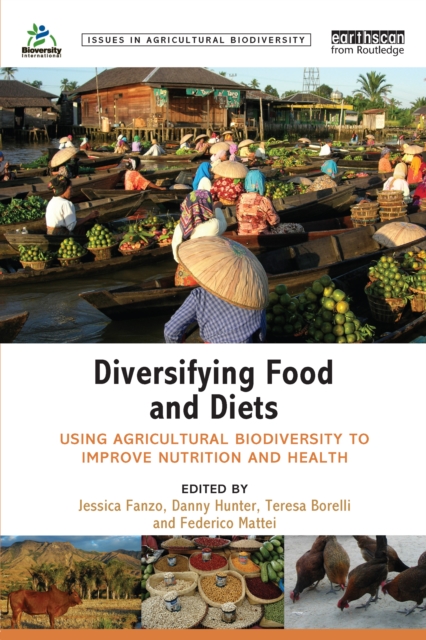
Diversifying Food and Diets
Currently 868 million people are undernourished and 195 million children under five years of age are stunted. At the same time, over 1 billion people are overweight and obese in both the developed and developing world. Diseases previously associated with affluence, such as cancer, diabetes and cardio-vascular disease, are on the rise. Food system-based approaches to addressing these problems that could enhance food availability and diet quality through local production and agricultural biodiversity often fall outside the traditional scope of nutrition, and have been under-researched. As a consequence, there remains insufficient evidence to support well-defined, scalable agricultural biodiversity interventions that can be linked to improvements in nutrition outcomes.
Agricultural biodiversity is important for food and nutritional security, as a safeguard against hunger, a source of nutrients for improved dietary diversity and quality, and strengthening local food systems and environmental sustainability. This book explores the current state of knowledge on the role of agricultural biodiversity in improving diets, nutrition and food security. Using examples and case studies from around the globe, the book explores current strategies for improving nutrition and diets and identifies key research and implementation gaps that need to be addressed to successfully promote the better use of agricultural biodiversity for rural and urban populations and societies in transition.
eBook