
Catalogue Search | MBRL


Are you sure you want to remove the book from the shelf?

{{itemTitle}}
18
result(s) for
"Fassbinder, Samuel Day"
Sort by:

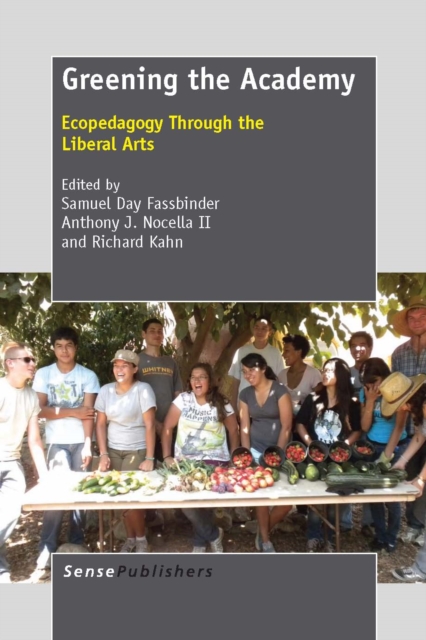
Greening the Academy
While it has become increasingly clear that facilitating the sustainability movement is the great 21st century educational challenge at hand, this book asserts that it is both a dangerous and criminal development today that sustainability in higher education has come to be defined by the complex-friendly \"green campus\" initiatives of science, technology, engineering and management programs.
eBook

History and Hope from the Present Moment: Peter McLaren and Revolutionary Critical Pedagogy
Examines the redesign of education as a vital component of the transitioning to the post-capitalist world society of the future. Attention is called to the current crisis of abrupt climate change coupled with the unraveling of the capitalist system as illustrated by the dollar decline & mortgage shakedown. Emphasis is placed on the need for a critical pedagogy that goes beyond teaching against domination to prepare students to support social change. The revolutionary critical pedagogy of Peter McLaren (1948-) which expands upon the work of Paulo Freire (1921-1997) is drawn upon to propose specific methods of addressing social change. The curricula of McLarens revolutionary critical pedagogy engages students in a three-pronged approach that progresses from a pedagogy of demystification, in which dominant sign systems are recognized & denaturalized, to a pedagogy of opposition, in which students analyze political systems/ideologies/histories; & finally a pedagogy of revolution where deliberative practices for transforming the social universe of capital are developed & put into practice. The application of a revolutionary critical pedagogy to ecological practice is described. J. Lindroth
Journal Article

Teresa Brennan (1952-2003): A Retrospective
The promise of instant gratification offered by the vending machine that provides instantly upon the insertion of a coin, the fastfood establishment that promises no delay, the internet connection that promises immediate access are, for Brennan, all evidence that the promise of service appeals to a desire for domination and control. The principal form of market economy that predated capitalism, and might succeed it, had a different relation to space and time. Globalization and its Terrors itself is full of criticism of the products of this creativity (e.g. genetic engineering); its purpose in Brennan's Utopia is left undiscussed.
Journal Article
Greening Education
Environmental education in all eras has taught about the natural world: the passing on of knowledge about nature is what has counted as education over most of the human race’s 200,000-year existence. “Environmental education” is, however, a term now connected to the relatively recent birth of environmentalism, and of the perception of environmental problems: Joy A. Palmer’s Environmental Education in the 21st Century suggests that environmental education began on a global level with the 1968 UNESCO Biosphere Conference, in Paris, which “called for the development of curriculum materials relating to studying the environment for all levels of education, the promotion of technical training, and the stimulation of global awareness of environmental problems.”
Book Chapter
