
Catalogue Search | MBRL


Are you sure you want to remove the book from the shelf?

{{itemTitle}}
17
result(s) for
"Fell, Hans-Josef"
Sort by:


An Economically Viable 100% Renewable Energy System for All Energy Sectors of Germany in 2030
To be able to fulfil the Paris Climate Agreement and keep global warming with reasonable confidence at a maximum of 1.5 °C above pre-industrial levels, Germany must set an end to all greenhouse gas emissions by 2030. At the core of this task is the switch to 100% renewables across all sectors on the same time horizon. Conventional technologies fueled by fossil and nuclear energies are, according to the vast majority of current cost calculations, energetically inefficient, too expensive, and too slow in expansion to be able to deliver a substantial contribution to rapid climate protection. We present the first comprehensive energy scenario that shows the way to 100% renewable energy for all energy sectors by 2030. The result of the calculations is a cost-effective energy system that is compatible with the German share of necessary greenhouse gas reduction. This study shows a target system of generation, conversion, and storage technologies that can achieve the transformation to 100% renewable energy in all energy sectors—electricity, heat, and mobility—in time and at competitive costs below the costs of the current system. Moreover, we demonstrate the huge cost effect that arises if southern Germany renounces its onshore wind resources and find that this would substantially increase the need for high-voltage direct-current transmission capacity.
Journal Article

Urban-Rural Cooperation for an Economy with 100% Renewable Energy and Climate Protection towards 2030 - the Region Berlin-Brandenburg
The German states of Berlin and Brandenburg are committed to the Paris Agreement with the goal of keeping global warming safely below 2 degrees to protect the Earth system from uncontrollable warming. This claim implies targeting 1.5 degrees to keep a reasonable chance of realisation. Renewable energies are the only sources that can be considered to accomplish this task. We use a linear cost minimization model for the Berlin-Brandenburg region to show how a 100% renewable energy target is possible without relying on contributions from other regions. We find that a 100% renewable energy system based predominantly on photovoltaics on buildings and on green hydrogen production, and a transition essentially to electricity for all purposes, is feasible in time and at a reasonable cost below that of fossil-nuclear energy. Hydrogen storage technology appears as one of the key cost determinants, while a sensible integration of German and European transition systems potentially limits costs to the lowest levels ever realized in real terms.
Journal Article
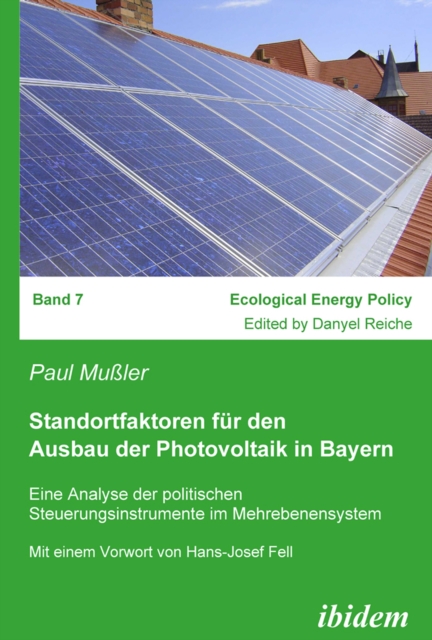
Standortfaktoren fur den Ausbau der Photovoltaik in Bayern: Eine Analyse der politischen Steuerungs-instrumente im Mehrebenensystem
Beinahe die Halfte aller deutschlandweit installierten Photovoltaikanlagen wurde in Bayern errichtet. Damit sind allein im Freistaat mehr Photovoltaikanlagen montiert als in den zweit- und drittgroten Photovoltaikmarkten Japan und den USA zusammengenommen. Paul Muler fragt in seiner vorliegenden Untersuchung nach den Erklarungsdeterminanten fur den bayerischen Photovoltaikcluster. Nicht etwa die Landespolitik als solche, sondern in erster Linie das technische Nutzungspotenzial, die bundespolitischen Initiativen und die Aktivitaten der Kommunen sowie zivilgesellschaftlicher Akteure und Unternehmen sind nach Mulers Einschatzung mageblich fur den Erfolg der Photovoltaik in Bayern. Der wissenschaftlichen Untersuchung Paul Mulers kommt das Verdienst zu, den Einfluss der bayerischen zivilen Gesellschaft auf den weltweit bestaunten Ausbau der Solarstromerzeugung in Bayern zu verdeutlichen. Diese zivilen, aus der Burgerschaft kommenden Krafte fur Erneuerbare Energien haben sich bis in die Gesetzgebung des Deutschen Bundestages hinein durchgesetzt - gegen die Interessen der konventionellen Energiewirtschaft sowie deren Verbundeter aus Politik und Medien. MdB Hans-Josef Fell, Sprecher fur Energie, Technologie- und Energieexperte der Fraktion BUNDNIS 90/DIE GRUNEN
eBook
The Importance of Energy Efficiency Measures
This chapter contains sections titled:
Traditional Extrapolation of Future Energy Demands or Alternatively “The Same or with Renewables Even Better Quality of Life with Much Less Energy”
Decrease in End Energy Needs with a “Better Quality of Life”
Today's Energy Needs with Known Energy Efficiency Measures
Support Mechanisms to Facilitate New Products: Ban the Old or Facilitate the New Ones
Book Chapter
Likelihood of and Timeline for a World Powered by 100% Renewable Energy
This chapter contains sections titled:
Likelihood of a 100% Renewable World
Global Network or Local Autonomy?
Timeline for a 100% Renewable World
Book Chapter
The Astonishing Predictive Power of Price Experience Curves
This chapter contains sections titled:
Basics about Price Experience Curves
Relevant Price Experience Curves Comparable to PV
Lesson Learned from PECs Discussed
Price Experience Curve for PV Modules
Price Experience Curve for DC/AC Inverters
Price Experience Curve for Wind Energy and other Relevant Products for a 100% Renewable World
Book Chapter