
Catalogue Search | MBRL


Are you sure you want to remove the book from the shelf?

{{itemTitle}}
4
result(s) for
"Fink, Max, 1923- author"
Sort by:

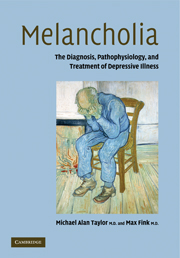
Melancholia
This book provides a comprehensive review of melancholia as a severe disorder of mood, associated with suicide, psychosis, and catatonia. The syndrome is defined with a clear diagnosis, prognosis, and range of management strategies, differentiated from other similar psychiatric, neurological, and general medical conditions. It challenges accepted doctrines in the classification and biology of the mood disorders and defines melancholia as a treatable mental illness. Described for millennia in medical texts and used as a term in literature and poetry, melancholia was included within early versions of the major diagnostic classificatory systems, but lost favour in later editions. This book updates the arguments for the diagnosis, describes its characteristics in detail, and promotes treatment and prevention. The book offers great hope to those with a disorder too often mis-diagnosed and often fatal. It should be read by all those responsible for the management of patients with mood disorders.
eBook

Electroshock : restoring the mind
Electroshock therapy (ECT) has long suffered from a controversial and bizarre public image, a reputation that has effectively removed it as a treatment option for many patients. In Electroshock, Max Fink, M.D., draws on 45 years of clinical and research experience to argue that ECT is now a safe, effective, painless, and sometimes life-saving treatment for emotional and mental disorders. Dr. Fink discusses the development of ECT from its discovery in 1934, its acceptance and widespread use for two decades until it was largely replaced by the introduction of psychotropic drugs in the 1950s, and its revival in the past twenty years as a viable treatment now that undesirable side-effects have been largely removed. He provides case studies of actual patients and the testimonies of their family members to illuminate successful responses. Many disorders, such as depression, mania, catatonia, and schizophrenia, respond well to ECT. We learn what the patient experiences, as the author explains the whole procedure from preparation to recovery. He also shows how anesthesia and muscle relaxation have refined ECT, minimizing discomfort and reducing its risks to a level far lower than many of the psychotropic drugs routinely prescribed for the same problems. An excellent sourcebook for patients, their families, caretakers, and mental health professionals, Electroshock clarifies misconceptions about ECT. For those who suffer from mental and emotional disorders, it offers a safe and highly effective treatment.
eBook