
Catalogue Search | MBRL


Are you sure you want to remove the book from the shelf?

{{itemTitle}}
246
result(s) for
"Fink, Steven"
Sort by:


Fact, Fiction, and History in Philip Roth's \Eli, the Fanatic\
This essay explores the historical foundations for Philip Roth’s short story “Eli, the Fanatic” (1959) and the ways in which Roth both uses and manipulates historical facts—foreshadowing, in some respects, Roth’s later, more explicit postmodernist play with fact and fiction. In “Eli, the Fanatic,” Eli Peck is a young lawyer engaged by his fellow assimilated Jews of prosperous Woodenton, New York to evict a newly-arrived band of Hassidic Holocaust survivors who have set up a yeshiva in an old Woodenton mansion. The pretext for the eviction is that local zoning laws forbid the establishment of a boarding school in a residential area. Unacknowledged by Roth’s critics, the basis for this story was a real episode that took place in 1948, in which Holocaust survivor Rabbi Michael Dov Weissmandl established a yeshiva in Westchester County, New York for the orphaned remnants of the Nitra yeshiva in Slovakia. As in Roth’s story, some members of the community objected and brought the case before the local zoning board, though in the actual episode, it was chiefly gentile members of the community who reacted to the yeshiva. An essay on the episode by Herrymon Maurer, published in Commentary magazine in April 1949, seems to have been Roth’s source for the premise and many of the details of “Eli, the Fanatic.” The most notable differences between the accounts are Roth’s focus on the Jewish, rather than the gentile, community’s reaction to the yeshiva and the imaginative license Roth exercises consequent to this shift in emphasis.
Journal Article


Evaluation of Test to Stay Strategy on Secondary and Tertiary Transmission of SARS-CoV-2 in K–12 Schools — Lake County, Illinois, August 9–October 29, 2021
The COVID-19 pandemic has resulted in school closures and reduction of in-person learning (1). In August 2021, the Lake County Health Department (LCHD) in Illinois introduced a Test to Stay (TTS) strategy, whereby unvaccinated students, teachers, and staff members with certain school-related COVID-19 exposures could remain in school and participate in school-related extracurricular activities. Eligibility to participate in TTS required the following conditions to be met: 1) the exposure occurred while both the person with COVID-19 (index patient) and the close contact were masked; 2) the close contact remained asymptomatic, practiced consistent mask wearing, and maintained physical distancing; and 3) the close contact underwent testing for SARS-CoV-2 (the virus that causes COVID-19) on days 1, 3, 5, and 7 after exposure to the index patient. LCHD permitted kindergarten through grade 12 (K-12) schools in Lake County to implement TTS; 90 schools, representing 31 school districts in Lake County, implemented TTS during August 9-October 29, 2021. During the implementation period, 258 COVID-19 cases were reported. Among 1,035 students and staff members enrolled in TTS, the secondary attack risk (number of close contacts who received a positive SARS-CoV-2 test result within 14 days after exposure to an index patient, divided by total number of close contacts) was 1.5% (16 of 1,035). Among the 16 secondary cases identified, all were in students, and none appeared to transmit SARS-CoV-2 to other school-based contacts. However, nine tertiary cases were identified among household contacts of the 16 secondary cases, and four of the nine were fully vaccinated. Assuming a maximum of 8 missed school days for every 10-day quarantine period, up to 8,152 in-person learning days were saved among TTS participants. Implementation of TTS with other concurrent prevention strategies, including masking and physical distancing, limited further spread of SARS-CoV-2 within K-12 schools and allowed students to safely sustain in-person learning. Although vaccination remains the leading public health recommendation to protect against COVID-19 for those aged ≥5 years, schools might consider TTS as an option for allowing close contacts who are not fully vaccinated to remain in the classroom as an alternative to home quarantine.
Journal Article

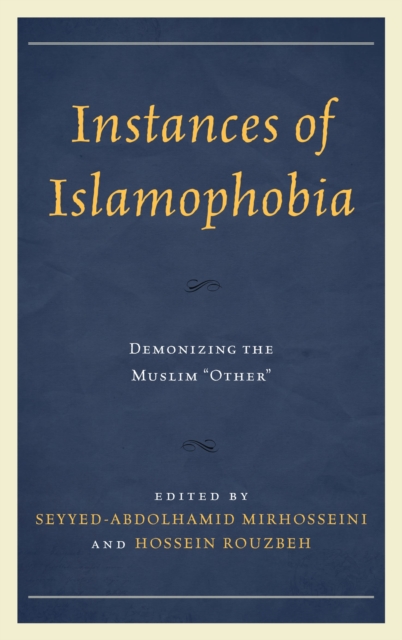
Instances of Islamophobia
Chapters of this volume, written by authorities from around the world, explore various instances of Islamophobia and examine discursive contexts such as media coverage and manipulation, political discourse, and general attitudes in the public sphere. The book extends existing discussions and highlights some hitherto less--debated concerns.
eBook


Preaching as reimagining: Christian thought in dialogue with North American Islam
This dissertation addresses how preaching can be an event in which the Bible or the Qur'an transforms listeners. I consider Walter Brueggemann's discussions of \"reimaginative preaching,\" organizing his ideas in accordance with a model that I find latent within his writings. This model comprises two elements regarding the content of reimaginative preaching (a diagnosis of idolatry and individualism and an alternative to idolatry and individualism) and two elements regarding its intended phenomenological structure (disruption and refiguration). I then expand upon the former through the thought of Karl Barth and the latter through writings of Paul Ricoeur. I draw upon these authors to substantiate Brueggemann's position that reimaginative preaching is an event in which the Bible can transform listeners. My intentions, however, take me beyond a consideration of preaching in Christianity. I discuss twenty-five North American Sunni khutbahs, or Friday sermons, that fit my model of reimaginative preaching. Surprisingly little scholarly attention has been given to preaching in Islam, especially in the North American context. I address this rather neglected topic from the standpoint of reimagination in order to promote greater understanding of Islamic preaching itself and also to consider its role in enabling Sunni Muslims to deal with problems and possibilities they face in contemporary North America. The twenty-five khutbahs I discuss primarily address either living in a largely materialistic, individualistic society or discouragement and despair after September 11. I argue that in each khutbah an alternative to idolatry and individualism is presented by way of an overarching idea, linked to at least one Qur'anic verse or passage, intended to disrupt and refigure listeners' interpretation of existence. Since arriving at this understanding of a type of preaching in Islam is rooted in thought from a different religious tradition, the final chapter of this dissertation identifies potential problems in comparative religious studies. Relating my use of a model to Hans-Georg Gadamer's understanding of dialogue, I propose that models may be a way forward for comparative studies in religion, not eradicating their problems but able to minimize them significantly.
Dissertation