
Catalogue Search | MBRL


Are you sure you want to remove the book from the shelf?

{{itemTitle}}
18
result(s) for
"Fish, Stanley Eugene"
Sort by:

Versions of antihumanism : Milton and others
\"Stanley Fish, one of the foremost critics of literature working today, has spent much of his career writing and thinking about Milton. This book brings together his finest published work with brand new material on Milton and on other authors and topics in early modern literature. In his analyses of Renaissance texts, he meditates on the interpretive problems that confront readers and offers a sustained critique of historicist methods of interpretation. Intention, he argues, is key to understanding which pieces of historical data are relevant to literary criticism. Lucid, provocative, direct and inimitable, this new book from Stanley Fish is required reading for anyone teaching or studying Milton and early modern literary studies\"--Provided by publisher.
Book
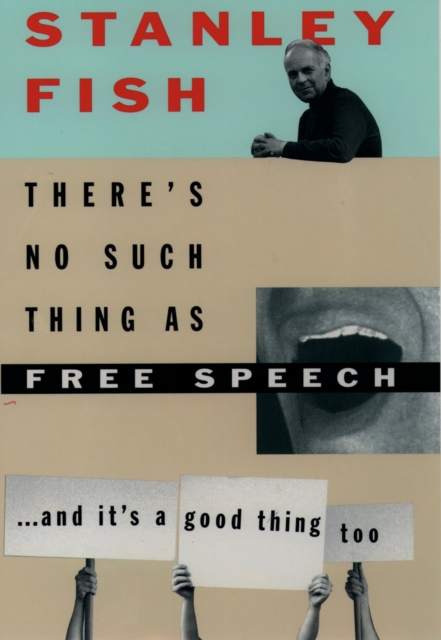
There's no such thing as free speech, and it's a good thing, too
I appear before you, writes Stanley Fish, \"by virtue of a mistake made by central casting which has tapped me for the role of ardent academic leftist, proponent of multiculturalism, and standard bearer of the politically correct.\" Indeed, as head of Duke University's English Department, Fish has drawn fire for supposedly championing campus speech codes (he does not, in fact); for his embrace of deconstruction (he would call himself a pragmatist), and for being a \"professor who revels in his affluence\" (as one journalist wrote)--despite his own status as a white male and a leading scholar in the traditional field of Renaissance literature. But as Adam Begley wrote in The New York Times Sunday Magazine, Fish is \"the epitome of he academic as showman,\" a professor of both English and law who is \"willfully provocative, politically conservative.\" In There's No Such Thing as Free Speech, Fish shows what all the fuss is about, with seventeen of his pivotal, provocative writings. Fish ranges across reverse discrimination, the First Amendment and hate speech codes, the nature of the law, and the state of the academy, lending his distinctive, insistent voice to the debate with sharply drawn and closely argued opinions. He goes straight to the core of America's orthodox platitudes, arguing that such liberal stand-bys as free speech, tolerance, equality, and nondiscrimination are meaningless in themselves; these concepts only exist in the context of the political views of those who invoke them (the assault on civil rights, he notes, has advanced under the David Duke banner \"Equal Rights for All; Special Privileges for None\"). Throughout, Fish applies techniques of literary criticism to the political debate, forcing us to examine the basis of our most sacrosanct principles. In the title essay, Fish writes that the First Amendment is \"the first refuge of scoundrels.\" The concept of \"free speech\" always exists only in reference to speech which is banned in advance because it undermines the basis of a community; it takes a political struggle to decide where to draw the boundary of tolerance--and he finds good reason to put \"hate speech beyond the pale. If left-leaning readers take comfort from such arguments, they will be discomforted in the second part of the book when Fish turns his searing critical attention to some of their cherished ideals and programs (including the expansion of tolerance and the politicization of humanistic studies). He concludes his critique of the academy by mocking the masochistic consumption of Volvos by affluent professors. Perhaps no other scholar in America has earned the notoriety achieved by Stanley Fish--notoriety he seems compelled to justify, relentlessly critiquing the values so many take for granted. This remarkable volume captures the essential Fish, with eloquent, witty, argumentative essays that are impossible to ignore.
eBook
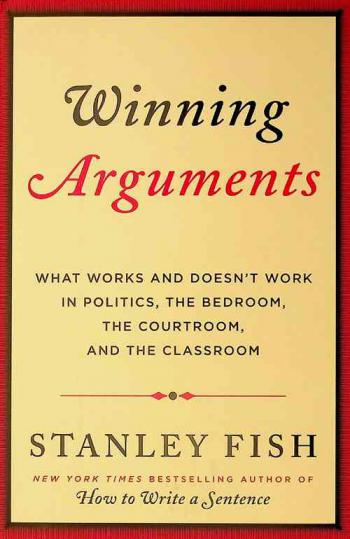
Winning arguments : what works and doesn't work in politics, the bedroom, the courtroom, and the classroom
\"Stanley Fish, the notoriously brash and brilliant English and Law professor, has authored dozens of academic books on subjects ranging from Milton to freedom of speech. In 2011, Fish turned his eye to a more popular subject, the art of writing great sentences. His short, wise book How to Write a Sentence became an instant New York Times Bestseller and continues to be read by students and aspiring writers. Adam Haslet called the book, \"deeper and more democratic than The Elements of Style.\" If great sentences are, in effect, performances at the highest level, Fish acts as a lively sportscaster giving the reader a blow-by-blow. In Winning Arguments, Fish employs this same wit and observational prowess as he guides readers through the \"greatest hits\" of rhetoric including landmark legal cases, arguments drawn from popular film and TV, and even Fish's own career. The success of books like Jay Heinrich's Thank You For Arguing demonstrate a clear audience for fun, intellectually nourishing books that make you feel just a little bit smarter for having read them. Like How to Write a Sentence, Winning Arguments will become a modern classic\"-- Provided by publisher.
Book
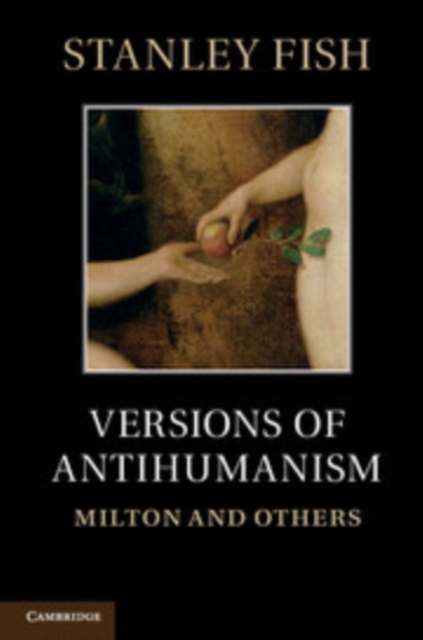
Versions of Anti-Humanism: Milton and Others
Stanley Fish, one of the foremost critics of literature working today, has spent much of his career writing and thinking about Milton. This book brings together his finest published work with brand new material on Milton and on other authors and topics in early modern literature. In his analyses of Renaissance texts, he meditates on the interpretive problems that confront readers and offers a sustained critique of historicist methods of interpretation. Intention, he argues, is key to understanding which pieces of historical data are relevant to literary criticism. Lucid, provocative, direct and inimitable, this new book from Stanley Fish is required reading for anyone teaching or studying Milton and early modern literary studies.
eBook

The first : how to think about hate speech, campus speech, religious speech, fake news, post-truth, and Donald Trump
\"From celebrated public intellectual and New York Times bestselling author, Stanley Fish, comes an urgent and sharply observed look at one of the most hotly debated issues of our time: freedom of speech\"-- Provided by publisher.
BOOK
Versions of Antihumanism
Stanley Fish, one of the foremost critics of literature working today, has spent much of his career writing and thinking about Milton. This book brings together his finest published work with brand new material on Milton and on other authors and topics in early modern literature. In his analyses of Renaissance texts, he meditates on the interpretive problems that confront readers and offers a sustained critique of historicist methods of interpretation. Intention, he argues, is key to understanding which pieces of historical data are relevant to literary criticism. Lucid, provocative, direct and inimitable, this new book from Stanley Fish is required reading for anyone teaching or studying Milton and early modern literary studies.
eBook

Winning arguments : what works and doesn't work in politics, the bedroom, the courtroom, and the classroom
\"Stanley Fish, the notoriously brash and brilliant English and Law professor, has authored dozens of academic books on subjects ranging from Milton to freedom of speech. In 2011, Fish turned his eye to a more popular subject, the art of writing great sentences. His short, wise book How to Write a Sentence became an instant New York Times Bestseller and continues to be read by students and aspiring writers. Adam Haslet called the book, \"deeper and more democratic than The Elements of Style.\" If great sentences are, in effect, performances at the highest level, Fish acts as a lively sportscaster giving the reader a blow-by-blow. In Winning Arguments, Fish employs this same wit and observational prowess as he guides readers through the \"greatest hits\" of rhetoric including landmark legal cases, arguments drawn from popular film and TV, and even Fish's own career. The success of books like Jay Heinrich's Thank You For Arguing demonstrate a clear audience for fun, intellectually nourishing books that make you feel just a little bit smarter for having read them. Like How to Write a Sentence, Winning Arguments will become a modern classic\"-- Provided by publisher.
BOOK


Administering Interpretation
Populism in politics and policy orientations in law have thrown the jurisdiction of the academy and the disciplines of interpretation into disarray. Critique flounders in abstraction and negativity, law loses itself in particularity. Administering Interpretation brings together philosophers, humanists, and jurists from both continental and Anglophone jurisdictions to reassess the status and trajectory of interpretative theory as applied in the art of law. Tracking the thread of philosophical influences upon the community of legal interpretation, the essays move from the translation and wake of Derrida to the work of Agamben, from deconstruction to oikononmia. Sharing roots in the philological excavation of the political theology of modern law, contributors assess the failure of secularism and the continuing theological borrowings of juridical interpretation. The book brings contemporary critique to bear upon the interpretative apparatuses of exclusion, the law of spectacular sovereignty, and the bodies that lie in its wake.
Contributors: Giovanna Borradori, Marinos Diamantides, Allen Feldman, Stanley Fish, Pierre Legrand, Bernadette Meyler, Michel Rosenfeld, Bernhard Schlink, Jeanne Schroeder, Laurent de Sutter, Katrin Trüstedt, Marco Wan Shows how principles of legal interpretation and legal practice have been affected by developments in philosophy in the wake of two major thinkers whose influence upon other fields is better known.Features original pieces by an international group of major scholars, including such prominent figures as Stanley Fish and Bernhard Schlink (author of the bestselling novel The Reader, in addition to being a prominent legal scholar).
eBook