
Catalogue Search | MBRL


Are you sure you want to remove the book from the shelf?

{{itemTitle}}
288
result(s) for
"Fitzgerald, James P"
Sort by:

Mammals of Colorado, Second Edition
Thoroughly revised and updated,Mammals of Colorado, Second Editionis a comprehensive reference on the nine orders and 128 species of Colorado's recent native fauna, detailing each species' description, habitat, distribution, population ecology, diet and foraging, predators and parasites, behavior, reproduction and development, and population status.An introductory chapter on Colorado's environments, a discussion of the development of the fauna over geologic time, and a brief history of human knowledge of Coloradan mammals provide ecological and evolutionary context. The most recent records of the state's diverse species, rich illustrations (including detailed maps, skull drawings, and photographs), and an extensive bibliography make this book a must-have reference.Amateur and professional naturalists, students, vertebrate biologists, and ecologists as well as those involved in conservation and wildlife management in Colorado will find value in this comprehensive volume.Co-published with the Denver Museum of Nature & Science
eBook
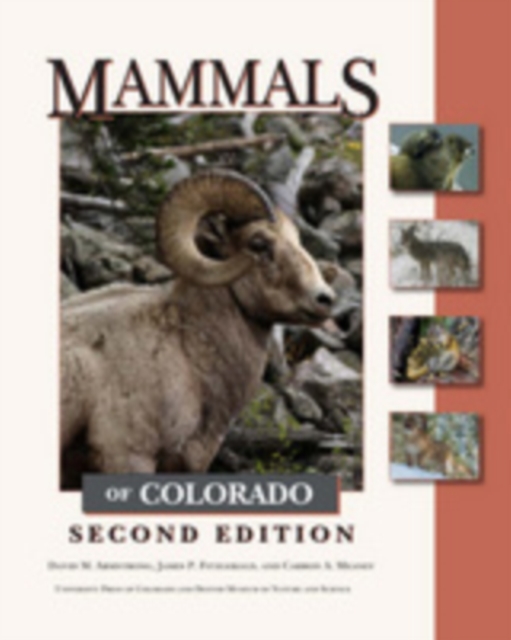
Mammals of Colorado
Thoroughly revised and updated, Mammals of Colorado, Second Edition is a comprehensive reference on the nine orders and 128 species of Colorado's recent native fauna, detailing each species' description, habitat, distribution, population ecology, diet and foraging, predators and parasites, behavior, reproduction and development, and population status. An introductory chapter on Colorado's environments, a discussion of the development of the fauna over geologic time, and a brief history of human knowledge of Coloradan mammals provide ecological and evolutionary context. The most recent records of the state's diverse species, rich illustrations (including detailed maps, skull drawings, and photographs), and an extensive bibliography make this book a must-have reference.Amateur and professional naturalists, students, vertebrate biologists, and ecologists as well as those involved in conservation and wildlife management in Colorado will find value in this comprehensive volume. Co-published with the Denver Museum of Nature Science
eBook

Conflicting research on the demography, ecology, and social behavior of Gunnison's prairie dogs (Cynomys gunnisoni)
Gunnison's prairie dogs (Cynomys gunnisoni) are rare, diurnal, colonial, burrowing, ground-dwelling squirrels. Studies of marked individuals living under natural conditions in the 1970s, 1980s, and 1990s showed that males are heavier than females throughout the year; that adult females living in the same territory are consistently close kin; and that females usually mate with the sexually mature male(s) living in the home territory. Research from 2007 through 2010 challenges all 3 of these findings. Here we discuss how different methods might have led to the discrepancies.
Journal Article

Mammals of Colorado, Second Edition
Thoroughly revised and updated, Mammals of Colorado, Second Edition is a comprehensive reference on the nine orders and 128 species of Colorado's recent native fauna, detailing each species' description, habitat, distribution, population ecology, diet and foraging, predators and parasites, behavior, reproduction and development, and population status. An introductory chapter on Colorado's environments, a discussion of the development of the fauna over geologic time, and a brief history of human knowledge of Coloradan mammals provide ecological and evolutionary context. The most recent records of the state's diverse species, rich illustrations (including detailed maps, skull drawings, and photographs), and an extensive bibliography make this book a must-have reference. Amateur and professional naturalists, students, vertebrate biologists, and ecologists as well as those involved in conservation and wildlife management in Colorado will find value in this comprehensive volume. Co-published with the Denver Museum of Nature & Science
eBook

Mammals of Colorado / David M. Armstrong, James P. Fitzgerald, and Carron A. Meaney
Thoroughly Revised and updated, Mammals of Colorado, Second Edition is a comprehensive reference on the 9 orders and 128 species of Colorado's recent native fauna, detailing each species' description, habitat, distribution, population ecology, diet and foraging, predators and parasites, behavior, reproduction and development, and population status. An introductory Chapter on Colorado's environments, a discussion of the development of the fauna over geologic time, and a brief history of human knowledge of Coloradan mammals provide ecological and evolutionary context. The most recent records of the state's diverse species, rich illustrations (including detailed maps, skull drawings, and photographs), and an extensive bibliography make this book a must-have reference. --Book Jacket.
eBook

ESTIMATION OF SWIFT FOX POPULATION SIZE AND OCCUPANCY RATES IN EASTERN COLORADO
The status of the swift fox (Vulpes velox) became a subject of controversy when a petition was submitted in 1992 to have it listed under the provisions of the Endangered Species Act. Colorado is believed to have one of the largest remaining populations of the species due to significant amounts of short-grass prairie habitat suitable for occupancy. In 1995, we initiated a survey in eastern Colorado to determine swift fox population size and presence or absence on 724.8×6.4 km2 grids trapped with 20 live traps. We drew trapping grids from a stratified random sample of grids plotted on 1:100,000 scale Gap vegetation maps of eastern Colorado. Of the grids sampled, 54% were from areas with 75% short-grass habitat. We captured 241 swift foxes (117 male, 121 female, and 3 undetermined) on 51 (71%) of the grids. We estimated a mean capture probability per night of an individual fox, weighted by number of grids and number of trapping occasions for each grid, as 0.234 (SE = 0.022). Highest capture and detection probabilities occurred during the September to March period. We estimated the average number of foxes per grid as 6.96 (SE = 0.794), likely a maximum estimate because of foxes being attracted to the trapping grids. Percentage of short-grass prairie habitat on each grid was an important predictor of both occupancy rate and detection probabilities. We estimated occupancy rate of the 72 grids trapped as 0.821 (SE = 0.0659), using the mean (66.9%) of the short-grass prairie habitat for the 72 grids as a covariate, suggesting that 59.1 (SE = 4.74) of the 72 grids trapped contained foxes. Alternatively, using the percentage of short grass prairie for each grid to estimate a grid-specific occupancy probability, we estimated 56.9 (SE = 4.13) of the 72 grids contained foxes. We estimated nightly detection probabilities of >0.60 for grids trapped in March. We used simulation to compute the power to detect simulated changes in occupancy rates assuming a detection probability of 0.6 and an occupancy rate of 0.8. With only 2 trapping occasions, even with 100 trapping grids, the power was only 80% to detect a change in occupancy from 0.8 to 0.5. With 50 trapping grids and 3 trapping occasions, the power was nearly 80% to detect a 0.3 reduction in occupancy rate and >80% for 4 trapping occasions.
Journal Article
Environments of Colorado
Mammals are a familiar and important component of Earth’s biodiversity. Biodiversity is the kinds of organisms and their genetic and ecological relationships—an evolutionary and ecological phenomenon in space and time (E. Wilson 1992). The mammalian fauna of Colorado is a fascinating piece of that whole. To understand the diversity of mammals we need to have a perspective of the ecosphere more generally. Such a perspective is the purpose of this chapter, with a focus on environments of Colorado.
Colorado is known for its scenic beauty—from majestic mountain peaks and rushing white rivers tumbling down dark canyons, to red-rock
Book Chapter

People and Wildlife
Colorado has a diverse and abundant mammalian fauna that is valued and enjoyed in numerous ways by residents and visitors alike. People are fascinated by wild mammals and find in them a range of recreational opportunities—from aesthetic and educational to consumptive. The US Fish and Wildlife Service estimated that in 2006 alone 87.5 million Americans spent $122 billion nationwide on wildlife-related recreational pursuits (US Fish and Wildlife Service and US Bureau of Census 2006). Between 1996 and 2006, the number of adults in the United States who participated in non-consumptive wildlife activities increased by 13 percent. This upward trend
Book Chapter
Order Perissodactyla
Horses, tapirs, rhinos, asses, and zebras constitute the order Perissodactyla, the odd-toed ungulates. Perissodactyls were a diverse and dominant group during the early and mid-Tertiary, ranging across North America, Eurasia, and Africa. The fossil history was reviewed by Hooker (2005) and K. Rose (2006). Nine of the 12 recognized families are extinct and the natural distribution of the remaining wild species is now restricted to parts of Asia, southeastern Europe, Africa, the East Indies, and parts of South and Central America. Disappearance of ancient perissodactyls generally coincided with expansion of the even-toed ungulates, the artiodactyls. Domestic horses (Equus caballus) and
Book Chapter