
Catalogue Search | MBRL


Are you sure you want to remove the book from the shelf?

{{itemTitle}}
1,267
result(s) for
"Fitzpatrick, Michelle"
Sort by:

The teaching brain : an evolutionary trait at the heart of education
\"What is at work in the mind of a five-year-old explaining the game of tag to a new friend? What is going on in the head of a thirty-five-year-old parent showing a first-grader how to button a coat? And what exactly is happening in the brain of a sixty-five-year-old professor discussing statistics with a room full of graduate students? While research about the nature and science of learning abounds, shockingly few insights into how and why humans teach have emerged--until now. Countering the dated yet widely held presumption that teaching is simply the transfer of knowledge from one person to another, The Teaching Brain weaves together scientific research and real-life examples to show that teaching is a dynamic interaction and an evolutionary cognitive skill that develops from birth to adulthood. With engaging, accessible prose, Harvard researcher Vanessa Rodriguez reveals what it actually takes to become an expert teacher. At a time when all sides of the teaching debate tirelessly seek to define good teaching--or even how to build a better teacher--The Teaching Brain upends the misguided premises for how we measure the success of teachers. This game-changing analysis of how the mind teaches will transform common perceptions of one of the most essential human practices (and one of the most hotly debated professions), charting a path forward for teachers, parents, and anyone seeking to better understand learning--and unlocking the teaching brain in all of us\"-- Provided by publisher.
Book

“ Rather than Simply Learning Statistics, We Aimed to Learn About the Bees, From the Bees ”: An Exploration of the Factors Influencing the Development of Positive Teacher Attitudes Toward Statistics
The proliferation of data in all aspects of our lives positions statistical literacy as a critical skill in the 21st century. As teachers’ attitudes toward statistics have far-reaching implications for their future learning and that of their students, there is an impetus to identify the types of experiences that support the development of positive attitudes toward statistics. Using Japanese Lesson Study as a guiding framework, this study examined the influence of an 11-week, practice-based mathematics elective on 28 pre-service primary teachers’ attitudes toward statistics. Using Shapiro’s framework to inform our approach, we report on quantitative and qualitative data to reveal the nature and trajectory of pre-service teacher attitudes across the duration of the elective and particular experiences they attribute to these changes. Our findings indicate that the pre-service teachers credited the exploration of locally generated, societally relevant data and the use of math action technology to support data analysis with positive changes in attitudes toward statistics. Furthermore, opportunities to collaboratively design, deliver and extend rich learning experiences in the classroom were valued by participants.
Journal Article
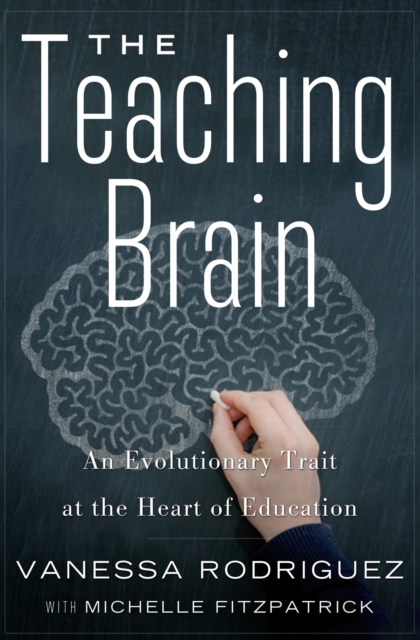
The teaching brain : an evolutionary trait at the heart of education
What is at work in the mind of a five-year-old explaining the game of tag to a new friend? What is going on in the head of a thirty-five-year-old parent showing a first-grader how to button a coat? And what exactly is happening in the brain of a sixty-five-year-old professor discussing statistics with a room full of graduate students? While research about the nature and science of learning abounds, shockingly few insights into how and why humans teach have emerged--until now. Countering the dated yet widely held presumption that teaching is simply the transfer of knowledge from one person to another, The Teaching Brain weaves together scientific research and real-life examples to show that teaching is a dynamic interaction and an evolutionary cognitive skill that develops from birth to adulthood. With engaging, accessible prose, Harvard researcher Vanessa Rodriguez reveals what it actually takes to become an expert teacher. At a time when all sides of the teaching debate tirelessly seek to define good teaching--or even how to build a better teacher--The Teaching Brain upends the misguided premises for how we measure the success of teachers. This game-changing analysis of how the mind teaches will transform common perceptions of one of the most essential human practices (and one of the most hotly debated professions), charting a path forward for teachers, parents, and anyone seeking to better understand learning--and unlocking the teaching brain in all of us.
eBook

CPEB3 low-complexity motif regulates local protein synthesis via protein–protein interactions in neuronal ribonucleoprotein granules
Biomolecular condensates, membraneless organelles found throughout the cell, play critical roles in many aspects of cellular function. Ribonucleoprotein granules (RNPs) are a type of biomolecular condensate necessary for local protein synthesis and are involved in synaptic plasticity and long-term memory. Most of the proteins in RNPs possess low-complexity motifs (LCM), allowing for increased promiscuity of protein– protein interactions. Here, we describe the importance of protein–protein interactions mediated by the LCM of RNA-binding protein cytoplasmic polyadenylation element binding protein 3 (CPEB3). CPEB3 is necessary for long-term synaptic plasticity and memory persistence, but the mechanisms involved are still not completely elucidated. We now present key mechanisms involved in its regulation of synaptic plasticity. We find that CPEB3-LCM plays a role in appropriate local protein synthesis of messenger ribonucleic acid (mRNA) targets, through crucial protein–protein interactions that drive localization to neuronal Decapping protein 1 (DCP1)-bodies. Translation-promoting CPEB3 and translation-inhibiting CPEB1 are packaged into neuronal RNP granules immediately after chemical long-term potentiation is induced, but only translation-promoting CPEB3 is repackaged to these organelles at later time points. This localization to neuronal RNP granules is critical for functional influence on translation as well as overall local protein synthesis (measured as α-amino-3-hydroxy-5-methyl-4-isoxazolepropionic acid (AMPA) insertion into the membrane and localization to the synapse). We therefore conclude that protein–protein interaction between the LCM of CPEB3 plays a critical role in local protein synthesis by utilizing neuronal RNP granules.
Journal Article