
Catalogue Search | MBRL


Are you sure you want to remove the book from the shelf?

{{itemTitle}}
92
result(s) for
"Fleming, James Rodger"
Sort by:

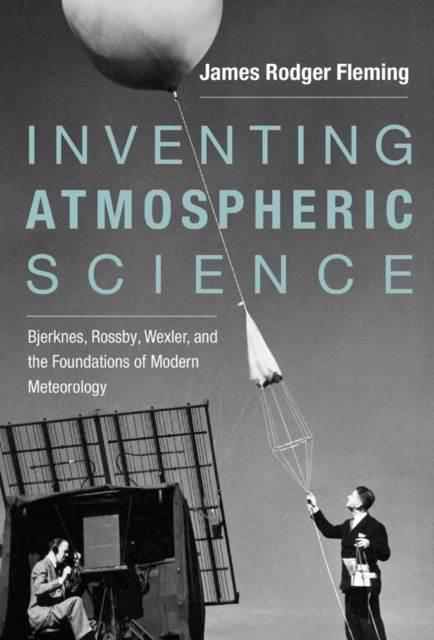
Inventing atmospheric science : Bjerknes, Rossby, Wexler, and the foundations of modern meteorology
How scientists used transformative new technologies to understand the complexities of weather and the atmosphere, told through the intertwined careers of three key figures.\"The goal of meteorology is to portray everything atmospheric, everywhere, always,\" declared John Bellamy and Harry Wexler in 1960, soon after the successful launch of TIROS 1.
eBook

Inventing atmospheric science : Bjerknes, Rossby, Wexler, and the foundations of modern meteorology
\"This big picture history of atmospheric research examines the first six decades of the twentieth century, from the dawn of applied fluid dynamics to the emergence, by 1960, of the interdisciplinary atmospheric sciences. Using newly available archival sources, it documents the work of three interconnected generations of scientists: Vilhelm Bjerknes, Carl-Gustaf Rossby, and Harry Wexler, whose aspirations were fueled by new theoretical insights, pressing societal needs, and expanded technological capabilities. Radio, radar, aviation, nuclear tracers, digital computing, sounding rockets, and satellites provided new ways to measure and study the global atmosphere -- a huge and dauntingly complex system. Bjerknes brought us a fundamental circulation theorem and founded the Bergen school of weather forecasting; Rossby established the graduate schools of meteorology at M.I.T., Chicago, and Stockholm, which focused on upper-air dynamics and, after 1947, on atmospheric environmental issues; and Wexler brought all the new technologies into the U.S. Weather Bureau and, with his colleague Jule Charney, prepared the foundations for the emergence of the interdisciplinary atmospheric sciences. This history weaves together cold war studies, military history, the rise of government research and development, and aviation and aeronautics with a nascent global awareness. It is a fascinating history of something we all experience--the weather --told through compelling historical characters\"-- Provided by publisher.
Book

Toxic Airs
Toxic Airsbrings together historians of medicine, environmental historians, historians of science and technology, and interdisciplinary scholars to address atmospheric issues on a spectrum of scales from body to place to planet. The chapters analyze airborne and atmospheric threats posed to humans, and contributors demonstrate how conceptions of toxicity have evolved and how humans have both created and mitigated toxins in the air.Specific topics discussed include medieval beliefs in the pestilent breath of witches, malarial theory in India, domestic and military use of tear gas, Gulf War Syndrome, Los Angeles smog, automotive emissions control, the epidemiological effects of air pollution, transboundary air pollution, ozone depletion, the contributions of contemporary artists to climate awareness, and the toxic history of carbon \"die\"-oxide. Overall, the essays provide a wide-ranging historical study of interest to students and scholars of many disciplines.
eBook

Globalizing polar science : reconsidering the International Polar and Geophysical years
\"The International Polar Years and the International Geophysical Year represented a remarkable international collaborative scientific effort that was focused on, but not limited to, understanding the Earth's poles. This groundbreaking collection redresses the surprising failure of historians to explore beyond even a cursory manner the richness of the IPYs and IGY as sites of historical and scientific study. In doing so, it illuminates critical aspects of the last 150 years of international scientific endeavour\"-- Provided by publisher.
Book


Knowing Global Environments
Knowing Global Environmentsbrings together nine leading scholars whose work spans a variety of environmental and field sciences, including archaeology, agriculture, botany, climatology, ecology, evolutionary biology, oceanography, ornithology, and tidology.Collectively their essays explore the history of the field sciences, through the lens of place, practice, and the production of scientific knowledge, with a wide-ranging perspective extending outwards from the local to regional, national, imperial, and global scales. The book also shows what the history of the field sciences can contribute to environmental history-especially how knowledge in the field sciences has intersected with changing environments-and addresses key present-day problems related to sustainability, such as global climate, biodiversity, oceans, and more.Contributors toKnowing Global Environmentsreveal how the field sciences have interacted with practical economic activities, such as forestry, agriculture, and tourism, as well as how the public has been involved in the field sciences, as field assistants, students, and local collaborators.
eBook

Historical Perspectives on Climate Change
This intriguing volume provides a thorough examination of the historical roots of global climate change as a field of inquiry, from the Enlightenment to the late twentieth century.
eBook

Toxic Airs
Toxic Airs brings together historians of medicine, environmental historians, historians of science and technology, and interdisciplinary scholars to address atmospheric issues on a spectrum of scales from body to place to planet. The chapters analyze airborne and atmospheric threats posed to humans, and contributors demonstrate how conceptions of toxicity have evolved and how humans have both created and mitigated toxins in the air.
Specific topics discussed include medieval beliefs in the pestilent breath of witches, malarial theory in India, domestic and military use of tear gas, Gulf War Syndrome, Los Angeles smog, automotive emissions control, the epidemiological effects of air pollution, transboundary air pollution, ozone depletion, the contributions of contemporary artists to climate awareness, and the toxic history of carbon “die”-oxide. Overall, the essays provide a wide-ranging historical study of interest to students and scholars of many disciplines.
eBook

Climate Physicians and Surgeons
Medical metaphors involving Earth and its atmosphere have a very long history. Both ancients and moderns anchored their environmental thinking in analogies of bodily growth and decay, health and disease. This tradition found its way into dynamic meteorological analysis in the first two decades of the twentieth century. Now dynamic climatology is appropriating this medicalized language, with some practitioners referring to themselves as climate \"physicians and surgeons.\" This essay examines the historical dimensions of the metaphor that the earth, especially its atmosphere, is coming under \"managed care\" by atmospheric scientists and is being prepped for invasive techniques administered by barber surgeons posing as climate engineers. It provides an example of how environmental historians can use their knowledge of the past to analyze language involving the \"control\" of nature and contribute effectively to current public policy debates.
Journal Article