
Catalogue Search | MBRL


Are you sure you want to remove the book from the shelf?

{{itemTitle}}
1,465
result(s) for
"Foner, Eric"
Sort by:

The fiery trial : Abraham Lincoln and American slavery
In a landmark work of deep scholarship and insight, Foner gives us a life of Lincoln as it intertwined with slavery, the defining issue of the time and the tragic hallmark of American history. The author demonstrates how Lincoln navigated a dynamic political landscape deftly, moving in measured steps, often on a path forged by abolitionists and radicals in his party, and that Lincoln's greatness lay in his capacity for moral and political growth.
Book

THE SUPREME COURT AND THE HISTORY OF RECONSTRUCTION—AND VICE-VERSA
Beginning in the 1930s, Reconstruction historiography underwent a dramatic change. Early-twentieth-century historians of Reconstruction viewed aggressive federal intervention to protect the civil rights of freed slaves as a mistake, and they celebrated the Compromise of 1877 and the subsequent retreat from Reconstruction. These historians also praised the decisions of the Supreme Court that offered narrow interpretations of Congressional power under the Thirteenth, Fourteenth, and Fifteenth Amendments. Modern historians reject the works of early historians of Reconstruction as incomplete, unbalanced, and often racist. Beginning with W.E.B. Du Bois in the 1930s, revisionist historians have reexamined the Reconstruction Era and developed a narrative that praises the Republicans who sought to protect the rights of freed slaves and the freed slaves themselves, who fought for civil and political rights during Reconstruction and its aftermath. Unfortunately, the legal profession and the courts have been slow to embrace the revolution in Reconstruction historiography. This Essay argues that a historical narrative of Reconstruction repudiated by historians continues to exert an outsized influence on Supreme Court jurisprudence, and that judicial unwillingness to overturn flawed Reconstruction-era precedents hinders the cause of equality before the law even today. It suggests that the overdue judicial repudiation of precedents resting, in part, on a faulty interpretation of Reconstruction's history would have a salutary effect on the Supreme Court's Thirteenth and Fourteenth Amendment jurisprudence.
Journal Article


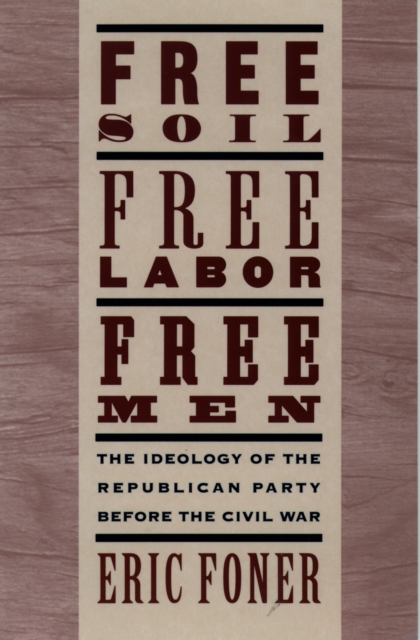
Free Soil, Free Labor, Free Men
Since its publication twenty-five years ago, Free Soil, Free Labor, Free Men has been recognized as a classic, an indispensable contribution to our understanding of the causes of the American Civil War. A key work in establishing political ideology as a major concern of modern American historians, it remains the only full-scale evaluation of the ideas of the early Republican party. In his new introduction, Eric Foner puts his argument into the context of contemporary scholarship, reassessing the concept of free labor in the light of the last twenty-five years of writing on such issues as work, gender, economic change, and political thought.
eBook


