
Catalogue Search | MBRL


Are you sure you want to remove the book from the shelf?

{{itemTitle}}
37
result(s) for
"Ford, Julienne"
Sort by:
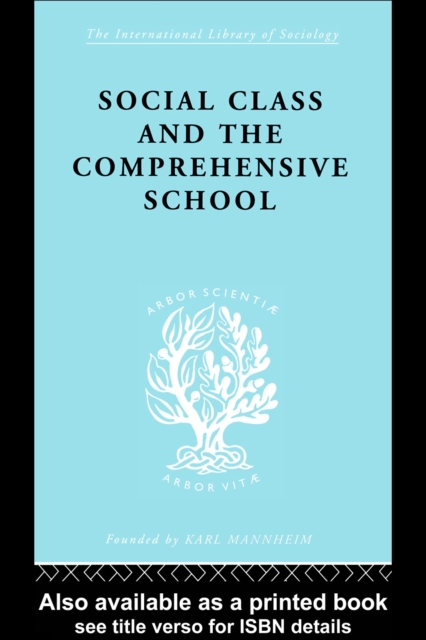
Social Class and the Comprehensive School
Drawing on the great wealth of knowledge and experience of educational practitioners and theorists, the volumes in The Sociology of Education set of the International Library of Sociology explore the very important relationship between education and society. These books became standard texts for actual and intending teachers. Drawing upon comparative material from Israel, France and Germany, titles in this set also discuss the key questions of girls' and special needs education, and the psychology of education.
eBook


Ability and opportunity in a comprehensive school
If we cannot, at present, draw any firm conclusions about the extent to which comprehensive schools are productive of talent, we can at least examine the extent to which they provide increased equality of opportunity for individuals with equal talent potential or 'ability'. For the most common criticism of the tripartite system is that while purporting to effect selection on the basis of ability (operationally defined as IQ) it does not in fact do so accurately.
Book Chapter

Thinking about Work
'Men's careers occupy a dominant place in their lives today, and the occupational structure is the foundation of the stratification system of contemporary industrial society. In the absence of hereditary castes or feudal estates, class differences come to rest primarily on occupational positions and the economic advantages and powers associated with them.'
1
Thus, for the child, the transition from school to work is a crucial stage in life, a process by which he reaffirms or denies the rank provisionally assigned to him on account of his father's occupational position.
2
In considering the question 'What job do you want to do when you leave school?', whether put to him by an overbearing aunt or a sociologist waving questionnaires, the child is forced to ponder the much more fundamental question, 'What do you want to be?' For it is largely in terms of man's occupational role that society defines him and evaluates him: assessments of occupational status 'seem to catch and concretize the impressions that most people have of the class structure.'
3
That ubiquitous figure the 'Man in the Street' assumes the saliency and consequentiality of the occupational role. For, although he may deny the importance of his job for his own self-definition he is quick to assume that others can be summed up in terms of the work they do.
4
Book Chapter
Epilogue
According to my lights, a last chapter should resemble a primitive orgy after harvest. The work may have come to an end but the worker cannot let go all at once. He is still full of energy that will fester if it cannot find an outlet. Accordingly he is allowed a time of licence, when he may say all sorts of things he would think twice before saying in more sober moments, when he is no longer bound by logic and evidence but free to speculate.
1
Book Chapter
Making Friends at School
It has often been said that the school can be viewed as a society in miniature, both reflecting and affecting the wider society of which it is a part.
1
Thus one might hypothesize that the peer social organization of the school would tend to incorporate the class stratification of the larger community. And, indeed, studies of American schoolchildren by Hollingshead, Neugarten and others lend support to this view by demonstrating that mutual friendship and popularity scores are related to social background.
2
It has therefore come to be widely believed that the friendship choices of secondary school children are a reflection of their class backgrounds. However the results of two more recent studies suggest that, while class stratification does have an important impact on school peer group formation, this effect operates in a slightly more complex way than had formerly been assumed.
Book Chapter
Justice and the Comprehensive Ideal
Among parents and teachers, as well as Labour Party idealists and educationalists, discontent with the tripartite organization of secondary education in England and Wales is very evident. But criticism of the present system of selection does not stem so much from a rejection of the general principle whereby rewards, material and symbolic, are unequally distributed in society, as from a distaste for the current bases of discrimination. Thus, as Pedley puts it, 'The Englishman of the 1960s does not believe in equality. What he wants is equal opportunity to be unequal.'
1
On closer examination, however, even the argument for equality of opportunity is seen to be a cover for a yet more limited plea. For, as Benn and Peters have noted, the cry for equality of opportunity refers in practice to the desire to accord individuals the same opportunities 'only in the sense that they are all entitled to be treated alike until relevant grounds are established for treating them differently'.
2
In the English situation relevant grounds are almost invariably considered in the context of ability. Thus we can see the main body of current criticism of the tripartite system of education, in sociological as well as political and administrative circles, as stemming from the view that selection should be based on the sole criterion of 'ability'
3
and that this cannot be adequately ascertained by an examination at Eleven-Plus.
4
Book Chapter
The Development of Talent
We have seen that discontent with the tripartite organization of secondary education stems not so much from rejection of selection in general as from distaste for the present mode of selection. Advocates of comprehensive education argue that, under the system instigated by the 1944 Act, such selection takes place too early and on the basis of inadequate criteria. For it is now accepted that talent is not a fixed genetic trait, there is no finite 'pool of ability' to be tapped by increasingly sophisticated selection procedures.
1
Talent, rather than being given by birth is, it is now believed, partly produced by school experience. Thus the predictive power of intelligence and aptitude tests reflects nothing more than a self-fulfilling prophecy.
2
Full development of talent is thus prevented by a system under which children learn to limit their achievement to that which is expected of them.
Book Chapter
Towards Utopia?
What, then, are the chances of comprehensive reorganization of secondary education bringing closer the Utopia we seem to be seeking? How far will such educational reform produce the 'Fairer Society'? What hope is there that comprehensive education will reduce the salience of social class in this society?
Book Chapter