
Catalogue Search | MBRL


Are you sure you want to remove the book from the shelf?

{{itemTitle}}
93
result(s) for
"Forsman, Eric D."
Sort by:

Nest trees of northern spotted owls (Strix occidentalis caurina) in Washington and Oregon, USA
The northern spotted owl (Strix occidentalis caurina) is a federally-threatened subspecies in the United States associated with late-successional forests. In mesic forests it nests primarily in tree cavities, but also uses various types of external platform nests in drier forests. We describe 1717 northern spotted owl nests in 16 different tree species in five study areas in Washington and Oregon in the Pacific Northwest, USA. The vast majority of nests (87%) were in Douglas-fir (Pseudotsuga menziesii) trees, except on the Olympic Peninsula, Washington, where nests were about equally abundant in Douglas-fir, western red cedar (Thuja plicata), and western hemlock (Tsuga heterophylla) trees. Distribution of nests was 57.9% in top cavities of trees with broken tops, 20.3% in side cavities of hollow tree trunks, and 21.8% on external platforms of trees. Platforms were most common in the two driest study areas in the Eastern Cascades Physiographic Province, Washington (89% of nests), and the Klamath Province, Oregon (32%). The vast majority (89%) of nests were in trees with intact or declining crowns. Nests in dead trees were most common on the Olympic Peninsula. Nest trees with top and side cavities were larger and much more prevalent in study areas where annual precipitation was highest (Olympic Peninsula, Oregon Coast Range). Large nest cavities and platforms used by northern spotted owls occur almost exclusively in old forest. Managing for the retention of such forests and for their replacement is a significant challenge for land managers, especially in the face of climate change and an increasing human population, but will likely be required for the persistence of viable populations of northern spotted owls.
Journal Article
Isolation by distance versus landscape resistance: Understanding dominant patterns of genetic structure in Northern Spotted Owls (Strix occidentalis caurina)
Landscape genetics investigations examine how the availability and configuration of habitat influence genetic structure of plants and animals. We used landscape genetics to evaluate the role that forest connectivity plays in determining genetic structure of the federally-threatened Northern Spotted Owl (Strix occidentalis caurina) using genotypes of 339 Northern Spotted Owls obtained for 10 microsatellite loci. Spatial clustering analyses identified a distinct genetic cluster at the southern extent of the region examined. This cluster could not be linked to landscape connectivity patterns and suggested that post-Pleistocene processes were involved with its development rather than contemporary landscape configuration. We also compared matrices of pairwise inter-individual genetic distances with resistance distances derived from a circuit-theory based framework. Resistance distances were obtained for an idealized raster map that reflected continuous unimpeded dispersal habitat across the landscape along with five empirically-derived raster maps reflecting the 1870's, 1940's, 1986, 1994, and 2012. Resistance distances from the idealized map served as surrogates for linear geographic distances. Relative to idealized conditions, resistance distances were ~250% higher in the 1940's and ~200% higher from 1986 onward. Resistance distances from the 1870's were ~40% higher than idealized conditions. Inter-individual genetic distances were most highly correlated with resistance distances from the idealized map rather than any of the empirical maps. Two hypotheses explain our results. First, our results may reflect temporal lags between the onset of large-scale habitat alterations and their novel effects on genetic structure in long-lived species such as Northern Spotted Owls. Second, because Northern Spotted Owls disperse over long distances, our results may indicate that forest habitat has never been sufficiently fragmented to the point where connectivity was disrupted. The second hypothesis could indicate that forest management practices mandated by the Northwest Forest Plan succeeded with one of its primary goals. However, our results do not represent a complete portrayal of the status of Northern Spotted Owls given detection of significant population declines and bottlenecks in other studies. Future investigations based on computer simulations may help distinguish between hypotheses.
Journal Article

Competitive interactions and resource partitioning between northern spotted owls and barred owls in western Oregon
The federally threatened northern spotted owl (Strix occidentalis camina) is the focus of intensive conservation efforts that have led to much forested land being reserved as habitat for the owl and associated wildlife species throughout the Pacific Northwest of the United States. Recently, however, a relatively new threat to spotted owls has emerged in the form of an invasive competitor: the congeneric barred owl (S. varia). As barred owls have rapidly expanded their populations into the entire range of the northern spotted owl, mounting evidence indicates that they are displacing, hybridizing with, and even killing spotted owls. The range expansion by barred owls into western North America has made an already complex conservation issue even more contentious, and a lack of information on the ecological relationships between the 2 species has hampered recovery efforts for northern spotted owls. We investigated spatial relationships, habitat use, diets, survival, and reproduction of sympatric spotted owls and barred owls in western Oregon, USA, during 2007-2009. Our overall objective was to determine the potential for and possible consequences of competition for space, habitat, and food between these previously allopatric owl species. Our study included 29 spotted owls and 28 barred owls that were radio-marked in 36 neighboring territories and monitored over a 24-month period. Based on repeated surveys of both species, the number of territories occupied by pairs of barred owls in the 745-km² study area (82) greatly outnumbered those occupied by pairs of spotted owls (15). Estimates of mean size of home ranges and core-use areas of spotted owls (1,843 ha and 305 ha, respectively) were 2-4 times larger than those of barred owls (581 ha and 188 ha, respectively). Individual spotted and barred owls in adjacent territories often had overlapping home ranges, but interspecific space sharing was largely restricted to broader foraging areas in the home range with minimal spatial overlap among coreuse areas. We used an information-theoretic approach to rank discrete-choice models representing alternative hypotheses about the influence of forest conditions, topography, and interspecific interactions on species-specific patterns of nighttime resource selection. Spotted owls spent a disproportionate amount of time foraging on steep slopes in ravines dominated by old (> 120 yr) conifer trees. Barred owls used available forest types more evenly than spotted owls, and were most strongly associated with patches of large hardwood and conifer trees that occupied relatively flat areas along streams. Spotted and barred owls differed in the relative use of old conifer forest (greater for spotted owls) and slope conditions (steeper slopes for spotted owls), but we found no evidence that the 2 species differed in their use of young, mature, and riparian-hardwood forest types. Mean overlap in proportional use of different forest types between individual spotted owls and barred owls in adjacent territories was 81% (range = 30-99%). The best model of habitat use for spotted owls indicated that the relative probability of a location being used was substantially reduced if the location was within or in close proximity to a core-use area of a barred owl. We used pellet analysis and measures of food-niche overlap to determine the potential for dietary competition between spatially associated pairs of spotted owls and barred owls. We identified 1,223 prey items from 15 territories occupied by spotted owls and 4,299 prey items from 24 territories occupied by barred owls. Diets of both species were dominated by nocturnal mammals, but diets of barred owls included many terrestrial, aquatic, and diurnal prey species that were rare or absent in diets of spotted owls. Northern flying squirrels (Glaucomys sabrinus), woodrats (Neotoma fuscipes, N. cinerea), and lagomorphs (Lepus americanus, Sylvilagus bachmani) were primary prey for both owl species, accounting for 81% and 49% of total dietary biomass for spotted owls and barred owls, respectively. Mean dietary overlap between pairs of spotted and barred owls in adjacent territories was moderate (42%; range = 28— 70%). Barred owls displayed demographic superiority over spotted owls; annual survival probability of spotted owls from known-fate analyses (0.81, SE = 0.05) was lower than that of barred owls (0.92, SE = 0.04), and pairs of barred owls produced an average of 4.4 times more young than pairs of spotted owls over a 3-year period. We found a strong, positive relationship between seasonal (6-month) survival probabilities of both species and the proportion of old (> 120 yr) conifer forest within individual home ranges, which suggested that availability of old forest was a potential limiting factor in the competitive relationship between these 2 species. The annual number of young produced by spotted owls increased linearly with increasing distance from a territory center of a pair of barred owls, and all spotted owls that attempted to nest within 1.5 km of a nest used by barred owls failed to successfully produce young. We identified strong associations between the presence of barred owls and the behavior and fitness potential of spotted owls, as shown by changes in movements, habitat use, and reproductive output of spotted owls exposed to different levels of spatial overlap with territorial barred owls. When viewed collectively, our results support the hypothesis that interference competition with barred owls for territorial space can constrain the availability of critical resources required for successful recruitment and reproduction of spotted owls. Availability of old forests and associated prey species appeared to be the most strongly limiting factors in the competitive relationship between these species, indicating that further loss of these conditions can lead to increases in competitive pressure. Our findings have broad implications for the conservation of spotted owls, as they suggest that spatial heterogeneity in vital rates may not arise solely because of differences among territories in the quality or abundance of forest habitat, but also because of the spatial distribution of a newly established competitor. Experimental removal of barred owls could be used to test this hypothesis and determine whether localized control of barred owl numbers is an ecologically practical and socio-politically acceptable management tool to consider in conservation strategies for spotted owls. S. occidentalis caurina es una especie amenazada y constituye el eje de intensos esfuerzos de conservación que han permitido la protección de bosques como habitat de la especie y la protección de otras especies de vida silvestre en el Pacífico Noroccidental de los Estados Unidos. Recientemente, sin embargo, una nueva amenaza para S. occidentalis caurina ha emergido en la forma de un competidor invasivo: su congénere S. varia. A medida que S. varia ha expandido rápidamente sus poblaciones dentro del rango entero de distribución de S. occidentalis caurina, más evidencia indica que S. varia está desplazando, matando e incluso se está hibridizando con S. occidentalis caurina. El rango de expansión de S. varia en el occidente de Norte América ha hecho que un problema de conservación complejo sea aún más polémico, y la carencia de información sobre las relaciones ecológicas entre las dos especies ha obstaculizado los esfuerzos de recuperación de S. occidentalis caurina. Investigamos las relaciones espaciales, el uso de habitat, la dieta, la supervivencia y la reproducción de S. occidentalis caurina y S. varia en condiciones de simpatría en el occidente de Oregon, USA, durante 2007-2009. Nuestro objetivo general fue determinar el potencial y posibles consecuencias de la competencia por espacio, habitat, y dieta entre estas especies previamente alopátricas. Nuestro estudio incluyó 29 individuos de S. occidentalis caurina y 28 individuos de S. varia que fueron radio-marcados en 36 territorios vecinos y monitoreados por un periodo de más de 24 meses. Con base en muéstreos repetidos de ambas especies, en el área de estudio correspondiente a 745-km², el número de territorios ocupados por parejas de S. varia (82) superó en gran medida el número de territorios ocupados por parejas de S. occidentalis caurina (15). El tamaño medio estimado de rangos de hogar y áreas de uso básico de S. occidentalis caurina fue 1,843 ha y 305 ha respectivamente, 2-4 veces más extenso que el promedio estimado para S. varia (581 ha y 188 ha, respectivamente). Individuos de ambas especies en territorios adjuntos tienen a menudo rangos de hogar superpuestos pero el espacio ínter-específico compartido estuvo ampliamente restringido a extensas áreas de forrajeo en el rango de hogar con una superposición espacial mínima entre las áreas de uso básico. Usamos un enfoque de la información teórica para categorizar los modelos de escogencia discreta que representan las hipótesis alternativas sobre la influencia de las condiciones del bosque, la topografía, y las relaciones interespecíficas de patrones específicos de las especies en la selección nocturna de recursos. S. occidentalis caurina usaron una desproporcionada cantidad de tiempo forrajeando en pendientes abruptas en barrancos dominados por coniferas de más de 120 años. S. varia usaron los diferentes tipos de bosque de manera más equitativa que S. occidentalis caurina, y estuvieron fuertemente asociados con parches de árboles de madera dura y coniferas que ocuparon relativamente áreas planas a lo largo de corrientes de agua. S. occidentalis caurina y S. varia se diferenciaron en el uso relativo de bosques viejos de coniferas (mucho más grande para S. occidentalis caurina) y las condiciones de pendiente (pendientes más pronunciadas para S. occidentalis caurina), pero no encontramos evidencia que ambas especies se diferencien en el uso de bosques jóvenes, maduros y tipo de bosques riparios de madera dura.
Journal Article
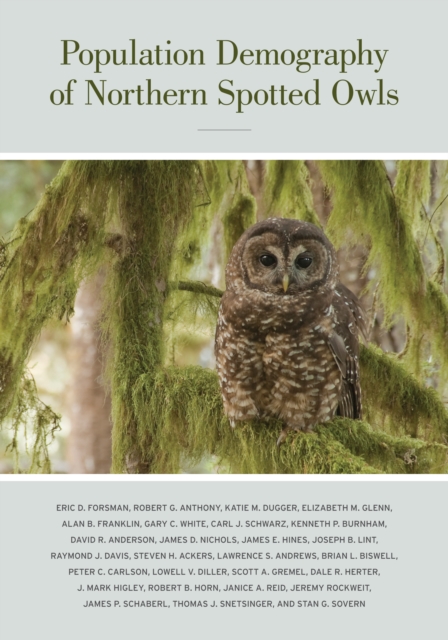
Population demography of northern spotted owls
The Northern Spotted Owl, a threatened species that occurs in coniferous forests in the western United States, has become a well-known environmental symbol. But how is the owl actually faring? This book contains the results of a long-term effort by a large group of leading researchers to document population trends of the Northern Spotted Owl. The study was conducted on 11 areas in the Pacific Northwest from 1985 to 2008, and its objectives were both to evaluate population trends and to assess relationships between reproductive rates and recruitment of owls and covariates such as weather, habitat, and the invasion of a closely related species, the Barred Owl. Among other findings, the study shows that fecundity was declining in five populations, stable in three, and increasing in three areas. Annual apparent survival rates of adults were declining in 10 out of 11 areas. This broad, synthetic work provides the most complete and up-to-date picture of the population status of this inconspicuous forest owl, which is at the center of the complex and often volatile debate regarding the management of forest lands in the western United States.
eBook

The past and future roles of competition and habitat in the range-wide occupancy dynamics of Northern Spotted Owls
Slow ecological processes challenge conservation. Short-term variability can obscure the importance of slower processes that may ultimately determine the state of a system. Furthermore, management actions with slow responses can be hard to justify. One response to slow processes is to explicitly concentrate analysis on state dynamics. Here, we focus on identifying drivers of Northern Spotted Owl (Strix occidentalis caurina) territorial occupancy dynamics across 11 study areas spanning their geographic range and forecasting response to potential management actions. Competition with Barred Owls (Strix varia) has increased Spotted Owl territory extinction probabilities across all study areas and driven recent declines in Spotted Owl populations. Without management intervention, the Northern Spotted Owl subspecies will be extirpated from parts of its current range within decades. In the short term, Barred Owl removal can be effective. Over longer time spans, however, maintaining or improving habitat conditions can help promote the persistence of northern spotted owl populations. In most study areas, habitat effects on expected Northern Spotted Owl territorial occupancy are actually greater than the effects of competition from Barred Owls. This study suggests how intensive management actions (removal of a competitor) with rapid results can complement a slower management action (i.e., promoting forest succession).
Journal Article

Spatiotemporal dynamics in vital rates of Humboldt's flying squirrels and Townsend's chipmunks in a late-successional forest
Knowledge of the spatiotemporal variability of abundance and vital rates is essential to the conservation of wildlife populations. In Pacific Northwest forests, previous small mammal research has focused on estimating abundance; few studies have focused on vital rates. We used robust design temporal symmetry models and live-trapping data collected 2011–2016 at nine sites to estimate apparent annual survival, population growth rate, and recruitment of Humboldt's flying squirrels (Glaucomys oregonensis) and Townsend's chipmunks (Neotamias townsendii) in a late-successional forest of the Cascade Mountains of Oregon, United States. We also estimated the proportional contribution of apparent annual survival and recruitment to population growth rate. Covariates previously associated with abundance were also associated with vital rates for Townsend's chipmunks, but less so for Humboldt's flying squirrels. Apparent annual survival was nearly constant (range = 0.47 to 0.51) among years and sites for Humboldt's flying squirrels but was consistently lower and more variable among years for Townsend's chipmunks (range = 0.13 to 0.31). Recruitment was variable among years for both species. Apparent annual survival generally contributed more than recruitment to the population growth rate of Humboldt's flying squirrels. For Townsend's chipmunks, recruitment consistently contributed more than apparent annual survival to population growth rate. These findings suggest that life history strategies differed for these co-occurring species. This study demonstrates substantial temporal variation in vital rates and some differences in abundance and vital rate habitat associations, suggesting that habitat suitability inferences based on short time series or variation in abundance could be misleading.
Journal Article
Nest trees of northern spotted owls
The northern spotted owl (Strix occidentalis caurina) is a federally-threatened subspecies in the United States associated with late-successional forests. In mesic forests it nests primarily in tree cavities, but also uses various types of external platform nests in drier forests. We describe 1717 northern spotted owl nests in 16 different tree species in five study areas in Washington and Oregon in the Pacific Northwest, USA. The vast majority of nests (87%) were in Douglas-fir (Pseudotsuga menziesii) trees, except on the Olympic Peninsula, Washington, where nests were about equally abundant in Douglas-fir, western red cedar (Thuja plicata), and western hemlock (Tsuga heterophylla) trees. Distribution of nests was 57.9% in top cavities of trees with broken tops, 20.3% in side cavities of hollow tree trunks, and 21.8% on external platforms of trees. Platforms were most common in the two driest study areas in the Eastern Cascades Physiographic Province, Washington (89% of nests), and the Klamath Province, Oregon (32%). The vast majority (89%) of nests were in trees with intact or declining crowns. Nests in dead trees were most common on the Olympic Peninsula. Nest trees with top and side cavities were larger and much more prevalent in study areas where annual precipitation was highest (Olympic Peninsula, Oregon Coast Range). Large nest cavities and platforms used by northern spotted owls occur almost exclusively in old forest. Managing for the retention of such forests and for their replacement is a significant challenge for land managers, especially in the face of climate change and an increasing human population, but will likely be required for the persistence of viable populations of northern spotted owls.
Journal Article
Range-wide sources of variation in reproductive rates of northern spotted owls
We conducted a range-wide investigation of the dynamics of site-level reproductive rate of northern spotted owls using survey data from 11 study areas across the subspecies geographic range collected during 1993–2018. Our analytical approach accounted for imperfect detection of owl pairs and misclassification of successful reproduction (i.e., at least one young fledged) and contributed further insights into northern spotted owl population ecology and dynamics. Both nondetection and state misclassification were important, especially because factors affecting these sources of error also affected focal ecological parameters. Annual probabilities of site occupancy were greatest at sites with successful reproduction in the previous year and lowest for sites not occupied by a pair in the previous year. Site-specific occupancy transition probabilities declined over time and were negatively affected by barred owl presence. Overall, the site-specific probability of successful reproduction showed substantial year-to-year fluctuations and was similar for occupied sites that did or did not experience successful reproduction the previous year. Site-specific probabilities for successful reproduction were very small for sites that were unoccupied the previous year. Barred owl presence negatively affected the probability of successful reproduction by northern spotted owls in Washington and California, as predicted, but the effect in Oregon was mixed. The proportions of sites occupied by northern spotted owl pairs showed steep, near-monotonic declines over the study period, with all study areas showing the lowest observed levels of occupancy to date. If trends continue it is likely that northern spotted owls will become extirpated throughout large portions of their range in the coming decades.
Journal Article
Response of arboreal rodents to increased availability of nest substrates in young forests
Many forest-dependent animals require complex branch and bole structural features as substrates for nesting, and these features may take decades or centuries to develop. In young forests, lack of suitable nest substrates may limit occurrence and abundance of arboreal rodents. To test this hypothesis, we measured the response of arboreal rodents to installation of 429 artificial nest platforms at 17 young forest sites in the Coast Range of Oregon, United States. We compared the percentage of 100-m2 plots at sites containing nests before and after installation of nest platforms, and examined 5 a priori hypotheses of spatial patterns of use using logistic regression. One year after installation, we observed a 5.8-fold increase (95% CI = 2.4–9.2) in plots containing nests of red tree voles (Arborimus longicaudus) and a 2.9-fold increase (95% CI = 1.3–4.4) of tree squirrels (Glaucomys oregonensis, Tamiasciurius douglasii). In addition, we captured 37 adult red tree voles (30 females, 7 males). Presence of conspecific nests < 75 m away increased the odds of use by red tree voles but not by tree squirrels. Our results support the hypothesis that lack of suitable nest substrates limits occurrence of red tree voles in young forests, but results were ambiguous for tree squirrels. Increasing the availability of nest substrates via installation of nest platforms may increase abundance of red tree voles in young forests. However, we do not know if this will allow red tree voles to persist in young forests that are subjected to repeated commercial thinning and clear-cut harvesting.
Journal Article

Social status, forest disturbance, and Barred Owls shape long-term trends in breeding dispersal distance of Northern Spotted Owls
Dispersal among breeding sites in territorial animals (i.e. breeding dispersal) is driven by numerous selection pressures, including competition and spatiotemporal variation in habitat quality. The scale and trend of dispersal movements over time may signal changing conditions within the population or on the landscape. We examined 2,158 breeding dispersal events from 694 male and 608 female individually marked Northern Spotted Owls (Strix occidentalis caurina) monitored over 28 yr on 7 study areas to assess the relative importance of individual (sex, experience), reproductive (annual productivity, mate availability), and environmental (forest alteration, presence of competitor) sources of variation in breeding dispersal distance. Median breeding dispersal distance was 3.17 km, with 99% of all breeding dispersal events <37 km. Mean annual dispersal distances increased by 2.43 km in Oregon and 9.40 km in Washington between 1990 and 2017, which coincided with increases in annual detections of nonnative Barred Owl (S. varia). Frequency of breeding dispersal events, both among and within individuals, also increased over time. Female owls moved farther than males (median of 3.26 and 3.10 km, respectively), and birds with less experience (territory tenure) moved farther than those with more experience. Owls that were single in the year prior to dispersal moved 13–31% farther than those paired prior to dispersal. The greatest environmental change occurring over the course of our study was the expansion of Barred Owl populations. Breeding dispersal distance was positively related to Barred Owls in the study area and disturbance within the originating territory. While it appears that social factors continue to be important drivers of breeding dispersal distance in Spotted Owls, increased competition from Barred Owls and habitat alteration have a contributing effect. Increased breeding dispersal distances should be of concern for conservation efforts and considered in population monitoring because changing dispersal behavior may lead to higher rates of mortality and/or emigration from historical study areas.
Journal Article