
Catalogue Search | MBRL


Are you sure you want to remove the book from the shelf?

{{itemTitle}}
36
result(s) for
"Fortna, Benjamin C"
Sort by:

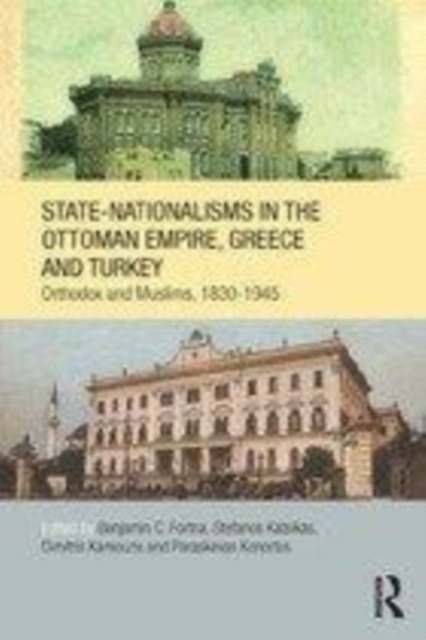
State-Nationalisms in the Ottoman Empire, Greece and Turkey
Tracing the emergence of minorities and their institutions from the late nineteenth century to the eve of the Second World War, this book provides a comparative study of government policies and ideologies of two states towards minority populations living within their borders.
Making extensive use of new archival material, this volume transcends the tendency to compare the Greek-Orthodox in Turkey and the Muslims in Greece separately and, through a comparison of the policies of the host states and the operation of the political, religious and social institutions of minorities, demonstrates common patterns and discrepancies between the two countries that have previously received little attention.
A collaboration between Greek and Turkish scholars with broad ranging research interests, this book benefits from an international and balanced perspective, and will be an indispensable aid to students and scholars alike.
eBook

Education and Change in the Late Ottoman Empire and Turkey
Abstract This article addresses the interrelated changes taking place in education during the transition from the Ottoman Empire to the Republic of Turkey in the late nineteenth and early twentieth centuries. In particular, it focuses on the ways in which schools altered their approach to space, time, and economic priorities in order to align themselves with the shifting conditions of the period. It proceeds by examining a series of tensions between the desiderata of state and society, the collective and the individual, the secular and the religious, the national and the supranational, before assessing the diverse range of responses they elicited.
Journal Article


Education and Change in the Late Ottoman Empire and Turkey
This article addresses the interrelated changes taking place in education during the transition from the Ottoman Empire to the Republic of Turkey in the late nineteenth and early twentieth centuries. In particular, it focuses on the ways in which schools altered their approach to space, time, and economic priorities in order to align themselves with the shifting conditions of the period. It proceeds by examining a series of tensions between the desiderata of state and society, the collective and the individual, the secular and the religious, the national and the supranational, before assessing the diverse range of responses they elicited.
Journal Article
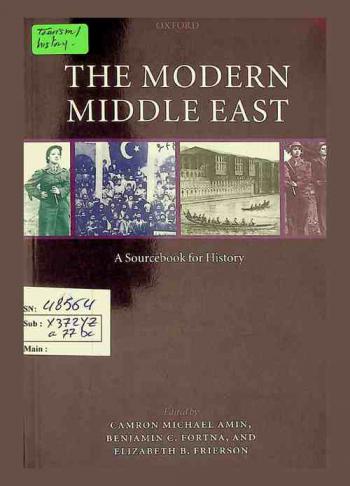
The Modern Middle East
The Modern Middle East is a collection of translated sources covering the period from 1700 to the present. Sources include official and private archives, the periodical press, memoirs, western journalists’ and travellers’ accounts, literature, and official reports (including statistical data). Each document has been prefaced, translated and annotated by a specialist in the particular history and culture from which it was drawn. Enough information is provided so that every student can appreciate the value of a document and begin a further exploration either of its specific historical context or its relationship to broader themes in modern Middle Eastern history, whilst scholars will find it of value for its use in teaching and discussion. Themes covered include the expansion of state power, changing gender roles, religious revival, nationalist mobilization, increasing participation in a wider global culture and economy, and the redefinition of traditions and identities.
eBook

