
Catalogue Search | MBRL


Are you sure you want to remove the book from the shelf?

{{itemTitle}}
95
result(s) for
"Francis, Becky"
Sort by:


British-Chinese pupils' and parents' constructions of the value of education
The high achievement of British-Chinese pupils in the British education system is established in the official literature, but few studies have asked British-Chinese pupils or parents about the factors contributing to their success. This paper explores value of education as a possible contributory aspect. It investigates the extent to which British-Chinese pupils and their parents value education, and the rationale behind their constructions in this regard. Cultural issues in the transmission of values are also explored. The findings demonstrate that British-Chinese pupils and their parents place an extremely high value on education, irrespective of social class and gender. However, pupils and parents do not necessarily provide the same explanations for this value. There is evidence, though, that the discourse of 'value of education' is mobilised as part of a cultural construction of racialised boundaries relating to the diasporic habitus of the Chinese in Britain. The paper discusses the benefits, costs and consequences for Chinese parents and pupils of their elevation and prioritisation of education.
Journal Article
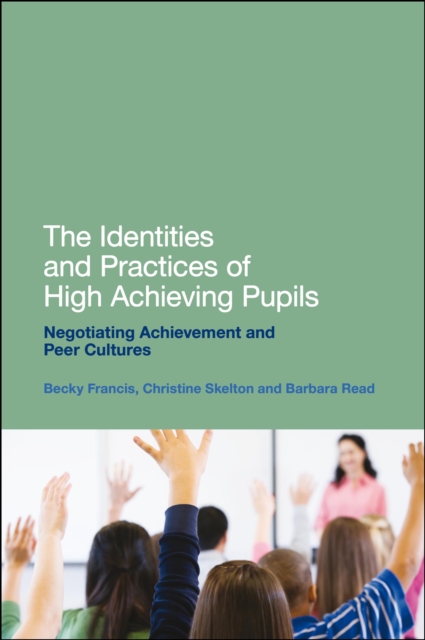
The identities and practices of high-achieving pupils
How do some students manage to excel in their studies and be popular while other high achievers are treated as social outcasts? This lively and accessible text looks at the relationships between gender, race and social class, and attainment and popularity, for high-achieving pupils. The internationally renowned authors present a lucid theoretical framework that reflects the complexity of these issues, placing them within the broader context of the policies that cause and constrain particular behaviours among teachers and pupils. The authors draw together empirical data, bringing the realities of young people to life and presenting the lessons that can be learnt to enhance the educational achievement of all students. It is an engaging text for advanced undergraduate and postgraduate students exploring the debates on identity and achievement.
eBook

The \Exceptional\ Physics Girl: A Sociological Analysis of Multimethod Data From Young Women Aged 10-16 to Explore Gendered Patterns of Post-16 Participation
Female underrepresentation in postcompulsory physics is an ongoing issue for science education research, policy, and practice. In this article, we apply Bourdieusian and Butlerian conceptual lenses to qualitative and quantitative data collected as part of a wider longitudinal study of students' science and career aspirations age 10-16. Drawing on survey data from more than 13,000 year 11 (age 15/16) students and interviews with 70 students (who had been tracked from age 10 to 16), we focus in particular on seven girls who aspired to continue with physics post-16, discussing how the cultural arbitrary of physics requires these girls to be highly \"exceptional,\" undertaking considerable identity work and deployment of capital in order to \"possibilize\" a physics identity—an endeavor in which some girls are better positioned to be successful than others.
Journal Article

Gender, toys and learning
In spite of continuing patterning of curriculum subject preference and choice by gender, there has been little recent attention to the argument developed in the 1970s that children play with different toys according to their gender, and that these provide girls and boys with (different) curriculum-related skills. The article describes a small-scale empirical study that asked parents of 3-5 year old children to identify their child's favourite toys and viewing material, and analysed responses according to children's gender. The most frequently identified toys and viewing materials were subjected to content and discourse analysis, with the intention of identifying both educative aspects of content, and the gender discourses reflected. The article explores conceptual issues around categorisations of 'education' within toys and entertainment resources, positing the notion of 'didactic information' to delineate between overtly educational content and other social discourses. Analysis reveals toy preferences to be highly gendered, with boys' toys and resources concentrated on technology and action, and girls' on care and stereotypically feminine interests. Didactic information, and aspects developing construction and literacy skills, were identified in the selected toys and resources for boys, and were lacking in those for girls. All the toys and resources could be read as implicated in 'gendering': the various gender discourses, and other discourses around aspects of social identity reflected in the toys and resources are identified and analysed. The analysis presented suggests the value of reinvigorated attention to children's toys and entertainment resources in terms both of the education they afford, and their role in the production of social identities.
Journal Article

Femininity, science, and the denigration of the girly girl
Hyper-femininity and the construction of the 'girly girl' label have been documented widely, but there has been less attention to their content (or any distinctions between these constructs). Indeed, it can be argued that the content of femininity remains a controversial and somewhat under-researched topic in feminist scholarship. This is also the case in relation to science, which has been widely characterised as a masculine terrain, but there has been less attention to why femininity is excluded from/by science. This article attempts to unpick some of these issues, with a particular focus on the construct of the 'girly girl', in relation to access to science. Drawing on qualitative data from the Economic and Social Research Council-funded ASPIRES 2 project, we analyse the discourses used by young people and parents in discussion of 'girly girls' and physics. We show the misogynist and excluding discourses projected onto the 'girly girl', and indeed that are used to interpolate femininity more broadly. We found that in discussions of science and (hyper-)femininity, even potentially positive feminine attributes were denigrated. Hyper-femininity was produced as 'more than lack': vacuous, but also a risible presence. In reflecting on our findings we consider whether femininity may be more derided in some discursive contexts (e.g. science discourse) than others, and whether femininity can or should be conceived as more than lack.
Journal Article

Students' university aspirations and attainment grouping in secondary schools
International evidence shows that students from more disadvantaged backgrounds are less likely to attend university. We examine the potential link between university aspiration and secondary schools' attainment grouping practices (tracking/setting). Modelling of longitudinal student questionnaires (N = 6680) completed in England suggests that there is a slight cumulative association between students' university aspirations and their set placement. Interestingly, we find that students' self-confidence predicts university aspirations over and above both prior aspirations and attainment. Our findings suggest that to improve our understanding of students' university aspirations it is crucial to take account of factors other than just prior attainment. The concept of capacity to aspire emphasises the multiplicity of factors involved in enabling or hindering aspirations for university, and their interaction over time. We argue that universities have an important role in realising more socially just patterns in higher education participation through outreach work that can enhance students' capacity to aspire to university.
Journal Article
The simultaneous production of educational achievement and popularity: How do some pupils accomplish it?
In spite of research showing that pupils—particularly boys—tend to experience tension between high academic achievement and popularity with peers at school, some pupils continue to maintain simultaneous production of both. This article focuses on a sample of 12–13 year-old pupils, identified as high achieving and popular, to examine classroom subjectivities, with attention to their practices around gender and educational achievement. Data are drawn from a qualitative study funded by the Economic and Social Research Council, which involved observation of classes at nine different co-educational state schools in England, and interviews with 71 high-achieving pupils, including 22 that were identified as high achieving and popular. The study findings belie the notion that high-achieving pupils necessarily jeopardise their social standing with classmates. However, it also demonstrates the importance of embodiment and even essential attributes in productions of subjectivity that successfully 'balance' popularity and achievement. Nevertheless, high-achieving and popular pupils are shown to undertake significant identity work, employing particular gendered performances and practices in order to maintain this simultaneous production.
Journal Article
The symbolic violence of setting: A Bourdieusian analysis of mixed methods data on secondary students' views about setting
'Setting' is a widespread practice in the UK, despite little evidence of its efficacy and substantial evidence of its detrimental impact on those allocated to the lowest sets. Taking a Bourdieusian approach, we propose that setting can be understood as a practice through which the social and cultural reproduction of dominant power relations is enacted within schools. Drawing on survey data from 12,178 Year 7 (age 11/12) students and discussion groups and individual interviews with 33 students, conducted as part of a wider project on secondary school grouping practices, we examine the views of students who experience setting, exploring the extent to which the legitimacy of the practice is accepted or challenged, focusing on students' negative views about setting. Analyses show that privileged students (White, middle class) were most likely to be in top sets whereas working-class and Black students were more likely to be in bottom sets. Students in the lowest sets (and boys, Black students and those in receipt of free school meals) were the most likely to express negative views of setting and to question the legitimacy and 'fairness' of setting as a practice, whereas top-set students defended the legitimacy of setting and set allocations as 'natural' and 'deserved'. This paper argues that setting is incompatible with social justice approaches to education and calls for the foregrounding of the views of those who are disadvantaged by the practice as a tool for challenging the doxa of setting.
Journal Article

Why is it difficult for schools to establish equitable practices in allocating students to attainment 'sets'?
Research has consistently shown 'ability' grouping (tracking) to be prey to poor practice, and to perpetuate inequity. A feature of these problems is inequitable and inaccurate practice in allocation to groups or 'tracks'. Yet little research has examined whether such practices might be improved. Here, we examine survey and interview findings from a large-scale intervention study of grouping practices in 126 English secondary schools. We find that when schools are encouraged to allocate students and move them between groups according to equitable principles by participation in a 'best practice' intervention, there is some increased equity of practice (i.e. a reduction in non-attainment factors used in allocation). However, the majority of schools continue to use subjective and potentially biased information to group students. Furthermore, some schools that claim to be using attainment setting appear to be using the inequitable practice of streaming. Our findings show that improvements in equity are constrained by operational and strategic factors, including timetabling, finance, and teachers' values and beliefs relating to student ability and progression. We suggest strategies for encouraging schools to change their grouping practices, drawing on approaches for working with complex organisations.
Journal Article