
Catalogue Search | MBRL


Are you sure you want to remove the book from the shelf?

{{itemTitle}}
35
result(s) for
"Frankish, Keith"
Sort by:


Toward dual-process theory 3.0
This commentary is sympathetic to De Neys's revision of dual-process theory but argues for a modification to his position on exclusivity and proposes a bold further revision, envisaging a dual-process theory 3.0, in which system 1 not only initiates system 2 thinking but generates and sustains it as well.
Journal Article

The Ethical Implications of Illusionism
Illusionism is a revisionary view of consciousness, which denies the existence of the phenomenal properties traditionally thought to render experience conscious. The view has theoretical attractions, but some think it also has objectionable ethical implications. They take illusionists to be denying the existence of consciousness itself, or at least of the thing that gives consciousness its ethical value, and thus as undermining our established ethical attitudes. This article responds to this objection. I argue that, properly understood, illusionism neither denies the existence of consciousness nor entails that consciousness does not ground ethical value. It merely offers a different account of what consciousness is and why it grounds ethical value. The article goes on to argue that the theoretical revision proposed by illusionists does have some indirect implications for our ethical attitudes but that these are wholly attractive and progressive ones. The illusionist perspective on consciousness promises to make ethical decision making easier and to extend the scope of our ethical concern. Illusionism is good news.
Journal Article
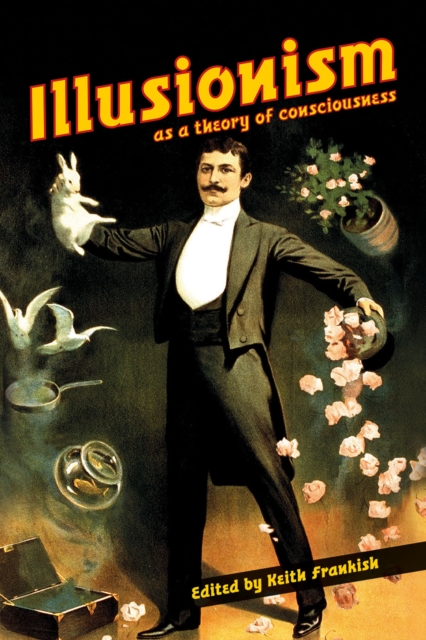
Illusionism
Illusionism is the view that phenomenal consciousness (in the philosophers' sense) is an illusion. This book is a reprint of a special issue of the Journal of Consciousness Studies devoted to this topic. It takes the form of a target paper by the editor, followed by commentaries from various thinkers, including leading defenders of the theory such as Daniel Dennett, Nicholas Humphrey, Derk Pereboom and Georges Rey. A number of disciplines are represented and different viewpoints are discussed and defended. The colleciton is tied together with a response to the commentaries from the editor.
eBook

Conscious thinking, acceptance, and self-deception
This commentary describes another variety of self-deception, highly relevant to von Hippel & Trivers's (VH&T's) project. Drawing on dual-process theories, I propose that conscious thinking is a voluntary activity motivated by metacognitive attitudes, and that our choice of reasoning strategies and premises may be biased by unconscious desires to self-deceive. Such biased reasoning could facilitate interpersonal deception, in line with VH&T's view.
Journal Article
Reasoning, argumentation, and cognition
This commentary does three things. First, it offers further support for the view that explicit reasoning evolved for public argumentation. Second, it suggests that promoting effective communication may not be the only, or even the main, function of public argumentation. Third, it argues that the data Mercier and Sperber (M&S) cite are compatible with the view that reasoning has subsequently been co-opted to play a role in individual cognition.
Journal Article
Delusions, Levels of Belief, and Non-doxastic Acceptances
In
Delusions and Other Irrational Beliefs
, Lisa Bortolotti argues that the irrationality of delusions is no barrier to their being classified as beliefs. This comment asks how Bortolotti’s position may be affected if we accept that there are two distinct types of belief, belonging to different levels of mentality and subject to different ascriptive constraints. It addresses some worries Bortolotti has expressed about the proposed two-level framework and outlines some questions that arise for her if the framework is adopted. It also suggests that, rather than being beliefs that fail to meet the relevant standards of rationality, delusions may be non-doxastic acceptances that were never meant to meet them.
Journal Article
Adaptive misbelief or judicious pragmatic acceptance?
This commentary highlights the distinction between belief and pragmatic acceptance, and asks whether the positive illusions discussed in section 13 of the target article may be judicious pragmatic acceptances rather than adaptive misbeliefs. I discuss the characteristics of pragmatic acceptance and make suggestions about how to determine whether positive illusions are attitudes of this type.
Journal Article