
Catalogue Search | MBRL


Are you sure you want to remove the book from the shelf?

{{itemTitle}}
1,239
result(s) for
"Freeman, Edward"
Sort by:


Managing for Stakeholders: Trade-offs or Value Creation
Issue Title: Special issue on Tribute to Juha Nasi
Journal Article
Scandinavian Cooperative Advantage: The Theory and Practice of Stakeholder Engagement in Scandinavia
In this article, we first provide evidence that Scandinavian contributions to stakeholder theory over the past 50 years play a much larger role in its development than is presently acknowledged. These contributions include the first publication and description of the term \"stakeholder\", the first stakeholder map, and the development of three fundamental tenets of stakeholder theory: jointness of interests, cooperative strategic posture, and rejection of a narrowly economic view of the firm. We then explore the current practices of Scandinavian companies through which we identify the evidence of relationships to these historical contributions. Thus, we propose that Scandinavia offers a particularly promising context from which to draw inspiration regarding effective company-stakeholder cooperation and where ample of examples of what is more recently referred to as \"creating shared value\" can be found. We conclude by endorsing the expression \"Scandinavian cooperative advantage\" in an effort to draw attention to the Scandinavian context and encourage the field of strategic management to shift its focus from achieving a competitive advantage toward achieving a cooperative advantage.
Journal Article

Business Cases for Sustainability
The “business case for sustainability” is a notion often referenced in the corporate sustainability and corporate social responsibility literature. Whereas some see sustainability and the business case as contradictions and thus emphasize the existence of trade-offs, others highlight how (potential) business cases can be created by managing ecological, social, and economic aspects. Both views have in common that the “business case” is implicitly or explicitly seen as creating financial performance, often for one group of stakeholders, only. The fact that a business case is not a given phenomenon but has to be co-created in the exchange between and with contributions from various stakeholders has so far not been analysed in depth. By taking a stakeholder theory perspective, this article extends the existing research on what business and a business case are about and analyses the understanding of business cases for sustainability and how they can be created with and by stakeholders.
Journal Article
Shake Your Stakeholder
While most extant scholarship has focused on how stakeholders influence firms, we propose that firms play a critical role in “shaking” stakeholders. Shaking stakeholders means to proactively initiate cooperation with those affected by a firm to alter awareness, behavior, and networks so as to catalyze change in society and the marketplace to reward cocreated innovations in core operations of the firm that improve social and environmental impacts. Two previously underappreciated aspects of stakeholder relations are highlighted. First, the firm can be the entity that leads engagement that shakes stakeholders out of complacency. Second, firms can catalyze collaborative relationships to cocreate sustainable value that is shared with stakeholders. We offer several cases to illustrate this strategy. While stakeholder shaking may be useful in any business environment, global ecological crises, societal problems, and governance failures heighten the need for firms to take action to bring about profound and systemic changes.
Journal Article
Corporate Social Responsibility and Sustainability in Scandinavia: An Overview
Scandinavia is routinely cited as a global leader in corporate social responsibility (CSR) and sustainability. In this article, we explore the foundation for this claim while also exploring potential contributing factors. We consider the deep-seated traditions of stakeholder engagement across Scandinavia including the claim that the recent concept of \"creating shared value\" has Scandinavian origins, institutional and cultural factors that encourage strong CSR and sustainability performances, and the recent phenomenon of movement from implicit to explicit CSR in a Scandinavian context and what this may entail. In sum, we depict the state of the art in CSR and sustainability in Scandinavia. We intend for this to serve as a basis to help establish a globally recognized research paradigm dedicated to considering CSR and sustainability in a Scandinavian context.
Journal Article

Stakeholder Theory and \The Corporate Objective Revisited\
Stakeholder theory begins with the assumption that values are necessarily and explicitly a part of doing business. It asks managers to articulate the shared sense of the value they create, and what brings its core stakeholders together. It also pushes managers to be clear about how they want to do business, specifically what kinds of relationships they want and need to create with their stakeholders to deliver on their purpose. This paper offers a response to Sundaram and Inkpen's article \"The Corporate Objective Revisited\" by clarifying misconceptions about stakeholder theory and concluding that truth and freedom are best served by seeing business and ethics as connected.
Journal Article
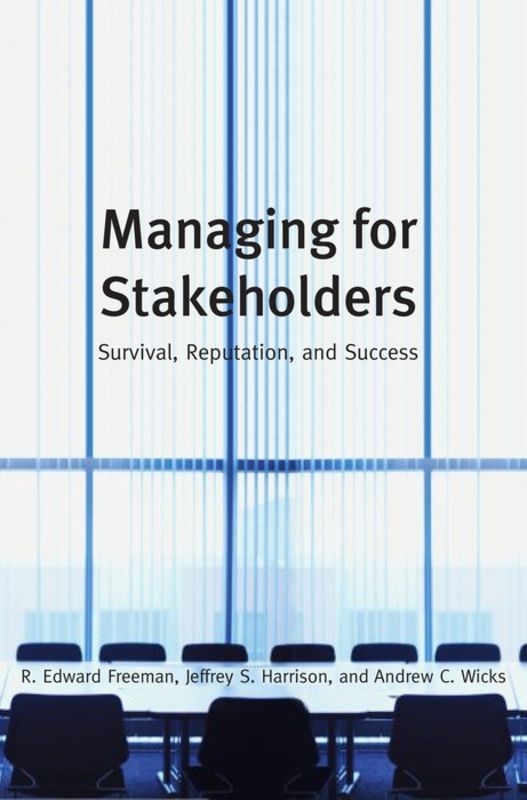
Managing for Stakeholders
Managing for Stakeholders: Survival, Reputation, and Success,the culmination of twenty years of research, interviews, and observations in the workplace, makes a major new contribution to management thinking and practice. Current ways of thinking about business and stakeholder management usually ask the Value Allocation Question: How should we distribute the burdens and benefits of corporate activities among stakeholders?Managing for Stakeholders,however, helps leaders develop a mindset that instead asks the Value Creation Question: How can we create as much value as possible for all of our stakeholders?
Business is about how customers, suppliers, employees, financiers (stockholders, bondholders, banks, etc.), communities, the media, and managers interact and create value. World-renowned management scholar R. Edward Freeman and his coauthors outline ten concrete principles and seven practical techniques for managing stakeholder relationships in order to ensure a firm's survival, reputation, and success.Managing for Stakeholdersis a revolutionary book that will change not only how managers do business but also how they recognize and evaluate business opportunities that would otherwise be invisible.
eBook

Profit and Other Values: Thick Evaluation in Decision Making
Profit maximizers have reasons to agree with stakeholder theorists that managers may need to consider different values simultaneously in decision making. However, it remains unclear how maximizing a single value can be reconciled with simultaneously considering different values. A solution can neither be found in substantive normative philosophical theories, nor in postulating the maximization of profit. Managers make sense of the values in a situation by means of the many thick value concepts of ordinary language. Thick evaluation involves the simultaneous consideration of different values: making sense of a value always involves knowing how to engage with it given the other values in the situation. This also goes for profit: maximization is only one way of engaging with the value of profit, and grasping whether maximization is appropriate involves considering other values. We discuss some consequences of our approach for stakeholder theorists and profit maximizers.
Journal Article
Stakeholder Theory(ies): Ethical Ideas and Managerial Action
Issue Title: Special issue on Stakeholder Theory(ies): Ethical Ideas and Managerial Action
Journal Article