
Catalogue Search | MBRL


Are you sure you want to remove the book from the shelf?

{{itemTitle}}
115
result(s) for
"Friedman, Hal"
Sort by:

Against medical advice : a true story
The true story of Cory and his family's decades-long battle for survival of Tourette syndrome in the face of extraordinary odds.
Book
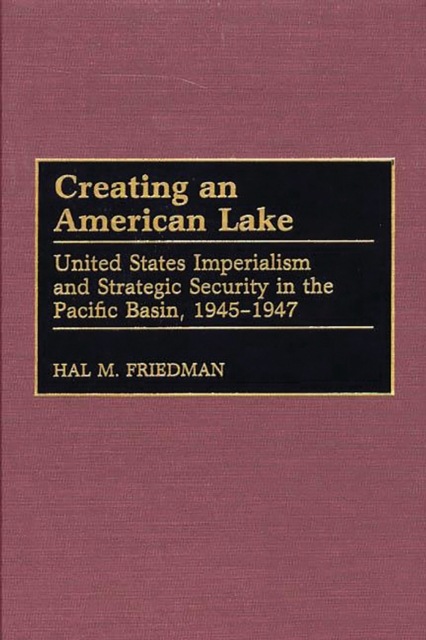
Creating an American Lake: United States Imperialism and Strategic Security in the Pacific Basin, 1945-1947
Many historians of U.S. foreign relations think of the post-World War II period as a time when the United States, as an anti-colonial power, advocated collective security through the United Nations and denounced territorial aggrandizement. Yet between 1945 and 1947, the United States violated its wartime rhetoric and instead sought an imperial solution to its postwar security problems in East Asia by acquiring unilateral control of the western Pacific Islands and dominating influence throughout the entire Pacific Basin. This detailed study examines American foreign policy from the beginning of the Truman Administration to the implementation of Containment in the summer and fall of 1947. As a case study of the Truman Administration's Early Cold War efforts, it explores pre-Containment policy in light of U.S. security concerns vis-a-vis the Pearl Harbor Syndrome. The American pursuit of a secure Pacific Basin was inconsistent at the time with its foreign policy toward other areas of the world. Thus, the consolidation of power in this region was an exception to the avowed goal of a multilateral response to the policies of the Soviet Union. This example of national or strategic security went much further than simple military control; it included the cultural assimilation of the indigenous population and the unilateral exclusion of all other powers. Analyzing traditional archival records in a new light, Friedman also investigates the persisting American notions of a Westward moving frontier that stretches beyond North American territorial bounds.
eBook

THE QUIET WARRIOR BACK IN NEWPORT
While many of them argued that it was a radically new world, they certainly did not see the ColdWar and atomicweapons as spelling the end of U.S. naval forces, and they even foresaw navalmissions that had a great deal of continuity with the past.57 Charged as President of the Naval War College with the strategic reformulation of American naval policy for this atomic and Cold War context, Admiral Spruance digested the lessons of the SecondWorldWar, especially from the Pacific, with particular focus on amphibious warfare and on how atomic weapons would change naval ship design, force strategy, and battle tactics.Not only did he dismiss the idea that navies were obsolete, but he saw an even greater role for the Navy in Cold War littoral operations.
Journal Article


\Red, White, and Black\ in the Motor City: Teaching the Early American Survey at a Comprehensive Metro Detroit Community College
This article is an exploration of how the new early American cultural history can be employed in the first half of the standard American history survey. The author discovered that the New Cultural History can be an outstanding tool by which to introduce a highly culturally diverse student population to the multiracial, multicultural, and multiethnic origins of the United States. The author also discovered that this is one way to link the issues of the Colonial and Early National past with the issues of the late 20th and early 21st centuries in a manner which is more familiar to the students. The locus of the experiment is Henry Ford Community College (HFCC) which is located in a highly urbanized area, Dearborn, Michigan, and is therefore a crossroads of sorts between several major universities, archives, and museums. The course objectives, reading assignments, and daily class schedule for the American History I course are presented. (Contains 9 notes.)
Journal Article

'Races undesirable from a military point of view': United states cultural security in the Pacific Islands, 1945-1947
Between 1945 and 1947, the United States pursued an imperial course to guarantee its security in the western Pacific and eastern Asia by consolidating its control over Micronesia, the Philippines, the Bonins, the Volcanoes, and the Ryukyus. Part of this process entailed ensuring that these islands were 'Americanised' and assimilated to US rule, particularly when it came to the strategically-located Micronesian Islands. Perceiving the Soviet Union as a post-war successor to pre-war Japan, American officials sought to prevent Micronesia being used for future bases by unfriendly foreign powers. Accordingly, US officials attempted to attach the Micronesian population to the continental United States by evacuating all East Asians, restricting the number of all but Caucasian-Americans in the islands, and assimilating the population through aspects of American culture and political economy. Some Americans unofficially even suggested 'whitening' the islands by colonising them with large numbers of Caucasian-Americans. This article not only recounts these ideas and events, but places this desire for 'cultural security' into a pre-1945 historical context, and explores the issue as an element of a broadened conception of strategic security.
Journal Article