
Catalogue Search | MBRL


Are you sure you want to remove the book from the shelf?

{{itemTitle}}
483
result(s) for
"Fritzsche, Peter"
Sort by:

An iron wind : Europe under Hitler
\"Unlike World War I, when the horrors of battle were largely confined to the front, World War II reached into the lives of ordinary people in an unprecedented way. Entire countries were occupied, millions were mobilized for the war effort, and in the end, the vast majority of the war's dead were non-combatant men, women, and children. Inhabitants of German-occupied Europe--the war's deadliest killing ground--experienced forced labor, deportation, mass executions, and genocide. As direct targets of and witnesses to violence, rather than far-off bystanders, civilians were forced to face the war head on. Drawing on a wealth of diaries, letters, fiction, and other first-person accounts, award-winning historian Peter Fritzsche redefines our understanding of the civilian experience of war across the vast territory occupied and threatened by Nazi Germany. Amid accumulating horrors, ordinary people across Europe grappled with questions of faith and meaning, often reaching troubling conclusions. World War II exceeded the human capacity for understanding, and those men and women who lived through it suspected that language could not adequately register the horrors they saw and experienced. But it nevertheless prompted an outpouring of writing, as people labored to comprehend and piece thoughts into philosophy. Their broken words are all we have to reconstruct how contemporaries saw the war around them, how they failed to see its terrible violence in full, and how they attempted to translate the destruction into narratives. Carefully reading these testimonies as no historian has done before, Fritzsche's groundbreaking work sheds new light on the most violent conflict in human history, when war made words inadequate, and the inadequacy of words heightened the devastation of war\"-- Provided by publisher.
BOOK

What Makes a Hot-Spring Habitat “Hot” for the Hot-Spring Snake: Distributional Data and Niche Modelling for the Genus Thermophis (Serpentes, Colubridae)
Knowledge about species’ distributions is central to diverse applications in ecology, biogeography, and conservation science. Hot-spring snakes of the genus Thermophis share a distribution restricted to geothermal sites at the Tibetan Plateau (T. baileyi) and in the Hengduan Mountains (T. zhaoermii, T. shangrila). Although the suture zones of these regions are widely covered with hot springs, Thermophis populations are restricted to only a few of these habitats. Here, we use bioclimatic, topographic, and land cover data to model the potential distribution of the genus. Moreover, using logistic regression on field survey data of T. zhaoermii, we test whether hot-spring water parameters and landscape features correlate with the species’ presence or absence. Hot springs with temperatures between 45 and 100 °C and winter precipitation showed the most predictive power. At small scale, our data support the relevance of the hot-spring temperature on the species’ occurrence and indicate that also the along-valley distance from the hot-spring site to the major river might influence the distribution of Thermophis species. Our findings contribute to better understand factors shaping the current distribution of the genus and will aid in setting priorities in applied conservation biology for the hot-spring snakes.
Journal Article

Between two homelands : letters across the borders of Nazi Germany
\"In 1920, at the age of thirteen, Irmgard Gebensleben first traveled from Germany to the Netherlands on a \"war-children transport.\" She would marry a Dutch man and live and raise her family there while keeping close to her German family and friends through the frequent exchange of letters. Yet during this period geography was not all that separated them. Increasing divergence in political opinions and eventual war between their countries meant letters contained not only family news but personal perspectives on the individual, local, and national choices that would result in the most destructive war in history. This important collection, first assembled by Irmgard Gebensleben's daughter Hedda Kalshoven, gives voice to ordinary Germans in the Weimar Republic and the Third Reich and in the occupied Netherlands. The correspondence between Irmgard, her friends, and four generations of her family delve into their most intimate and candid thoughts and feelings about the rise of National Socialism. The responses to the German invasion and occupation of the Netherlands expose the deeply divided loyalties of the family and reveal their attempts to bridge them. Of particular value to historians, the letters evoke the writers' beliefs and their understanding of the dramatic events happening around them. This first English translation of Ik denk zoveel aan jullie: Een briefwisseling tussen Nederland en Duitsland, 1920-1949 has been edited, abridged, and annotated by Peter Fritzsche with the assent and collaboration of Hedda Kalshoven. After the book's original publication, the diary of Irmgard's brother (and loyal Wehrmacht soldier), Eberhard, was discovered and edited by Kalshoven. Fritzsche has drawn on this important additional source in his preface, and the main text includes excerpts from the diary.\"--Page 4 of cover.
BOOK

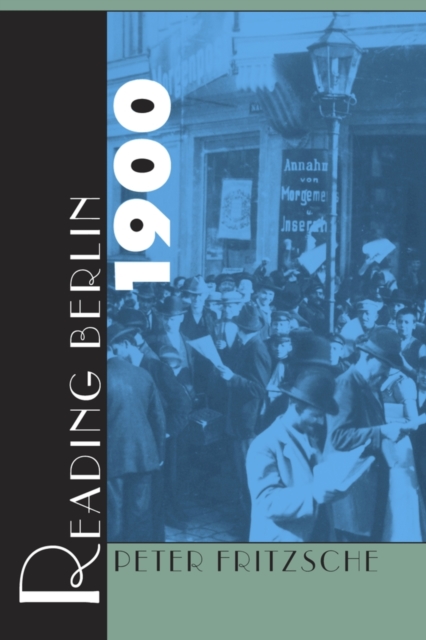
Reading Berlin 1900
The great cities at the turn of the century were mediated by words--newspapers, advertisements, signs, and schedules--by which the inhabitants lived, dreamed, and imagined their surroundings. In this original study of the classic text of urban modernism--the newspaper page--Peter Fritzsche analyzes how reading and writing dramatized Imperial Berlin and anticipated the modernist sensibility that celebrated discontinuity, instability, and transience. It is a sharp-edged story with cameo appearances by Georg Simmel, Walter Benjamin, and Alfred Döblin. This sumptuous history of a metropolis and its social and literary texts provides a rich evocation of a particularly exuberant and fleeting moment in history.
eBook

A Nation of Fliers
Reviews of this book: \"Peter Fritzsche's unusual and enthralling
history is about the most pervasive of [Germany's] dreams, the
national dream of an empire of the air.\" --Martin Pawley, The
Guardian
\"An important, thought-provoking study.\"
-- Dissent
\"An excellent book, beautifully written...There is really
nothing quite like it in the field...Its combination of solid
scholarship, appealing writing, and provocative thought makes it an
important contribution to our understanding of modern German
military history.\"
--Edward Homze, Air Power History
\"A fascinating tale that provides a refreshing perspective on
the history of early twentieth-century Germany, and Peter Fritzsche
has told it with flair, passion, and an array of evidence taken
from a wide range of little-known sources.\"
--Robert Wohl, German Politics and Society
\"A fundamental breakthrough in the development of an
understanding of how technology fed a Faustian vision of modernism
in which nationalism and industrial society became ever more
compatible and ever more popular...A model in its insight into the
correlation of technology and the popular imagination in the
twentieth century.\"
--Ronald Warloski, American Historical Review
\"Peter Fritzsche presents a remarkable blend of technological,
social, and cultural history in his study of the popular German
reaction to early aviation...His findings have sizable implications
for all scholars of twentieth-century Germany.\"
--Norman W. Goda, German Studies Review
eBook
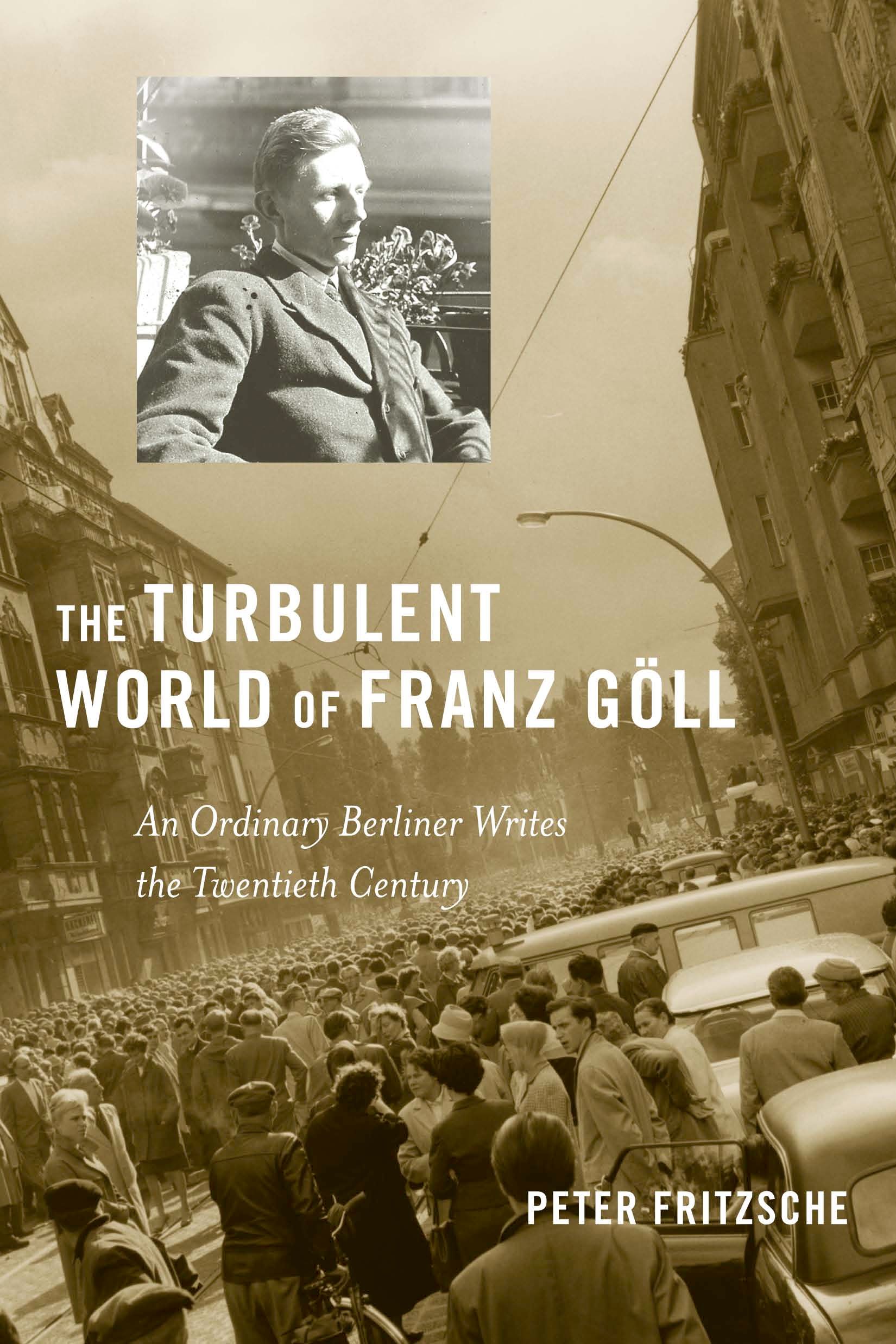
The turbulent world of Franz Göll : an ordinary Berliner writes the twentieth century
Franz Göll was a thoroughly typical Berliner. He worked as a clerk, sometimes as a postal employee, night watchman, or publisher's assistant. He enjoyed the movies, ate spice cake, wore a fedora, tamed sparrows, and drank beer or schnapps. He lived his entire life in a two-room apartment in Rote Insel, Berlin's famous working-class district. What makes Franz Göll different is that he left behind one of the most comprehensive diaries available from the maelstrom of twentieth-century German life. Deftly weaving in Göll's voice from his diary entries, Fritzsche narrates the quest of an ordinary citizen to make sense of a violent and bewildering century.
Peter Fritzsche paints a deeply affecting portrait of a self-educated man seized by an untamable impulse to record, who stayed put for nearly seventy years as history thundered around him. Determined to compose a \"symphony\" from the music of everyday life, Göll wrote of hungry winters during World War I, the bombing of Berlin, the rape of his neighbors by Russian soldiers in World War II, and the flexing of U.S. superpower during the Reagan years. In his early entries, Göll grappled with the intellectual shockwaves cast by Darwin, Freud, and Einstein, and later he struggled to engage with the strange lifestyles that marked Germany's transition to a fluid, dynamic, unmistakably modern society.
With expert analysis, Fritzsche shows how one man's thoughts and desires can give poignant shape to the collective experience of twentieth-century life, registering its manifold shocks and rendering them legible.
eBook

Reading Berlin 1900
In this original study of the classic text of urban modernism--the newspaper page--Peter Fritzsche analyzes how reading and writing dramatized Imperial Berlin and anticipated the modernist sensibility that celebrated discontinuity, instability, and transience.
eBook

