
Catalogue Search | MBRL


Are you sure you want to remove the book from the shelf?

{{itemTitle}}
203
result(s) for
"Fry, Tony"
Sort by:

City futures in the age of a changing climate
\"This book goes beyond current ways that the impact of climate change upon the city are understood. In doing so it addresses climate in a variety of connotations. It looks to the nomadic behaviour patterns of the past for lessons for today's population unsettlement, and argues that as human survival will increasingly be linked directly to movement, the city can no longer be defined as a constrained space. The impacts of climate change must to be understood as a combination of the actual and the expected, and have to be addressed both practically and culturally. City Futures in an Age of Changing Climate looks at how cities can adapt and respond to the unsustainable conditions they are now facing. The book considers possible post-urban futures, exposing a range of very different urban forms, and addresses the concept of fragmentation; the breaking up of any coherent economic or cultural nucleic urban spaces. Urban planners, designers, development practitioners, and anyone seeking to understand what the future is likely to look like for our cities, and how to prepare for it, will find this an essential read\"-- Provided by publisher.
Book
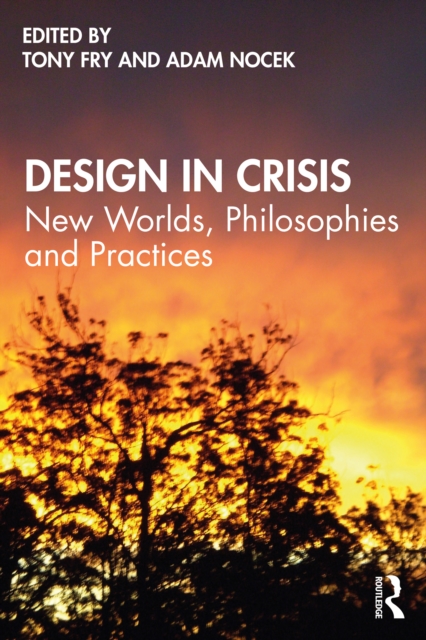
Design in Crisis
This book is an essential contribution to the transdisciplinary field of critical design studies.
The essays in this collection locate design at the centre of a series of interrelated planetary crises, from climate change, nuclear war, and racial and geopolitical violence to education, computational culture, and the loss of the commons. In doing so, the essays propose a range of needed interventions in order to transform design itself and its role within the shifting realities of a planetary crisis. It challenges the widely popular view that design can contribute to solving world problems by exposing how this attitude only intensifies the problems we currently face. In this way, the essays critique the dominant modes of framing the meaning and scope of design as a largely Anglo-European 'problem-solving' practice. By drawing on post-development theory, decolonial theory, black studies, continental philosophy, science and technology studies, and more, the contributions envision a critical and speculative practice that problematises both its engagement with planet and itself.
The essays in this collection will appeal to design theorists and practitioners alike, but also to scholars and students generally concerned with how the past and future of design is implicated in the unfolding complexity of ecological devastation, racial and political violence, coloniality, technological futures, and the brutality of modern Western culture generally.
eBook

Becoming human by design
\"The last in Tony Fry's celebrated trilogy of books continues his radical rethinking of design. 'Becoming Human by Design's provocative argument presents a revised reading of human 'evolution' centred on ontological design. Examining the relation of design to the nature of the human species - where the species came from, how it was created, what it became and its likely future - Fry asserts that current biological and social models of evolution are an insufficient explanation of how 'we humans' became what we are. Making a case for ontological design as an evolutionary agency, the book posits the relation between the formation of the world of human fabrication and the making of mankind itself as indivisible. It also functions as a provocation to rethink the fate of Homo sapiens, recognising that all species are finite and that the fate of humankind turns on a fundamental Darwinian principle - adapt or die. Fry considers the nature of adaptation, arguing that it will depend on an ability to think and design in new ways\"--P. [4] of cover.
Book

Design and the Question of History
Design and the Question of History offers a new perspective on the historical significance of design, showing how design is an agent of historical change rather than a single aspect. Despite a historical sensibility being essential in making critical and directional choices, Design History presents an extremely selective view, which cannot deliver the historical knowledge to sufficiently and sensitively inform designers and design thinkers’ practice. Focusing on how the relationship between design and history is understood and presented, this book uses a methodological approach to address this problem. The book covers the issue of history and how design in history needs to be understood by recognising that design is always historically embedded in a relational context; the efficacy of Design History as a sub-discipline within design; and the delivery of a more substantial historical sensibility to emergent designers, identifying the pedagogic problems it presents and discussing the agency of such knowledge in practice. This book is the flagship of the Design, History & Futures series, edited by Tony Fry, Lisa Norton and Anne-Marie Willis.
eBook

Remaking cities : an introduction to urban metrofitting
\"Unprecedented challenges await the future of the world's cities. Accelerating population pressure, climate change, food insecurity, poverty and geopolitical instability - in the face of such problems our current attempts at producing a sustainable agenda for the world's cities appear fragmented and inadequate. Fresh thinking is needed. In Remaking Cities, renowned design theorist Tony Fry brings a conceptual design perspective to the challenge of urban sustainability and resilience. In a typically far-sighted and provocative work, Fry presents ideas and actions for 'metrofitting' - a new kind of practice in architecture and urban design. Metrofitting expands the technological concept of retrofit up to the city scale, placing social, cultural, political and ethical concerns at its heart. Metrofitting is not about visionary technology, it is about transforming existing cities by combining available resources with human creativity, prompted by new thinking about new and old urban problems. It requires overcoming outmoded Eurocentric assumptions of what constitutes a city, rethinking their forms and structures, and understanding their metabolic processes and social and economic functions. This book provides conceptually strong practical approaches that will ultimately change the whole way we view cities and the way the urban future is designed. Illustrated with international case studies of metrofitting in action, Remaking Cities will provoke and stimulate debate among architects, urban designers, and anyone concerned with the urban environment and social and cultural change.\"-- Provided by publisher.
Book


Editorial: The fate of cities: an evocation
Fate defies control, and while its arrival, form and consequences are not foreseeable, its nature can, and often is, prefigured by human activity; For example, the unexpected deaths of people due to fated events such as a landslide, flood, collapse of a building, or fire can and do happen because of (i) ill-conceived or poorly executed human actions, and (ii) a group of people being in the wrong place at the wrong time. More broadly, globalisation, the flux of geopolitical reconfiguration, conflict, population pressures, a new order of transformational technologies, climate change and other environmental problems all converge to constitute a maelstrom of unmanaged change, sealing the fate of millions of people and their cities.
Journal Article

Design and the question of history
\"Design and the Question of History offers a new perspective on the historical significance of design, showing how design is an agent of historical change rather than a single aspect. Despite a historical sensibility being essential in making critical and directional choices, Design History presents an extremely selective view, which cannot deliver the historical knowledge to sufficiently and sensitively inform designers and design thinkers' practice. Focusing on how the relationship between design and history is understood and presented, this book uses a methodological approach to address this problem. The book covers the issue of history and how design in history needs to be understood by recognising that design is always historically embedded in a relational context; the efficacy of Design History as a sub-discipline within design; and the delivery of a more substantial historical sensibility to emergent designers, identifying the pedagogic problems it presents and discussing the agency of such knowledge in practice. This book is the flagship of the Design, History & Futures series, edited by Tony Fry, Lisa Norton and Anne-Marie Willis\"-- Provided by publisher.
Book
Design after design
[...]those problems that can be solved cannot be done so simply by instrumental means. [...]much in the name of sustainability sustains the unsustainable. [...]liberal reform becomes a weak version of political romanticism. * Inside outsiders-while there is no outside to hegemonic techno-capitalism, inside outsiders function from a recognized position of alienation and creative contestation. [...]a curriculum could be continuous rather than divided into years; it would include, for example: * Retrofitting and metrofitting-design practice directed at 'what is' and centered on redirective practice (breaking down of existing design disciplines and opening to others so as to create diverse team of learning and inquiry). * Situated problem research placement-this based on going to a problem, living and working with it; this could mean remaking or making something new. * Intercultural literacy and the philosophy of design-this so graduates can comprehend different cosmologies, modes of being and species futures. * Design actor-leaders-rather than service providers, this activity would focus not just on leadership via project creation but how to establish a counter-design practice economy. * Project would be central to the whole approach.
Journal Article