
Catalogue Search | MBRL


Are you sure you want to remove the book from the shelf?

{{itemTitle}}
49
result(s) for
"Furneaux, Holly"
Sort by:


Mortimer Lightwood; or, Seriality, Counterfactuals, Co-Production, and Queer Fantasy
In this reflection on her participation as Mortimer Lightwood in Birkbeck’s Our Mutual Friend Twitter reading project, Holly Furneaux situates the project in a long legacy of actively reading Dickens’s works. She opens up some possibilities about the queer potentials of the serial form, the counterfactual, and Dickens fans’ creative responses.
Journal Article

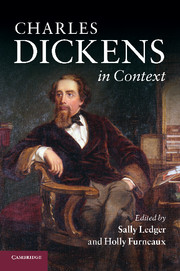
Charles Dickens in Context
Charles Dickens, a man so representative of his age as to have become considered synonymous with it, demands to be read in context. This book illuminates the worlds - social, political, economic and artistic - in which Dickens worked. Dickens's professional life encompassed work as a novelist, journalist, editor, public reader and passionate advocate of social reform. This volume offers a detailed treatment of Dickens in each of these roles, exploring the central features of Dickens's age, work and legacy, and uncovering sometimes surprising faces of the man and of the range of Dickens industries. Through 45 digestible short chapters written by a leading expert on each topic, a rounded picture emerges of Dickens's engagement with his time, the influence of his works and the ways he has been read, adapted and re-imagined from the nineteenth century to the present.
eBook
Charting the Crimean War: Contexts, Nationhood, Afterlives
The Crimean War (1853–56) is much more culturally significant than its popular mythologies suggest. Now remembered mainly for the Charge of the Light Brigade and the Lady with the Lamp, the Crimean War is a pivotal moment in the history of modern warfare seen as both the last of the old wars and first of the new. The first total war, it inaugurated new forms of weaponry, tactics, communication, war reporting, military medicine, and new attitudes towards soldiers. The introduction outlines this issue of 19’s case for the conflict’s wide-ranging significance, placing the Crimean War in the context of earlier and later nineteenth-century warfare, and considering its varied cultural afterlives.
Journal Article
Introduction: Dickens, Science and the Victorian Literary Imagination
In this introduction to the Dickens and Science issue of 19, Holly Furneaux and Ben Winyard consider the relationship between Dickens’s writing, science and the Victorian literary imagination. Dickens’s response to scientific ideas was very often at the heart of his cherished ideal that literature should show ‘the romantic side of familiar things’, illuminating the wonder, even magic, of everyday phenomena for people of all classes, and affectively uniting them by relieving a shared thirst for imaginative succour.
Journal Article
Thinking Feeling at the Dickens Bicentenary
Dickens 2012 has been characterised by heart-felt responses to Dickens. In these ‘think pieces’ a number of scholars of Dickens and the Victorian period from the Victorian Studies Centre at the University of Leicester ruminate on the inflections of bi-centenary feeling: What are the politics, and aesthetics, of Dickensian feeling? How close are these to Dickens’s expressed aspirations for his work? Are there continuities with Victorian responses, and those at the 1912 centenary? Where is 2012 sentiment located culturally and nationally? How are feelings other than celebration registered and expressed? The short pieces that follow seek to open up these questions in a way that will, we hope, encourage further response and discussion.
Journal Article

