
Catalogue Search | MBRL


Are you sure you want to remove the book from the shelf?

{{itemTitle}}
9
result(s) for
"Furnham, Adrian, author"
Sort by:

The myths of management : forty fables from the world of management
\"Is management any more than common sense? Do employers really know how to recruit the best people for their firms? How important is training to employee development? Which management techniques motivate employees best? Is money the best motivator? These are key questions which every ambitious organisation should be asking about itself and the way it operates. Or do they simply represent the latest fashionable management fads promoted by trendy consultants?\" \"The Myths of Management scrutinises these and other management issues. Its author, Adrian Furnham, is Professor of Psychology at the Business Psychology Unit, University College London and director of Applied Behavioural Research Associates Ltd. He also writes a column for the Financial Times and makes frequent media appearances. This book presents his latest thoughts on a wide range of recurrent themes which managers and organisations regularly have to address. It provides a useful collection of points to consider for the purposeful manager or those who aspire to that position.\"--Jacket.
Book

High potential : how to spot, manage and develop talented people at work
In today's competitive job market, can employers afford to spend large sums on recruitment, and then simply let talented people go?High Potential provides a practical framework for managers to create a strong, strategic vision for a high-performing, high-potential workforce.Updated to reflect more recent research in the area, the book presents an.
eBook

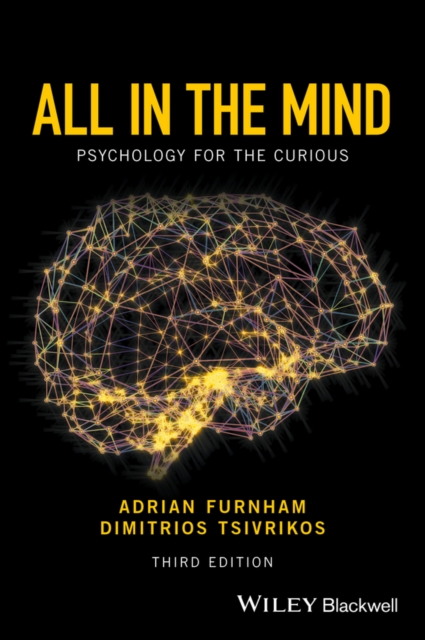
All in the mind
All in the Mind: Psychology for the Curious, Third Edition covers important, topical, and sometimes controversial subjects in the field of Psychology in an engaging alternative or supplement to traditional student textbooks. The third edition of a successful and uniquely readable textbook – includes more than two thirds brand new material, with all retained material thoroughly revised and updated. All in the Mind, 3rd Edition offers a new and engaging way to consider key theories and approaches in psychology; providing an original alternative or supplement to traditional teaching textbooks.
eBook

Disenchantment : managing motivation and demotivation at work
Workplace disenchantment can cause major issues for organisations - productivity decreases, employees can turn actively destructive and individual health and well-being can deteriorate. Most people start a job happy enough and determined to do a good job - if they are lucky, they have found a job which suits their skills and values. They may be eager, hopeful and willing to be engaged. So when and why do they become disenchanted and demotivated? In this new book, Adrian Furnham and Luke Treglown look at several theories into job satisfaction and workplace motivation. They explore how much of a motivator money really is, and which personality profiles are more likely to lead to a disruptive, disenchanted employee. Disenchantment discusses the related and identifiable behaviours that very clearly lead to disenchantment, and how individuals and organisations can work to prevent this and boost motivation and engagement in a way that is practicable and sustainable. Keeping employees motivated takes more than just ensuring they're not unhappy, and Disenchantment outlines some of the ways that organisations can manage this.
Book
The Psychology of Personnel Selection
This engaging and thought-provoking text introduces the main techniques, theories, research and debates in personnel selection, helping students and practitioners to identify the major predictors of job performance as well as the most suitable methods for assessing them. Tomas Chamorro-Premuzic and Adrian Furnham provide a comprehensive, critical and up-to-date review of the constructs we use in assessing people – intelligence, personality, creativity, leadership and talent – and explore how these help us to predict differences in individuals' performance. Covering selection techniques such as interviews, references, biographical data, judgement tests and academic performance, The Psychology of Personnel Selection provides a lively discussion of both the theory behind the use of such techniques and the evidence for their usefulness and validity. The Psychology of Personnel Selection is essential reading for students of psychology, business studies, management and human resources, as well as for anyone involved in selection and assessment at work.
eBook


Personality and Intellectual Competence
This book provides a comprehensive state-of-the-art review of personality and intelligence, as well as covering other variables underlying academic and occupational performance. Personality and Intellectual Competence is a unique attempt to develop a comprehensive model to understand individual difference by relating major personality dimensions to cognitive ability measures, academic and job performance, and self-assessed abilities, as well as other traditional constructs such as leadership and creativity. It will be essential reading for anyone interested in personality, intelligence, and the prediction of future achievement in general.Personality and Intellectual Competence is an outstanding account of the relationship between major individual differences constructs. With its informative summary of the last century of research in the field, this book provides a robust and systematic theoretical background for understanding the psychological determinants of future achievement. The authors have sought to combine technical expertise with applied interests, making this a groundbreaking theoretical tool for anyone concerned with the scientific prediction of human performance.
eBook
